割
| ||||||||
 | ||||||||
 | ||||||||
Translingual
Han character
割 (Kangxi radical 18, 刀+10, 12 strokes, cangjie input 十口中弓 (JRLN), four-corner 32600, composition ⿰害刂)
Derived characters
- 𢵷, 𥢫, 𫗛, 𦺧, 𬕲, 𫦢
References
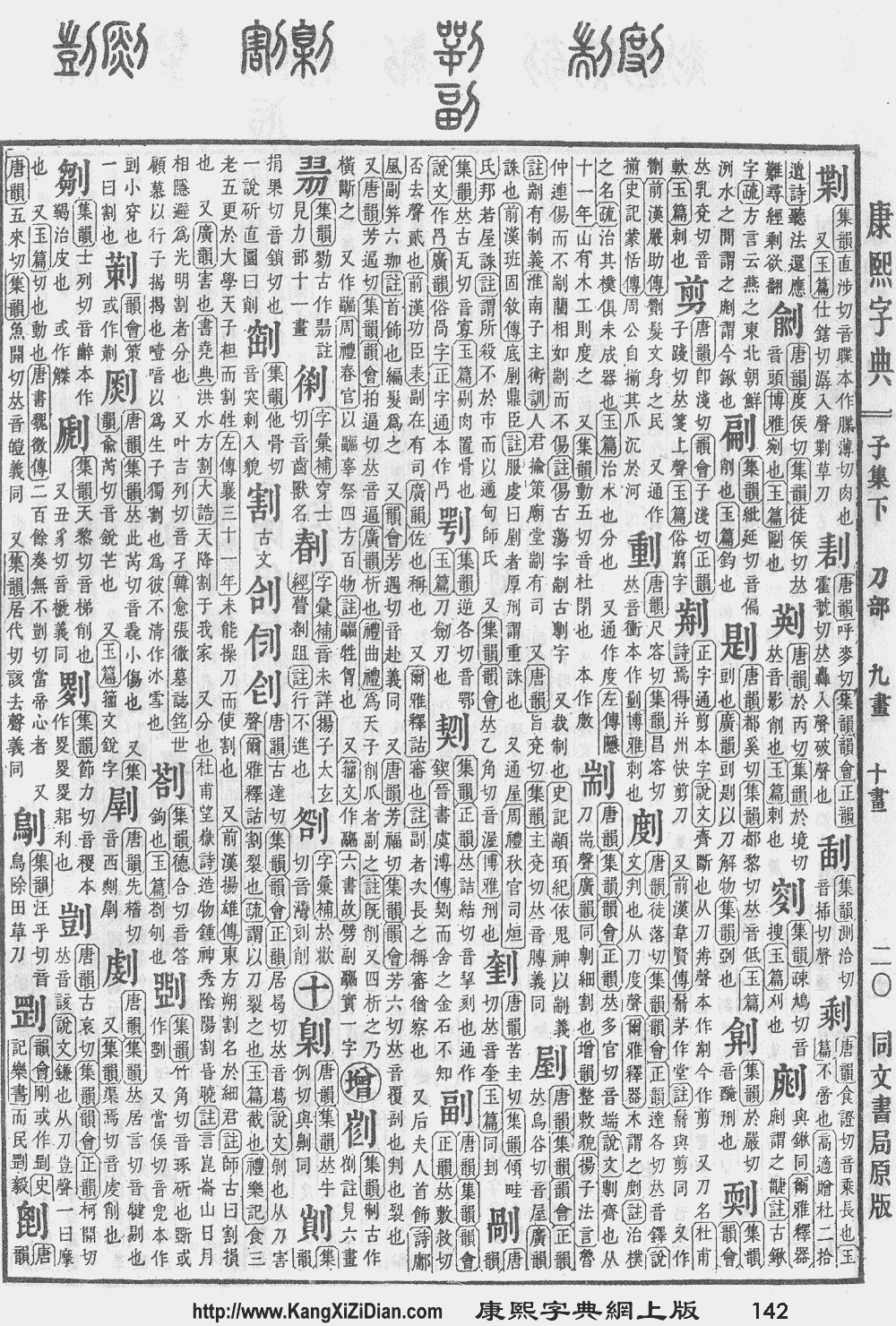
- Kangxi Dictionary: page 142, character 32
- Dai Kanwa Jiten: character 2112
- Dae Jaweon: page 323, character 4
- Hanyu Da Zidian (first edition): volume 1, page 351, character 7
- Unihan data for U+5272
- Unihan data for U+2F822
Chinese
| trad. | 割 | |
|---|---|---|
| simp. # | 割 | |
| 2nd round simp. | 刈 | |
| alternative forms | 㓣 ancient 刈 Min Nan 𠛛 𠛷 | |
Glyph origin
Phono-semantic compound (形聲/形声, OC *kaːd) : phonetic 害 (OC *ɡaːds) + semantic 刂.
Etymology
According to Schuessler (2007), from Sino-Tibetan and an area word. Externally, cognate with Tibetan འགས་པ ('gas pa, “to split; to break; to burst apart”), Proto-Mon-Khmer *kat ~ *kaat (“to cut”), whence Khmer កាត់ (kat, “to cut”) and Proto-South-Bahnaric *kat ("to chop; to cut"). Within Chinese, cognate with 害 (OC *ɡaːds, “to harm; to injure”), and 犗 (OC *kraːds, “to castrate”), which is perhaps the r-causative of 割 (OC *kaːd).
On the other hand, STEDT compares it to Proto-Sino-Tibetan *d-ra-t (“cut; slash”), to which 害 (OC *ɡaːds, “to harm; to injure”), 犗 (OC *kraːds, “to castrate”), 剌 (OC *raːd, “to cut; perverse”) are also compared. Descended from the Proto-Sino-Tibetan root are Tibetan དྲ་བ (dra ba, “to cut”) and Burmese ရှန (hra.na., “wounded”).
Pronunciation 1
Definitions
割
- to cut; to cut off; to sever
- to divide; to cut apart; to break up; to partition; to split
- 70th tetragram of the Taixuanjing; "severance" (𝍋)
- to cut in self-harm; short for 割腕 (gēwàn).
- ⁜ (literary) to give up; to abandon; to reject; to discard
- (Mainland China Hokkien) to wholesale (of merchandise)
- (Taiwanese Hokkien) to allocate; to divide (property)
Synonyms
- (to divide):
- (to give up):
- 丟掉/丢掉 (diūdiào)
- 丟棄/丢弃 (diūqì)
- 割捨/割舍 (gēshě) (literary)
- 屏棄/屏弃 (bǐngqì)
- 廢棄/废弃 (fèiqì)
- 扔掉 (rēngdiào)
- 扔棄/扔弃 (rēngqì)
- 拋/抛 (pāo)
- 㧒捒 (Xiamen Hokkien, Zhangzhou Hokkien)
- 㧒捔 (Xiamen Hokkien, Zhangzhou Hokkien)
- 拋棄/抛弃 (pāoqì)
- 捐 (literary, or in compounds)
- 捨去/舍去 (shěqù) (literary)
- 捨棄/舍弃 (shěqì)
- 揕捒 (Hokkien)
- 揚棄/扬弃 (yángqì)
- 摒棄/摒弃 (bìngqì)
- 擯棄/摈弃 (bìnqì)
- 擯除/摈除 (bìnchú)
- 擲捒/掷捒 (Hokkien)
- 放捒 (Hokkien)
- 放棄/放弃 (fàngqì)
- 放生 (Singapore Hokkien)
- 棄絕/弃绝 (qìjué) (literary)
- 犧牲/牺牲 (xīshēng) (figurative)
- 甩捒 (Hokkien)
- 甩掉 (shuǎidiào)
- 遺棄/遗弃 (yíqì)
- 離棄/离弃 (líqì)
Compounds
- 不可分割
- 交割 (jiāogē)
- 任人宰割 (rènrénzǎigē)
- 分割 (fēngē)
- 切割 (qiēgē)
- 分割區/分割区
- 切割機/切割机
- 割傷/割伤 (gēshāng)
- 割價/割价
- 割切 (gēqiē)
- 割包
- 割包皮 (gē bāopí)
- 割取
- 割和青
- 割喉 (gēhóu)
- 割地 (gēdì)
- 割尾巴
- 割席 (gēxí)
- 割愛/割爱
- 割捆機 (gēkǔnjī)
- 割接
- 割掉
- 割捨/割舍 (gēshě)
- 割接法
- 割據/割据 (gējù)
- 割斷/割断 (gēduàn)
- 割曬機/割晒机
- 割棄/割弃
- 割治
- 割漆
- 割炬
- 割禮/割礼 (gēlǐ)
- 割禾
- 割禾青
- 割線/割线 (gēxiàn)
- 割肉 (gēròu)
- 割肚牽腸/割肚牵肠
- 割股 (gēgǔ)
- 割股療親/割股疗亲
- 割脈/割脉
- 割膠/割胶
- 割臂之盟
- 割草 (gēcǎo)
- 割草機/割草机 (gēcǎojī)
- 割蜜
- 割袍斷義/割袍断义
- 割裂 (gēliè)
- 割讓/割让 (gēràng)
- 割除 (gēchú)
- 割雞焉用牛刀/割鸡焉用牛刀 (gējī yān yòng niúdāo)
- 割頸/割颈
- 宰割 (zǎigē)
- 封建割據/封建割据 (fēngjiàn gējù)
- 心如刀割 (xīnrúdāogē)
- 忍痛割愛/忍痛割爱
- 收割 (shōugē)
- 收割機/收割机 (shōugējī)
- 收割者
- 正割 (zhènggē)
- 氣割/气割
- 氧割
- 聯合收割機/联合收割机 (liánhé shōugējī)
- 臠割/脔割
- 自割
- 鉛刀一割/铅刀一割
- 閹割/阉割 (yāngē)
- 雙曲餘割/双曲余割
- 難割難捨/难割难舍
- 餘割/余割 (yúgē)
- 黃金分割/黄金分割 (huángjīn fēngē)
Pronunciation 2
Japanese
| Shinjitai | 割 | |
| Kyūjitai [1][2] |
割 割or 割+ ︀? |
|
| 割󠄀 割+ 󠄀?(Adobe-Japan1) | ||
| 割󠄅 割+ 󠄅?(Hanyo-Denshi) (Moji_Joho) | ||
| The displayed kanji may be different from the image due to your environment. See here for details. | ||
Readings
Compounds
Etymology 1
| Kanji in this term |
|---|
| 割 |
| わり Grade: 6 |
| kun’yomi |
Noun
割 • (wari)
- proportion
- 割に合わない ― wari ni awanai ― unfit for the proportion
- tenth
- 二割 ― ni wari ― two-tenths
Etymology 2
| Kanji in this term |
|---|
| 割 |
| かつ Grade: 6 |
| on’yomi |
Pronunciation
- IPA(key): [ka̠t͡sɨᵝ]
References
- Haga, Gōtarō (1914) 漢和大辞書 [The Great Kanji-Japanese Dictionary] (in Japanese), Fourth edition, Tōkyō: Kōbunsha, , page 308 (paper), page 204 (digital)
- Shōundō Henshūjo, editor (1927), 新漢和辞典 [The New Kanji-Japanese Dictionary] (in Japanese), Ōsaka: Shōundō, , page 228 (paper), page 126 (digital)
- Matsumura, Akira, editor (2006), 大辞林 [Daijirin] (in Japanese), Third edition, Tōkyō: Sanseidō, →ISBN