刈
| ||||||||
Translingual
Han character
刈 (Kangxi radical 18, 刀+2, 4 strokes, cangjie input 大中弓 (KLN), four-corner 42000, composition ⿰乂刂)
Derived characters
References
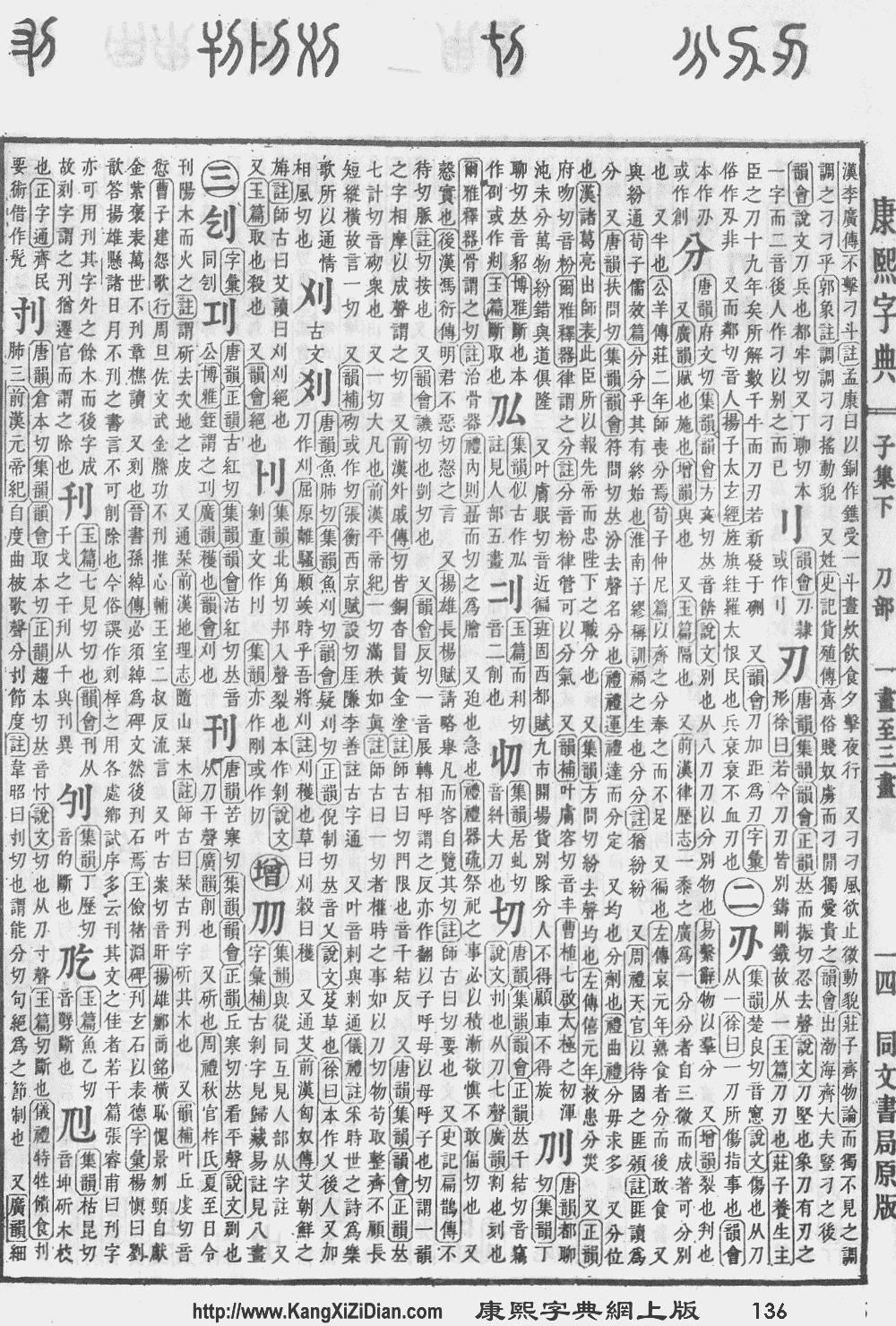
- Kangxi Dictionary: page 136, character 10
- Dai Kanwa Jiten: character 1859
- Dae Jaweon: page 307, character 6
- Hanyu Da Zidian (first edition): volume 1, page 323, character 7
- Unihan data for U+5208
Chinese
| simp. and trad. |
刈 | |
|---|---|---|
| alternative forms | ||
Glyph origin
Characters in the same phonetic series (乂) (Zhengzhang, 2003)
Originally written 乂. Now phono-semantic compound (形聲/形声, OC *ŋads) and ideogrammic compound (會意/会意) : phonetic 乂 (OC *ŋads, “to mow”) + semantic 刂 (“knife”).
Etymology 1
From Proto-Sino-Tibetan *r-ŋa-p (“to mow, cut, reap”) (STEDT, Schuessler, 2007).
Cognate with Tibetan རྔ་བ (rnga ba), བརྔས (brngas), and colloquial Western Tibetan རྔབ་བ (rngab ba), which Coblin (1986) and STEDT treat as more conservative.
Pronunciation
Definitions
刈
- to mow; to cut; to weed
- 葛之覃兮、施于中谷。
- From: The Classic of Poetry, c. 11th – 7th centuries BCE, translated based on James Legge's version
- Gě zhī tán xī, shī yú zhōnggǔ.
Wéi yè mòmò, shì yì shì huò.
Wèi chī wèi xì, fú zhī wúyì. [Pinyin] - How the dolichos spread itself out, extending to the middle of the valley!
Its leaves were luxuriant and dense. I cut it and I boiled it,
And made both fine cloth and coarse, which I will wear without getting tired of it.
維葉莫莫、是刈是濩。
為絺為綌、服之無斁。 [Pre-Classical Chinese, trad.]
葛之覃兮、施于中谷。
维叶莫莫、是刈是濩。
为𫄨为绤、服之无𭣧。 [Pre-Classical Chinese, simp.]
- (obsolete) crops that have been cut
- 一春違其農,二夏食其穀,三秋取其刈,四冬凍其葆。 [Classical Chinese, trad.]
- From: Lost Book of Zhou, circa 4th – 1st centuries BCE
- Yī chūn wéi qí nóng, èr xià shí qí gǔ, sān qiū qǔ qí yì, sì dōng dòng qí bǎo. [Pinyin]
- First, in spring encircle their farmlands; second, in summer eat their provisions; third, in autumn seize their harvests / crops, in winter expose their stores.
一春违其农,二夏食其谷,三秋取其刈,四冬冻其葆。 [Classical Chinese, simp.]
- (literary) sickle
- 時雨既至,挾其槍、刈、耨、鎛,以旦暮從事於田野。 [Classical Chinese, trad.]
- From: Guoyu, circa 4th century BCE
- Shíyǔ jì zhì, xié qí qiāng, yì, nòu, bó, yǐ dànmù cóngshì yú tiányě. [Pinyin]
- When the timely seasonal rain is just come, [they farmers] clasp their stakes, sickles, weeders, and hoes to work from dawn to dusk in the fields.
时雨既至,挟其枪、刈、耨、镈,以旦暮从事于田野。 [Classical Chinese, simp.]
- (literary) to kill; to chop; to lop
- (literary) to eradicate; to eliminate
- a surname
Compounds
- 刈包
- 刈蓍遺簪/刈蓍遗簪
- 刈鉤/刈钩
- 刈香
- 剷刈/铲刈
- 斬刈殺伐/斩刈杀伐
Etymology 2
| For pronunciation and definitions of 刈 – see 割 (“to cut; to cut off; to sever; to divide; to cut apart; to break up; to partition; to split; etc.”). (This character is the second-round simplified form of 割). |
Notes:
|
Japanese
Korean
Vietnamese
This article is issued from Wiktionary. The text is licensed under Creative Commons - Attribution - Sharealike. Additional terms may apply for the media files.