后
| ||||||||
Translingual
| Stroke order | |||
|---|---|---|---|
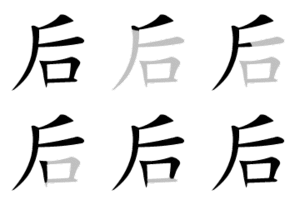 | |||
Han character
后 (Kangxi radical 30, 口+3, 6 strokes, cangjie input 竹一口 (HMR), four-corner 72261, composition ⿸𠂋口)
Derived characters
References
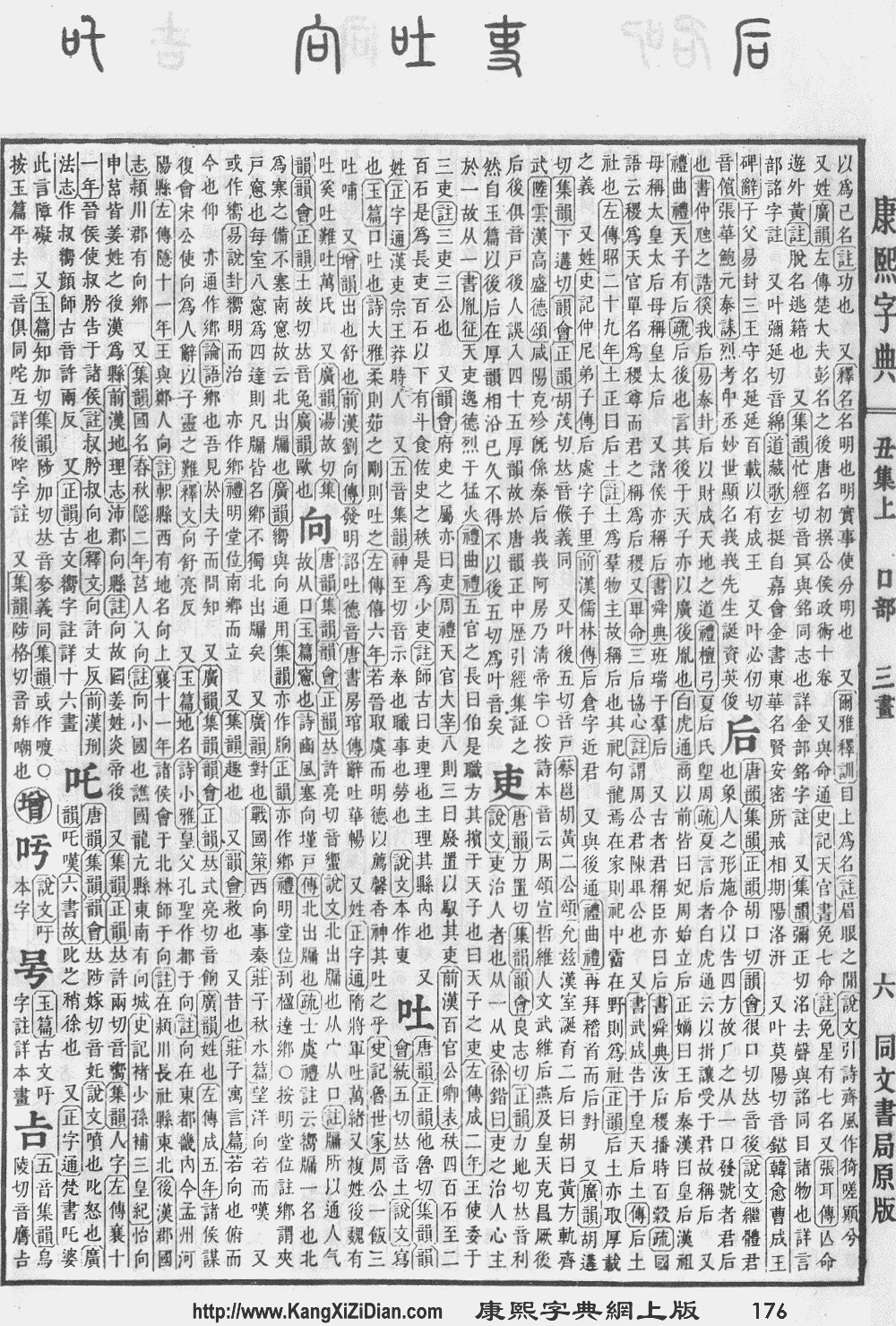
- Kangxi Dictionary: page 176, character 1
- Dai Kanwa Jiten: character 3298
- Dae Jaweon: page 393, character 1
- Hanyu Da Zidian (first edition): volume 1, page 580, character 1
- Unihan data for U+540E
Chinese
Glyph origin
| Historical forms of the character 后 | |||
|---|---|---|---|
| Shang | Spring and Autumn | Shuowen Jiezi (compiled in Han) | Liushutong (compiled in Ming) |
| Oracle bone script | Bronze inscriptions | Small seal script | Transcribed ancient scripts |
 |
 |
 |
 |
Lateral inversion of 后 generates 司 (OC *slɯ).
According to Kōjien[zh 1] and 学研漢和大字典, ideogrammic compound (會意/会意) : 人 (“person (variant form)”) + 口 (“hole”) — a depiction of a person's (人) anus, with the additional meaning of “behind”, “rear”, as well as coming to mean “emperor/empress”, who would live in a palace “behind” wordly troubles.
Etymology 1
| simp. and trad. |
后 | |
|---|---|---|
From Proto-Sino-Tibetan *m/s-gaw (“head”). Cognate with Tibetan གོ (go, “head; headman”), མགོ (mgo, “head, top, beginning”).
Pronunciation
Definitions
后
Compounds
- 仙后座 (Xiānhòuzuò)
- 元后
- 后冠
- 后土 (hòutǔ)
- 后妃 (hòufēi)
- 后帝 (hòudì)
- 后座 (hòuzuò)
- 后王 (hòuwáng)
- 后皇
- 后稷 (Hòujì)
- 后羿 (Hòuyì)
- 后羿射日
- 后辛
- 后辟
- 后里 (Hòulǐ)
- 夏后氏 (Xiàhòushì)
- 大天后宮
- 天后 (Tiānhòu)
- 太后 (tàihòu)
- 太皇太后 (tài huáng tàihòu)
- 川后
- 影后 (yǐnghòu)
- 慈安太后
- 慈禧太后 (Cíxǐ Tàihòu)
- 武后
- 母后 (mǔhòu)
- 王后 (wánghòu)
- 甄后
- 皇后 (huánghòu)
- 皇太后 (huángtàihòu)
- 皇天后土 (huángtiānhòutǔ)
- 稱王封后
- 竇太后
- 群后
- 蕭太后
- 西后
- 西太后 (Xītàihòu)
- 賀后罵殿/贺后骂殿
- 賈后
- 韋后
- 風后
- 馬后練服/马后练服
- 齊后破環/齐后破环
See also
| Chess pieces in Mandarin · 國際象棋棋子/国际象棋棋子 (guójì xiàngqí qízǐ) (layout · text) | |||||
|---|---|---|---|---|---|
 |
 |
 |
 |
 |
 |
| 王 (wáng), 國王/国王 (guówáng) |
后 (hòu), 皇后 (huánghòu) |
車/车 (jū), 城堡 (chéngbǎo) |
象 (xiàng), 主教 (zhǔjiào) |
馬/马 (mǎ), 騎士/骑士 (qíshì) |
兵 (bīng) |
Etymology 2
| For pronunciation and definitions of 后 – see 後 (“behind; rear; back; later; after; afterwards; etc.”). (This character is the simplified and variant form of 後). |
Notes:
|
Usage notes
In the traditional-Chinese literate context, the use of 后 (hòu) as a variant of 後 is mostly confined to the occurrences in a few well-known historical texts such as the Great Learning (《大學》).
References
- Shinmura, Izuru, editor (1998), 広辞苑 [Kōjien] (in Japanese), Fifth edition, Tōkyō: Iwanami Shoten, →ISBN
Japanese
Readings
Derived terms
Etymology 2
| Kanji in this term |
|---|
| 后 |
| きさき Grade: 6 |
| kun’yomi |
| Alternative spelling |
|---|
| 妃 |
Derivation unknown.
Possibly originally a contraction of 君幸 (kimi saki, literally “lordly good fortune”). (Can this(+) etymology be sourced?)
Pronunciation
Noun
后 • (kisaki)
Derived terms
Etymology 3
| Kanji in this term |
|---|
| 后 |
| きさい Grade: 6 |
| irregular |
| Alternative spelling |
|---|
| 皇后 |
/kisaki/ → /kisaĩ/ → /kisai/
Sound shift from kisaki above.
Appears to be less common in isolation than the kisaki reading above.[2][1]
Noun
后 • (kisai)
- (uncommon, archaic) Same as きさき (kisaki) above
- c. 1001–1014, Murasaki Shikibu, Genji Monogatari (Agemaki)
- 「もし、世の中移りて、帝・后の、思しおきつるままにも、おはしまさば...」
- “Moshi, yononaka utsurite, mikado, kisai no, oboshi-okitsuru mama ni mo, owashimasaba...”
- (please add an English translation of this example)
- 「もし、世の中移りて、帝・后の、思しおきつるままにも、おはしまさば...」
- c. 1001–1014, Murasaki Shikibu, Genji Monogatari (Agemaki)
Derived terms
- 后の宮 (kisai no miya)
- 后腹 (kisaibara)
- 大后 (ōkisai)
Etymology 4
| Kanji in this term |
|---|
| 后 |
| ご Grade: 6 |
| kan’yōon |
| For pronunciation and definitions of 后 – see the following entry. | ||
| ||
| (This term, 后, is an alternative spelling of the above term.) |
References
- Matsumura, Akira, editor (2006), 大辞林 [Daijirin] (in Japanese), Third edition, Tōkyō: Sanseidō, →ISBN
- Shōgaku Tosho (1988) 国語大辞典(新装版) [Unabridged Dictionary of Japanese (Revised Edition)] (in Japanese), Tōkyō: Shogakukan, →ISBN
Korean
Etymology
From Middle Chinese 后 (MC huwH).
| Historical readings |
|---|
|
Pronunciation
- (SK Standard/Seoul) IPA(key): [ɸʷu]
- Phonetic hangul: [후]