吠

吠 U+5420, 吠
CJK UNIFIED IDEOGRAPH-5420
← 吟
[U+541F]
CJK Unified Ideographs 吡 →
[U+5421]

Translingual

Han character

吠 (Kangxi radical 30, 口+4, 7 strokes, cangjie input 口戈大 (RIK), four-corner 63034, composition ⿰口犬)

Derived characters

  • 𦜀

References

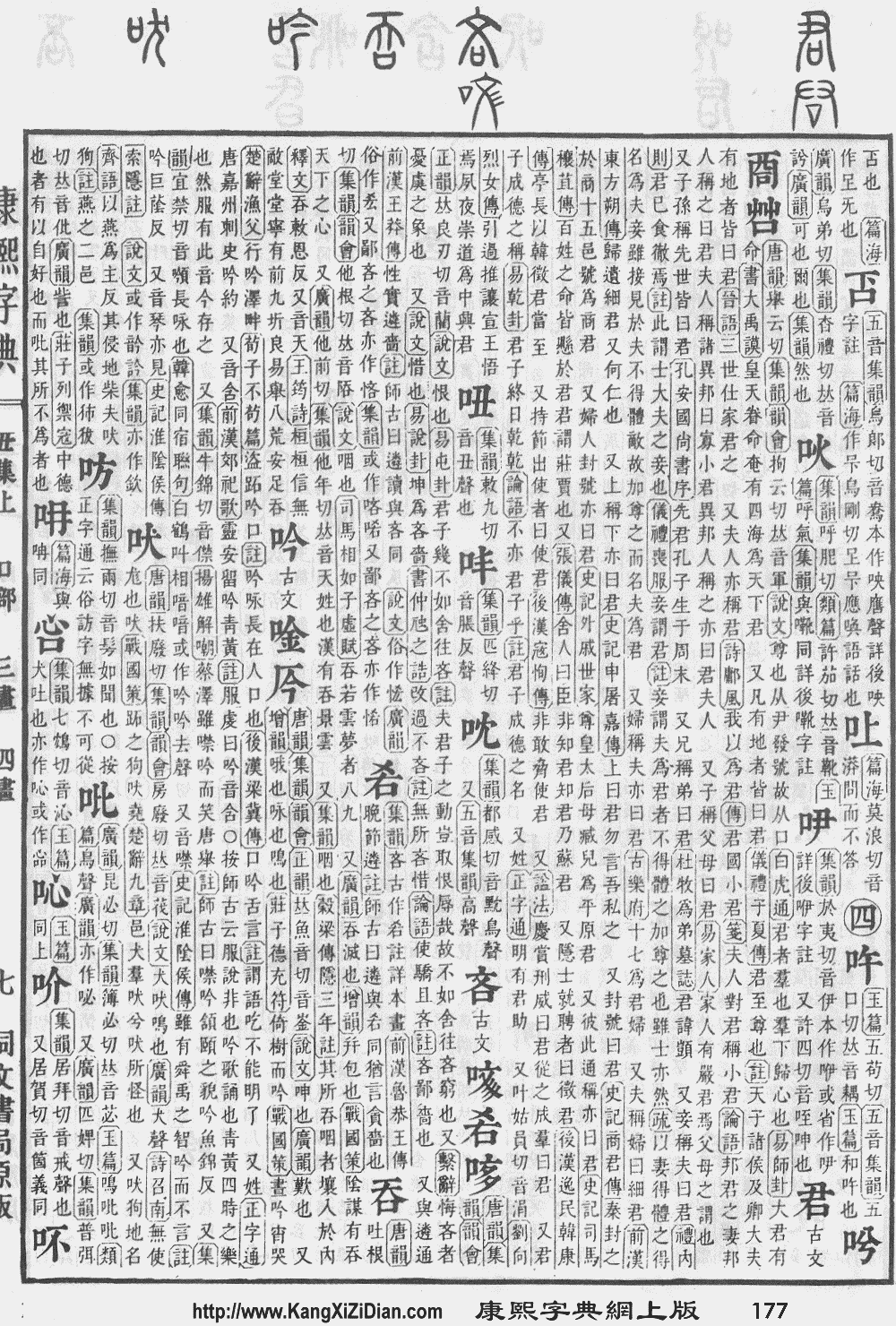
  • Kangxi Dictionary: page 177, character 22
  • Dai Kanwa Jiten: character 3331
  • Dae Jaweon: page 395, character 4
  • Hanyu Da Zidian (first edition): volume 1, page 587, character 2
  • Unihan data for U+5420

Chinese

simp. and trad.
吠
alternative forms 𠲎

Glyph origin

Ideogrammic compound (會意/会意) : 口 (“mouth”) + 犬 (“dog”) – to bark.

Etymology

Onomatopoeic and from Proto-Sino-Tibetan, perhaps *baus: cognate to Mizo bauh (“to bark”), from earlier *baus (Schuessler 2007).

Pronunciation


Note:
  • pūi/pǔi - vernacular;
  • hūi - literary.

Rime
Character 吠
Reading # 1/1
Initial (聲) 並 (3)
Final (韻) 廢 (28)
Tone (調) Departing (H)
Openness (開合) Closed
Division (等) III
Fanqie 符廢切
Baxter bjojH
Reconstructions
Zhengzhang
Shangfang
/bʉɐiH/
Pan
Wuyun
/bʷiɐiH/
Shao
Rongfen
/biuɐiH/
Edwin
Pulleyblank
/buajH/
Li
Rong
/biuɐiH/
Wang
Li
/bĭwɐiH/
Bernard
Karlgren
/bʱi̯wɐiH/
Expected
Mandarin
Reflex
fèi
Expected
Cantonese
Reflex
fai6
Baxter–Sagart system 1.1 (2014)
Character 吠
Reading # 1/1
Modern
Beijing
(Pinyin)
fèi
Middle
Chinese
‹ bjojH ›
Old
Chinese
/*Cə.bo[t]-s/
English bark (v.)

Notes for Old Chinese notations in the Baxter–Sagart system:

* Parentheses "()" indicate uncertain presence;
* Square brackets "[]" indicate uncertain identity, e.g. *[t] as coda may in fact be *-t or *-p;
* Angle brackets "<>" indicate infix;
* Hyphen "-" indicates morpheme boundary;

* Period "." indicates syllable boundary.
Zhengzhang system (2003)
Character 吠
Reading # 1/1
No. 3127
Phonetic
component
吠
Rime
group
祭
Rime
subdivision
3
Corresponding
MC rime
吠
Old
Chinese
/*bods/

Definitions

吠

  1. (of a dog) to bark

Compounds

  • 吠堯/吠尧
  • 吠形吠聲/吠形吠声
  • 吠影吠聲/吠影吠声
  • 吠日
  • 吠舍 (fèishè)
  • 吠陀 (fèituó)
  • 吠非其主
  • 夜珠吠陀
  • 桀犬吠堯/桀犬吠尧
  • 犬不夜吠
  • 犬吠之盜/犬吠之盗
  • 犬吠之警
  • 狂吠 (kuángfèi)
  • 狗吠 (gǒufèi)
  • 狗吠之警
  • 狗吠之驚/狗吠之惊
  • 狗吠非主
  • 粵犬吠雪/粤犬吠雪
  • 蜀犬吠日 (shǔquǎnfèirì)
  • 越犬吠雪
  • 跖犬吠堯/跖犬吠尧
  • 跖狗吠堯/跖狗吠尧
  • 邑犬群吠
  • 阿吠斯陀
  • 雞鳴犬吠/鸡鸣犬吠
  • 雞鳴狗吠/鸡鸣狗吠
  • 驢鳴犬吠/驴鸣犬吠
  • 黎俱吠陀

References

Japanese

Kanji

吠

(uncommon “Hyōgai” kanji)

  1. Bark; howl.

Readings

Compounds

Korean

Hanja

吠 (eum 폐 (pye))

  1. This term needs a translation to English. Please help out and add a translation, then remove the text {{rfdef}}.

Vietnamese

Han character

吠: Hán Nôm readings: phệ, phịa

  1. This term needs a translation to English. Please help out and add a translation, then remove the text {{rfdef}}.

References

This article is issued from Wiktionary. The text is licensed under Creative Commons - Attribution - Sharealike. Additional terms may apply for the media files.