咎

咎 U+548E, 咎
CJK UNIFIED IDEOGRAPH-548E
← 咍
[U+548D]
CJK Unified Ideographs 咏 →
[U+548F]

Translingual

Han character

咎 (Kangxi radical 30, 口+5, 8 strokes, cangjie input 竹人口 (HOR) or 竹卜口 (HYR), four-corner 28604, composition ⿱处口(G) or ⿱⿺夂人口(TJK))

Derived characters

References

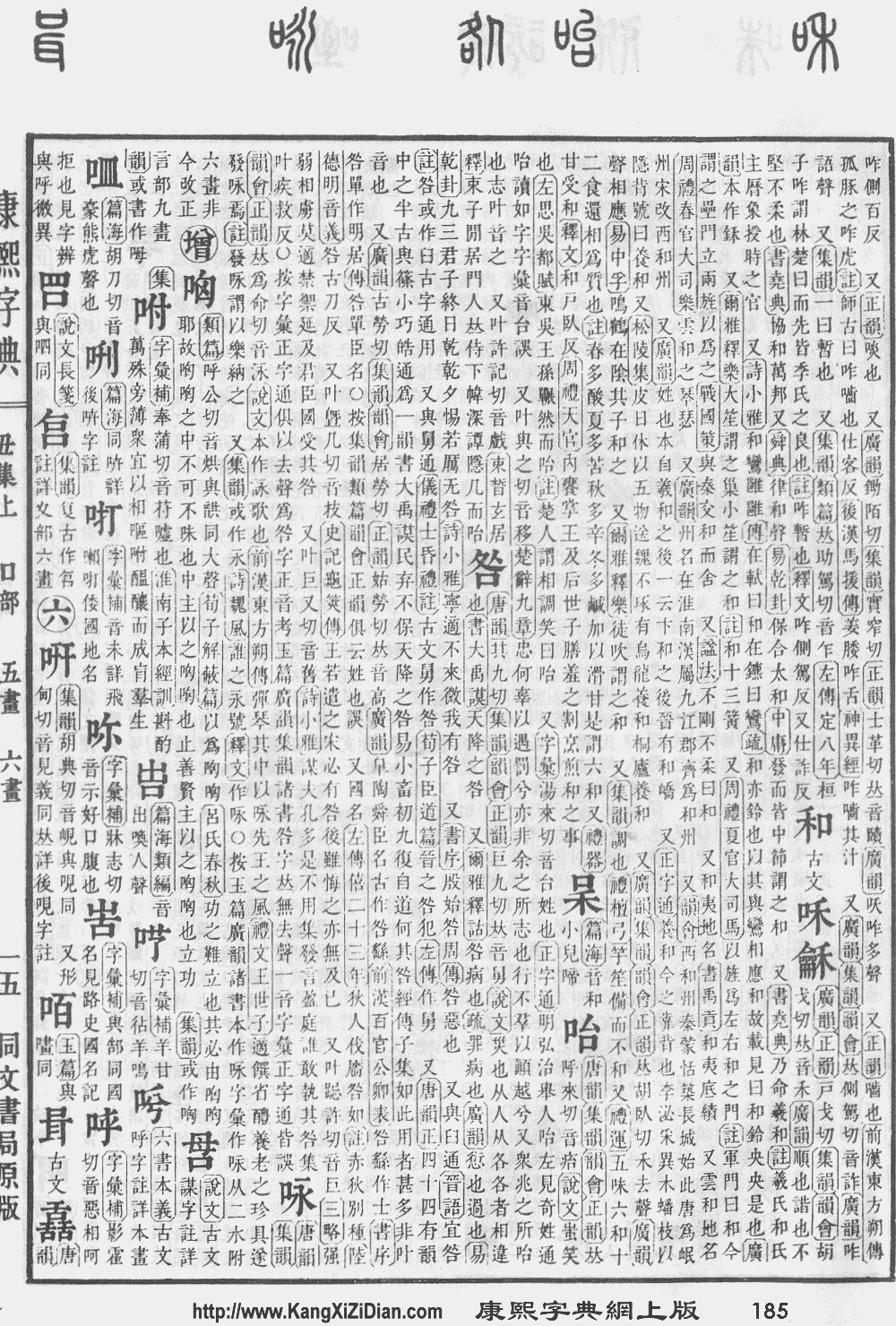
  • Kangxi Dictionary: page 185, character 6
  • Dai Kanwa Jiten: character 3493
  • Dae Jaweon: page 404, character 6
  • Hanyu Da Zidian (first edition): volume 1, page 607, character 6
  • Unihan data for U+548E

Chinese

trad. 咎
simp. # 咎

Glyph origin

Historical forms of the character 咎
Shang Warring States Shuowen Jiezi (compiled in Han)
Bronze inscriptions Oracle bone script Chu slip and silk script Qin slip script Small seal script

Originally ideogrammic compound (會意/会意) : 夊 (“foot”) + 人 (“person”). Later 口 was added, making the modern form an ideogrammic compound (會意/会意) : 各 + 人.

Pronunciation


Rime
Character 咎
Reading # 2/2
Initial (聲) 群 (30)
Final (韻) 尤 (136)
Tone (調) Rising (X)
Openness (開合) Open
Division (等) III
Fanqie 其九切
Baxter gjuwX
Reconstructions
Zhengzhang
Shangfang
/ɡɨuX/
Pan
Wuyun
/ɡiuX/
Shao
Rongfen
/ɡiəuX/
Edwin
Pulleyblank
/guwX/
Li
Rong
/ɡiuX/
Wang
Li
/ɡĭəuX/
Bernard
Karlgren
/gi̯ə̯uX/
Expected
Mandarin
Reflex
jiù
Expected
Cantonese
Reflex
gau6
Baxter–Sagart system 1.1 (2014)
Character 咎
Reading # 1/1
Modern
Beijing
(Pinyin)
jiù
Middle
Chinese
‹ gjuwX ›
Old
Chinese
/*[ɡ](r)uʔ/
English fault, blame (n.)

Notes for Old Chinese notations in the Baxter–Sagart system:

* Parentheses "()" indicate uncertain presence;
* Square brackets "[]" indicate uncertain identity, e.g. *[t] as coda may in fact be *-t or *-p;
* Angle brackets "<>" indicate infix;
* Hyphen "-" indicates morpheme boundary;

* Period "." indicates syllable boundary.
Zhengzhang system (2003)
Character 咎
Reading # 2/2
No. 6988
Phonetic
component
咎
Rime
group
幽
Rime
subdivision
2
Corresponding
MC rime
舅
Old
Chinese
/*ɡɯwʔ/

Definitions

咎

  1. fault; defect; error; mistake
  2. calamity; misfortune
  3. to blame; to punish; to find fault

Compounds

  • 不咎既往 (bùjiùjìwǎng)
  • 休咎
  • 動輒得咎/动辄得咎
  • 取咎
  • 咎徵/咎征
  • 咎悔
  • 咎戾
  • 咎由自取 (jiùyóuzìqǔ)
  • 咎過/咎过
  • 執咎/执咎
  • 委咎
  • 引咎 (yǐnjiù)
  • 引咎自責/引咎自责
  • 引咎責躬/引咎责躬
  • 引咎辭職/引咎辞职
  • 招咎
  • 既往不咎 (jìwǎngbùjiù)
  • 歸咎/归咎 (guījiù)
  • 無咎無譽/无咎无誉
  • 獲咎/获咎
  • 盈滿之咎/盈满之咎
  • 自取其咎 (zìqǔqíjiù)
  • 自咎
  • 降咎
  • 難辭其咎/难辞其咎 (náncíqíjiù)

Pronunciation


Rime
Character 咎
Reading # 1/2
Initial (聲) 見 (28)
Final (韻) 豪 (89)
Tone (調) Level (Ø)
Openness (開合) Open
Division (等) I
Fanqie 古勞切
Baxter kaw
Reconstructions
Zhengzhang
Shangfang
/kɑu/
Pan
Wuyun
/kɑu/
Shao
Rongfen
/kɑu/
Edwin
Pulleyblank
/kaw/
Li
Rong
/kɑu/
Wang
Li
/kɑu/
Bernard
Karlgren
/kɑu/
Expected
Mandarin
Reflex
gāo
Expected
Cantonese
Reflex
gou1
Zhengzhang system (2003)
Character 咎
Reading # 1/2
No. 6983
Phonetic
component
咎
Rime
group
幽
Rime
subdivision
2
Corresponding
MC rime
髙
Old
Chinese
/*kɯːw/

Definitions

咎

  1. † Alternative form of 鼛 (gāo, “large drum”)
  2. a surname
  3. Alternative form of 皋 (gāo, “a surname”):
  1. used in 咎繇

Compounds

Japanese

Kanji

咎

(uncommon “Hyōgai” kanji)

  1. fault
  2. blame

Readings

Etymology

Kanji in this term
咎
とが
Hyōgaiji
kun’yomi
For pronunciation and definitions of 咎 – see the following entry.
【科とが】2
[noun] mistake, error
[noun] crime, offense, wrongdoing
[noun] fault, flaw
(This term, 咎, is an alternative spelling of the above term.)

Korean

Hanja

咎 • (gu, go) (hangeul 구, 고, revised gu, go, McCune–Reischauer ku, ko)

  1. This term needs a translation to English. Please help out and add a translation, then remove the text {{rfdef}}.

Vietnamese

Han character

咎: Hán Việt readings: cữu[1]

  1. This term needs a translation to English. Please help out and add a translation, then remove the text {{rfdef}}.

References

  1. Trần (2004).
This article is issued from Wiktionary. The text is licensed under Creative Commons - Attribution - Sharealike. Additional terms may apply for the media files.