墟
| ||||||||
Translingual
Han character
墟 (Kangxi radical 32, 土+12, 15 strokes, cangjie input 土卜心金 (GYPC) or 土卜心一 (GYPM), four-corner 41117, composition ⿰土虛)
References
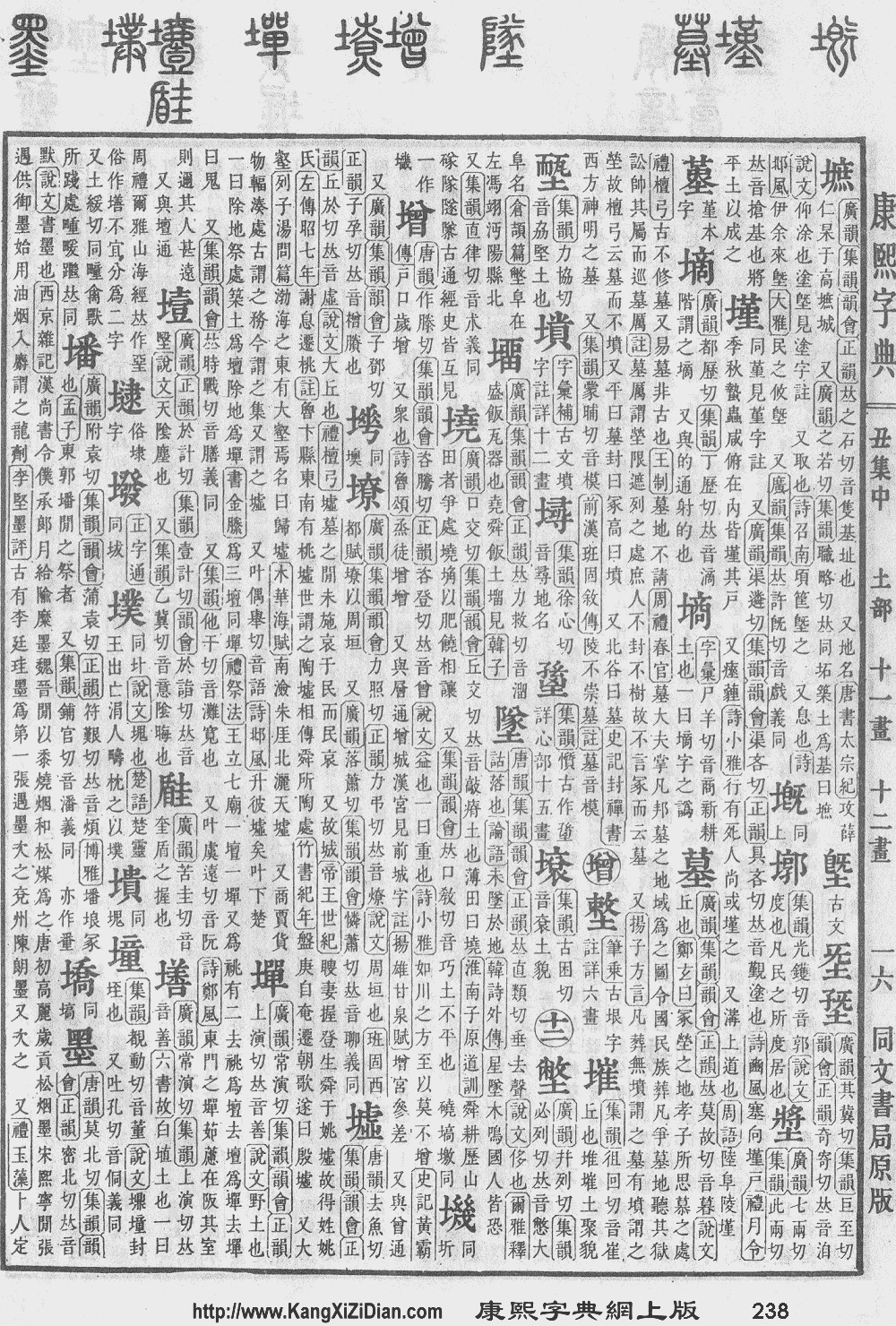
- Kangxi Dictionary: page 238, character 28
- Dai Kanwa Jiten: character 5457
- Dae Jaweon: page 477, character 13
- Hanyu Da Zidian (first edition): volume 1, page 479, character 12
- Unihan data for U+589F
Chinese
| trad. | 墟 | |
|---|---|---|
| simp. # | 墟 | |
| alternative forms | 圩 market | |
Glyph origin
Characters in the same phonetic series (虍) (Zhengzhang, 2003)
| Old Chinese | |
|---|---|
| 唬 | *qʰraːs, *kʷraːɡ |
| 戲 | *qʰral, *qʰrals, *qʰaː |
| 巇 | *qʰra |
| 隵 | *qʰra |
| 嚱 | *qʰras |
| 盧 | *b·raː |
| 鑪 | *raː |
| 壚 | *raː |
| 籚 | *raː |
| 蘆 | *raː, *ra |
| 顱 | *b·raː |
| 髗 | *b·raː |
| 鱸 | *raː |
| 攎 | *raː |
| 櫨 | *raː |
| 轤 | *raː |
| 黸 | *raː |
| 獹 | *raː |
| 鸕 | *raː |
| 艫 | *raː |
| 纑 | *raː |
| 瀘 | *raː |
| 瓐 | *raː |
| 爐 | *raː |
| 嚧 | *raː |
| 矑 | *b·raː |
| 罏 | *raː |
| 蠦 | *raː |
| 虜 | *raːʔ |
| 擄 | *raːʔ |
| 艣 | *raːʔ |
| 鐪 | *raːʔ |
| 虖 | *qʰaː, *qʰʷa, *qʰaː, *qʰʷa |
| 虍 | *qʰaː |
| 雐 | *qʰʷlaː |
| 虎 | *qʰlaːʔ |
| 琥 | *qʰlaːʔ |
| 萀 | *qʰlaːʔ |
| 臚 | *b·ra |
| 廬 | *ra |
| 驢 | *b·ra |
| 藘 | *ra |
| 爈 | *ra, *ras |
| 櫖 | *ra, *ras |
| 儢 | *raʔ |
| 慮 | *ras |
| 勴 | *ras |
| 鑢 | *ras |
| 濾 | *ras |
| 攄 | *r̥ʰa |
| 處 | *kʰljaʔ, *kʰljas |
| 豦 | *kas, *ɡa |
| 據 | *kas |
| 鐻 | *kas, *ɡa, *ɡaʔ |
| 澽 | *kas, *ɡas |
| 虛 | *kʰa, *qʰa |
| 墟 | *kʰa |
| 懅 | *ɡa |
| 蘧 | *ɡa, *ɡʷa |
| 籧 | *ɡa |
| 醵 | *ɡa, *ɡas, *ɡaɡ |
| 璩 | *ɡa |
| 虡 | *ɡaʔ |
| 遽 | *ɡas |
| 勮 | *ɡas |
| 噓 | *qʰa, *qʰas |
| 驉 | *qʰa |
| 歔 | *qʰa |
| 魖 | *qʰa |
| 膚 | *pla |
| 虧 | *kʰʷral |
| 噱 | *ɡaɡ |
| 臄 | *ɡaɡ |
| 劇 | *ɡaɡ |
| 諕 | *qʰʷraːɡ |
Phono-semantic compound (形聲/形声, OC *kʰa) : semantic 土 (“dirt”) + phonetic 虛 (OC *kʰa, *qʰa).
Etymology
- "ruin"
- Possibly a nominal derivation, with *k- prefix, from 虛 (OC *kʰa, *qʰa) (Karlgren, 1958, Schuessler, 2007), maybe related to Mizo ko (“raised ground; bank; mound”). Perhaps not related to 丘 (OC *kʰʷɯ) "mound, hill" (contra Wang, 1982).
- "market"
- A Yuè (越) dialectal word, which also occurs in some Tai languages such as Yoy [script needed] (hɯA1, “market”) (Schuessler, 2007). It also occurs in some Min dialects; Kwok (2018) reconstructs Proto-Southern Min *hɯ1.
Pronunciation
Definitions
墟
Japanese
Usage notes
Rarely replaced by 虚 in modern usage.
Korean
Hanja
墟 • (heo) (hangeul 허, revised heo, McCune–Reischauer hŏ)
- This term needs a translation to English. Please help out and add a translation, then remove the text
{{rfdef}}.
Vietnamese
Han character
- This term needs a translation to English. Please help out and add a translation, then remove the text
{{rfdef}}.
References
This article is issued from Wiktionary. The text is licensed under Creative Commons - Attribution - Sharealike. Additional terms may apply for the media files.