虜
See also: 虏
| ||||||||
 | ||||||||
| ||||||||
Translingual
Han character
虜 (Kangxi radical 141, 虍+6, 13 strokes, cangjie input 卜心田大尸 (YPWKS), four-corner 21227, composition ⿸虍男(GHJV) or ⿸虍⿱⿻毌力(TK) or ⿸虍⿱⿻囗十力(TK))
| Traditional | 虜 |
|---|---|
| Simplified | 虏 |
| Japanese | 虜 |
| Korean | 虜 |
References
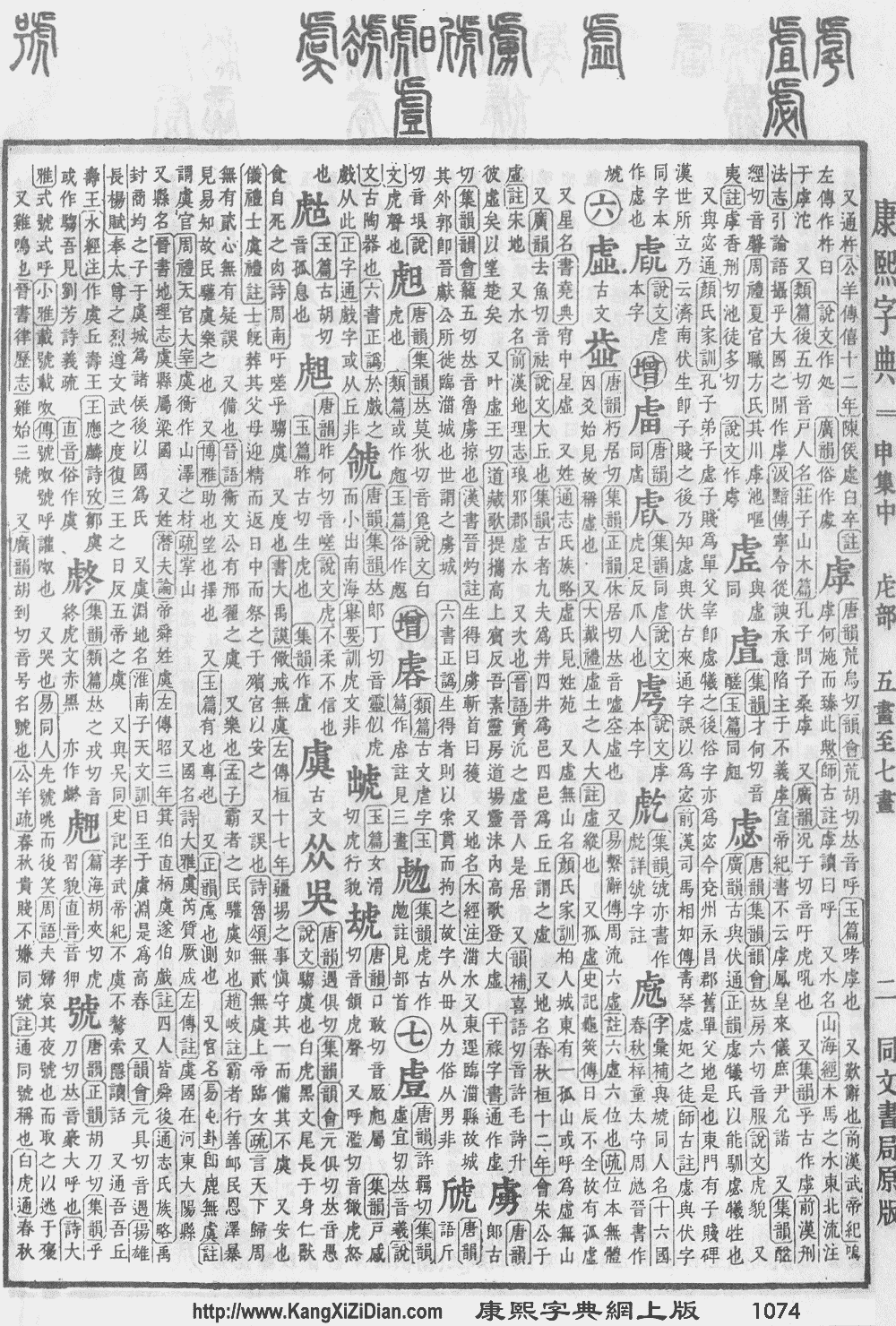
- Kangxi Dictionary: page 1074, character 13
- Dai Kanwa Jiten: character 32710
- Dae Jaweon: page 1542, character 1
- Hanyu Da Zidian (first edition): volume 4, page 2827, character 3
- Unihan data for U+865C
- Unihan data for U+F936
- Unihan data for U+2F9B4
Chinese
| trad. | 虜 | |
|---|---|---|
| simp. | 虏* | |
Glyph origin
Characters in the same phonetic series (虍) (Zhengzhang, 2003)
| Old Chinese | |
|---|---|
| 唬 | *qʰraːs, *kʷraːɡ |
| 戲 | *qʰral, *qʰrals, *qʰaː |
| 巇 | *qʰra |
| 隵 | *qʰra |
| 嚱 | *qʰras |
| 盧 | *b·raː |
| 鑪 | *raː |
| 壚 | *raː |
| 籚 | *raː |
| 蘆 | *raː, *ra |
| 顱 | *b·raː |
| 髗 | *b·raː |
| 鱸 | *raː |
| 攎 | *raː |
| 櫨 | *raː |
| 轤 | *raː |
| 黸 | *raː |
| 獹 | *raː |
| 鸕 | *raː |
| 艫 | *raː |
| 纑 | *raː |
| 瀘 | *raː |
| 瓐 | *raː |
| 爐 | *raː |
| 嚧 | *raː |
| 矑 | *b·raː |
| 罏 | *raː |
| 蠦 | *raː |
| 虜 | *raːʔ |
| 擄 | *raːʔ |
| 艣 | *raːʔ |
| 鐪 | *raːʔ |
| 虖 | *qʰaː, *qʰʷa, *qʰaː, *qʰʷa |
| 虍 | *qʰaː |
| 雐 | *qʰʷlaː |
| 虎 | *qʰlaːʔ |
| 琥 | *qʰlaːʔ |
| 萀 | *qʰlaːʔ |
| 臚 | *b·ra |
| 廬 | *ra |
| 驢 | *b·ra |
| 藘 | *ra |
| 爈 | *ra, *ras |
| 櫖 | *ra, *ras |
| 儢 | *raʔ |
| 慮 | *ras |
| 勴 | *ras |
| 鑢 | *ras |
| 濾 | *ras |
| 攄 | *r̥ʰa |
| 處 | *kʰljaʔ, *kʰljas |
| 豦 | *kas, *ɡa |
| 據 | *kas |
| 鐻 | *kas, *ɡa, *ɡaʔ |
| 澽 | *kas, *ɡas |
| 虛 | *kʰa, *qʰa |
| 墟 | *kʰa |
| 懅 | *ɡa |
| 蘧 | *ɡa, *ɡʷa |
| 籧 | *ɡa |
| 醵 | *ɡa, *ɡas, *ɡaɡ |
| 璩 | *ɡa |
| 虡 | *ɡaʔ |
| 遽 | *ɡas |
| 勮 | *ɡas |
| 噓 | *qʰa, *qʰas |
| 驉 | *qʰa |
| 歔 | *qʰa |
| 魖 | *qʰa |
| 膚 | *pla |
| 虧 | *kʰʷral |
| 噱 | *ɡaɡ |
| 臄 | *ɡaɡ |
| 劇 | *ɡaɡ |
| 諕 | *qʰʷraːɡ |
Pronunciation
Definitions
虜
- to capture; to imprison
- to plunder; to rob
- captive; prisoner of war
- (literary, derogatory) enemy
- (literary, derogatory) northern barbarian
- 是以北人詆南為島夷,南人指北為索虜,在當日之人,不務修德行仁,而徒事口舌相譏,已為至卑至陋之見。 [Literary Chinese, trad.]
- From: 18th century, Yongzheng Emperor,《大義覺迷錄》"Resolving Confusion with a Discourse on Righteousness", translated by Devin Fitzgerald & annotated by Maura Dykstra
- Shìyǐ běirén dǐ nán wèi dǎoyí, nánrén zhǐ běi wèi suǒlǔ, zài dāngrì zhī rén, bù wù xiūdé xíngrén, ér tú shì kǒushé xiàng jī, yǐ wèi zhìbēi zhìlòu zhī jiàn. [Pinyin]
- So, the northerners began to slander southerners by calling them “isolated outlanders” and southerners began pointing to northerns as “braided savages.” During that time, people did not labor to perfect virtue and practice righteousness. Instead, they served the trivial matter of ridiculing each other, making their perspective only crude and base.
是以北人诋南为岛夷,南人指北为索虏,在当日之人,不务修德行仁,而徒事口舌相讥,已为至卑至陋之见。 [Literary Chinese, simp.]
- (literary) slave; servant
- 爵吏而為縣尉,則賜虜,六加五千六百。 [Classical Chinese, trad.]
- From: The Book of Lord Shang, circa 3rd century BCE, translated based on J.J.L. Duyvendak's version
- Juélì ér wèi xiànwèi, zé cì lǔ, liù jiā wǔqiān liùbǎi. [Pinyin]
- When an officer is raised to the rank of a district commander [...] then he is presented with six prisoner-slaves, and provided with 5,000 soldiers and an income of 600 piculs of grain.
爵吏而为县尉,则赐虏,六加五千六百。 [Classical Chinese, simp.]
Japanese
| Shinjitai | 虜 | |
| Kyūjitai [1] |
虜 虜or 虜+ ︀? |
|
| 虜󠄀 虜+ 󠄀?(Adobe-Japan1) | ||
| 虜󠄃 虜+ 󠄃?(Hanyo-Denshi) (Moji_Joho) | ||
| The displayed kanji may be different from the image due to your environment. See here for details. | ||
Kanji
虜
- This term needs a translation to English. Please help out and add a translation, then remove the text
{{rfdef}}.
Readings
References
- “虜”, in 漢字ぺディア (Kanjipedia) (in Japanese), 日本漢字能力検定協会, 2015–2024
Korean
Etymology
From Middle Chinese 虜 (MC luX).
| Historical Readings | ||
|---|---|---|
| Dongguk Jeongun Reading | ||
| Dongguk Jeongun, 1448 | Recorded as Middle Korean 롱〯 (Yale: lwǒ?) in Dongguk Jeongun (東國正韻 / 동국정운), 1448. | |
| Middle Korean | ||
| Text | Eumhun | |
| Gloss (hun) | Reading | |
| Hunmong Jahoe, 1527 | 되〯 로〮 | Recorded as Middle Korean 로〮 (lwó) (Yale: lwó) in Hunmong Jahoe (訓蒙字會 / 훈몽자회), 1527. |
| Gwangju Cheonjamun, 1575 | 되 로 / 사ᄅᆞ자ᄇᆞᆯ 로 | Recorded as Middle Korean 로 (lwo) (Yale: lwo) in Sinjeung Yuhap (新增類合 / 신증유합), 1576. |
Pronunciation
- (SK Standard/Seoul) IPA(key): [ɾo̞] ~ [no̞]
- Phonetic hangul: [로/노]
Vietnamese
This article is issued from Wiktionary. The text is licensed under Creative Commons - Attribution - Sharealike. Additional terms may apply for the media files.