擄
See also: 掳
| ||||||||
| ||||||||
Translingual
Han character
擄 (Kangxi radical 64, 手+13, 16 strokes, cangjie input 手卜心尸 (QYPS), four-corner 51027, composition ⿰扌虜)
References
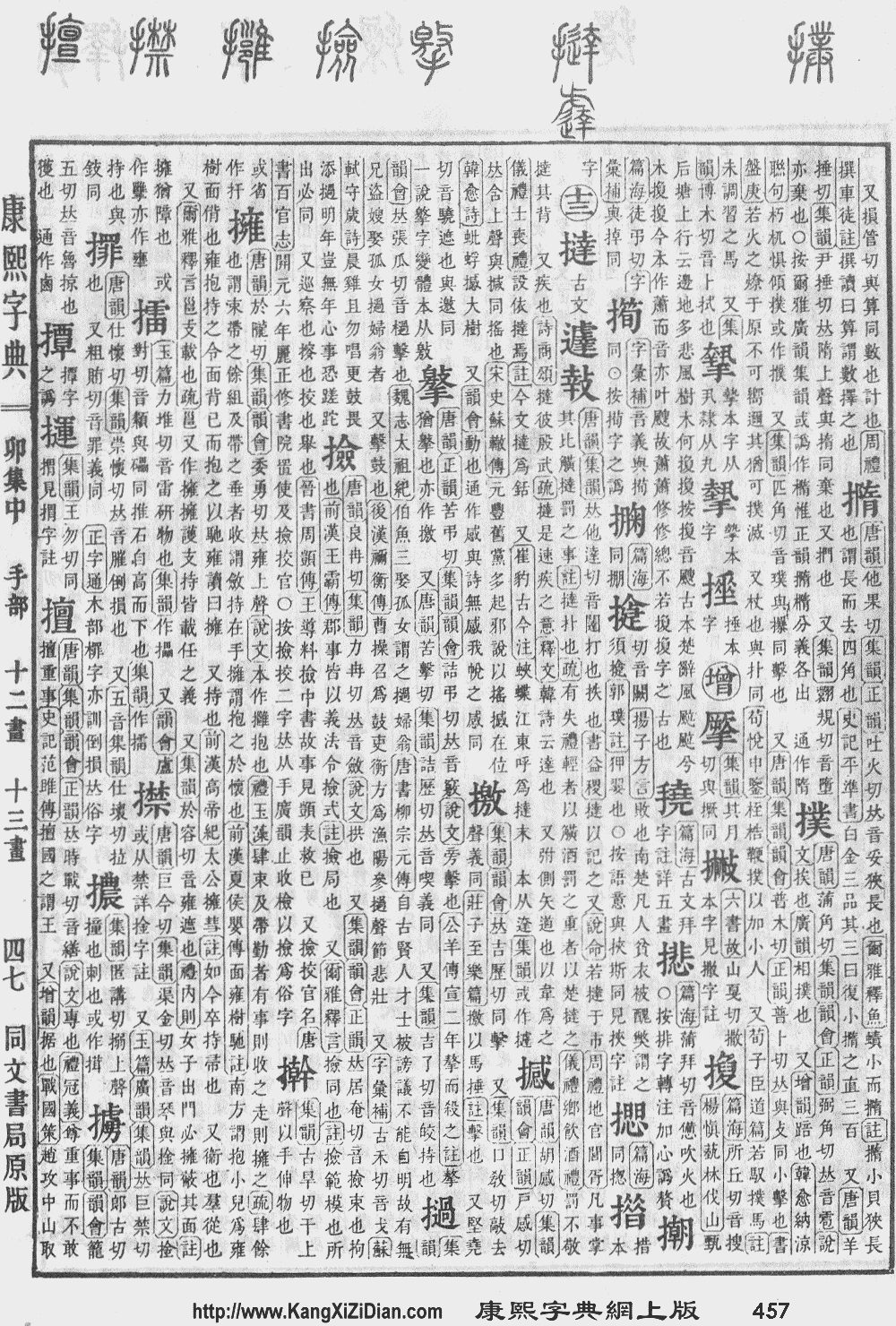
- Kangxi Dictionary: page 457, character 31
- Dai Kanwa Jiten: character 12787
- Dae Jaweon: page 806, character 15
- Hanyu Da Zidian (first edition): volume 3, page 1968, character 1
- Unihan data for U+64C4
- Unihan data for U+F930
Chinese
| trad. | 擄 | |
|---|---|---|
| simp. | 掳 | |
| 2nd round simp. | 虏 | |
| alternative forms | 虜 | |
Glyph origin
Characters in the same phonetic series (虍) (Zhengzhang, 2003)
| Old Chinese | |
|---|---|
| 唬 | *qʰraːs, *kʷraːɡ |
| 戲 | *qʰral, *qʰrals, *qʰaː |
| 巇 | *qʰra |
| 隵 | *qʰra |
| 嚱 | *qʰras |
| 盧 | *b·raː |
| 鑪 | *raː |
| 壚 | *raː |
| 籚 | *raː |
| 蘆 | *raː, *ra |
| 顱 | *b·raː |
| 髗 | *b·raː |
| 鱸 | *raː |
| 攎 | *raː |
| 櫨 | *raː |
| 轤 | *raː |
| 黸 | *raː |
| 獹 | *raː |
| 鸕 | *raː |
| 艫 | *raː |
| 纑 | *raː |
| 瀘 | *raː |
| 瓐 | *raː |
| 爐 | *raː |
| 嚧 | *raː |
| 矑 | *b·raː |
| 罏 | *raː |
| 蠦 | *raː |
| 虜 | *raːʔ |
| 擄 | *raːʔ |
| 艣 | *raːʔ |
| 鐪 | *raːʔ |
| 虖 | *qʰaː, *qʰʷa, *qʰaː, *qʰʷa |
| 虍 | *qʰaː |
| 雐 | *qʰʷlaː |
| 虎 | *qʰlaːʔ |
| 琥 | *qʰlaːʔ |
| 萀 | *qʰlaːʔ |
| 臚 | *b·ra |
| 廬 | *ra |
| 驢 | *b·ra |
| 藘 | *ra |
| 爈 | *ra, *ras |
| 櫖 | *ra, *ras |
| 儢 | *raʔ |
| 慮 | *ras |
| 勴 | *ras |
| 鑢 | *ras |
| 濾 | *ras |
| 攄 | *r̥ʰa |
| 處 | *kʰljaʔ, *kʰljas |
| 豦 | *kas, *ɡa |
| 據 | *kas |
| 鐻 | *kas, *ɡa, *ɡaʔ |
| 澽 | *kas, *ɡas |
| 虛 | *kʰa, *qʰa |
| 墟 | *kʰa |
| 懅 | *ɡa |
| 蘧 | *ɡa, *ɡʷa |
| 籧 | *ɡa |
| 醵 | *ɡa, *ɡas, *ɡaɡ |
| 璩 | *ɡa |
| 虡 | *ɡaʔ |
| 遽 | *ɡas |
| 勮 | *ɡas |
| 噓 | *qʰa, *qʰas |
| 驉 | *qʰa |
| 歔 | *qʰa |
| 魖 | *qʰa |
| 膚 | *pla |
| 虧 | *kʰʷral |
| 噱 | *ɡaɡ |
| 臄 | *ɡaɡ |
| 劇 | *ɡaɡ |
| 諕 | *qʰʷraːɡ |
Etymology
From 虜 (OC *raːʔ).
Pronunciation
Definitions
擄
- to capture; to seize
- 主的靈在我身上,因為他用膏膏我,叫我傳福音給貧窮的人;差遣我報告:被擄的得釋放,瞎眼的得看見,叫那受壓制的得自由,報告神悅納人的禧年。 [MSC, trad.]
- From: 新標點和合本 (Chinese Union Version with New Punctuation), 路加福音 (Luke) 4:18–19
- Zhǔ de líng zài wǒ shēnshàng, yīnwèi tā yòng gāo gào wǒ, jiào wǒ chuán fúyīn gěi pínqióng de rén; chāiqiǎn wǒ bàogào: bèi lǔ de dé shìfàng, xiāyǎn de dé kànjiàn, jiào nà shòu yāzhì de dé zìyóu, bàogào Shén yuènà rén de xǐnián. [Pinyin]
- The Spirit of the Lord is upon me, because he hath anointed me to preach the gospel to the poor; he hath sent me to heal the brokenhearted, to preach deliverance to the captives [lit. those who are captured], and recovering of sight to the blind, to set at liberty them that are bruised, To preach the acceptable year of the Lord.
主的灵在我身上,因为他用膏膏我,叫我传福音给贫穷的人;差遣我报告:被掳的得释放,瞎眼的得看见,叫那受压制的得自由,报告神悦纳人的禧年。 [MSC, simp.]
- to plunder; to rob
Japanese
Kanji
擄
- This term needs a translation to English. Please help out and add a translation, then remove the text
{{rfdef}}.
Korean
Vietnamese
This article is issued from Wiktionary. The text is licensed under Creative Commons - Attribution - Sharealike. Additional terms may apply for the media files.