征
| ||||||||
Translingual
| Japanese | 征 徴 |
|---|---|
| Simplified | 征 徵 |
| Traditional | 征 徵 |
Han character
征 (Kangxi radical 60, 彳+5, 8 strokes, cangjie input 竹人一卜一 (HOMYM), four-corner 21211, composition ⿰彳正)
References
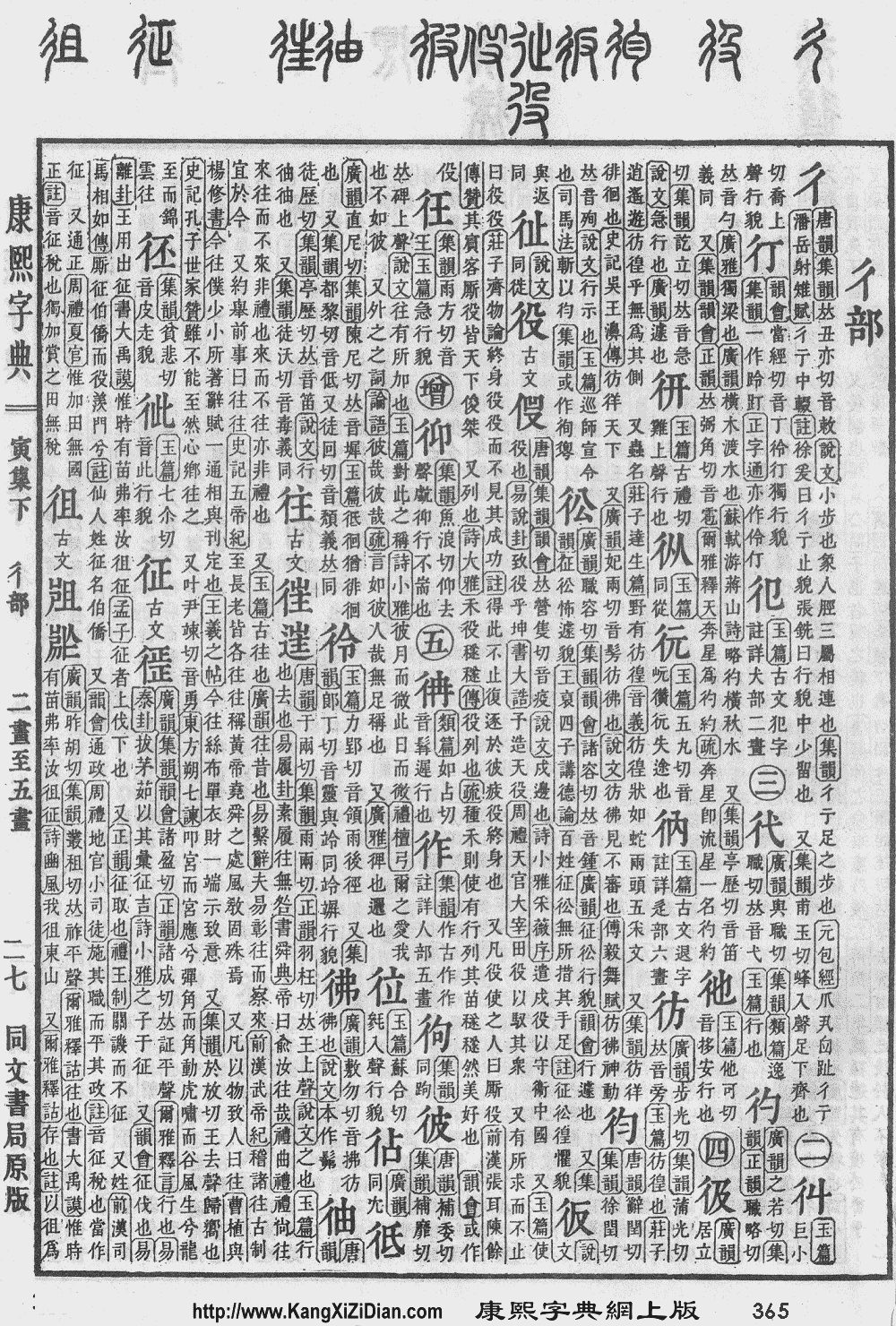
- Kangxi Dictionary: page 365, character 37
- Dai Kanwa Jiten: character 10077
- Dae Jaweon: page 686, character 4
- Hanyu Da Zidian (first edition): volume 2, page 815, character 2
- Unihan data for U+5F81
Chinese
| simp. and trad. |
征 | |
|---|---|---|
| alternative forms | 徰 ancient | |
Glyph origin
Characters in the same phonetic series (正) (Zhengzhang, 2003)
Phono-semantic compound (形聲/形声, OC *tjeŋ) : semantic 彳 + phonetic 正 (OC *tjeŋ, *tjeŋs, “straight”). Also ideogrammic compound (會意/会意) .
Simplified from 徵 (徵 → 正) as well as existing already as a traditional character.
Etymology 1
From 正 (OC *tjeŋ, *tjeŋs, “straight”); see there for more.
Pronunciation
Definitions
征
Compounds
- 出征 (chūzhēng)
- 力征 (lìzhēng)
- 北征
- 南征
- 南征北伐
- 南征北戰 (nánzhēngběizhàn)
- 南征北討
- 卜征
- 孤征
- 宵征
- 寓禁於征
- 專征
- 征人
- 征伐 (zhēngfá)
- 征勦
- 征塵 (zhēngchén)
- 征夫 (zhēngfū)
- 征客
- 征屬
- 征帆 (zhēngfān)
- 征彸 (zhēngzhōng)
- 征戍
- 征戰 (zhēngzhàn)
- 征收 (zhēngshōu)
- 征斂
- 征旆
- 征服 (zhēngfú)
- 征服者 (zhēngfúzhě)
- 征服自然
- 征營
- 征程 (zhēngchéng)
- 征衣
- 征衫
- 征討 (zhēngtǎo)
- 征軒
- 征途 (zhēngtú)
- 征馬
- 征駕
- 御駕親征/御驾亲征 (yùjiàqīnzhēng)
- 急征重斂
- 有征無戰/有征无战
- 東征
- 東征西怨
- 東征西討/东征西讨
- 東討西征/东讨西征
- 橫征暴斂/横征暴敛
- 舉薦征辟
- 親征 (qīnzhēng)
- 輸征
- 遄征
- 遠征 (yuǎnzhēng)
- 遠征軍/远征军
- 長征 (chángzhēng)
- 關征
- 飛征
Etymology 2
| For pronunciation and definitions of 征 – see 徵 (“to convene; to assemble; to collect; etc.”). (This character is the simplified form of 徵). |
Notes:
|
Japanese
Korean
Hanja
征 (eum 정 (jeong))
- This term needs a translation to English. Please help out and add a translation, then remove the text
{{rfdef}}.
Vietnamese
Han character
征: Hán Nôm readings: chinh
- This term needs a translation to English. Please help out and add a translation, then remove the text
{{rfdef}}.
This article is issued from Wiktionary. The text is licensed under Creative Commons - Attribution - Sharealike. Additional terms may apply for the media files.