患
| ||||||||
Translingual
Han character
患 (Kangxi radical 61, 心+7, 11 strokes, cangjie input 中中心 (LLP), four-corner 50336, composition ⿱串心)
References
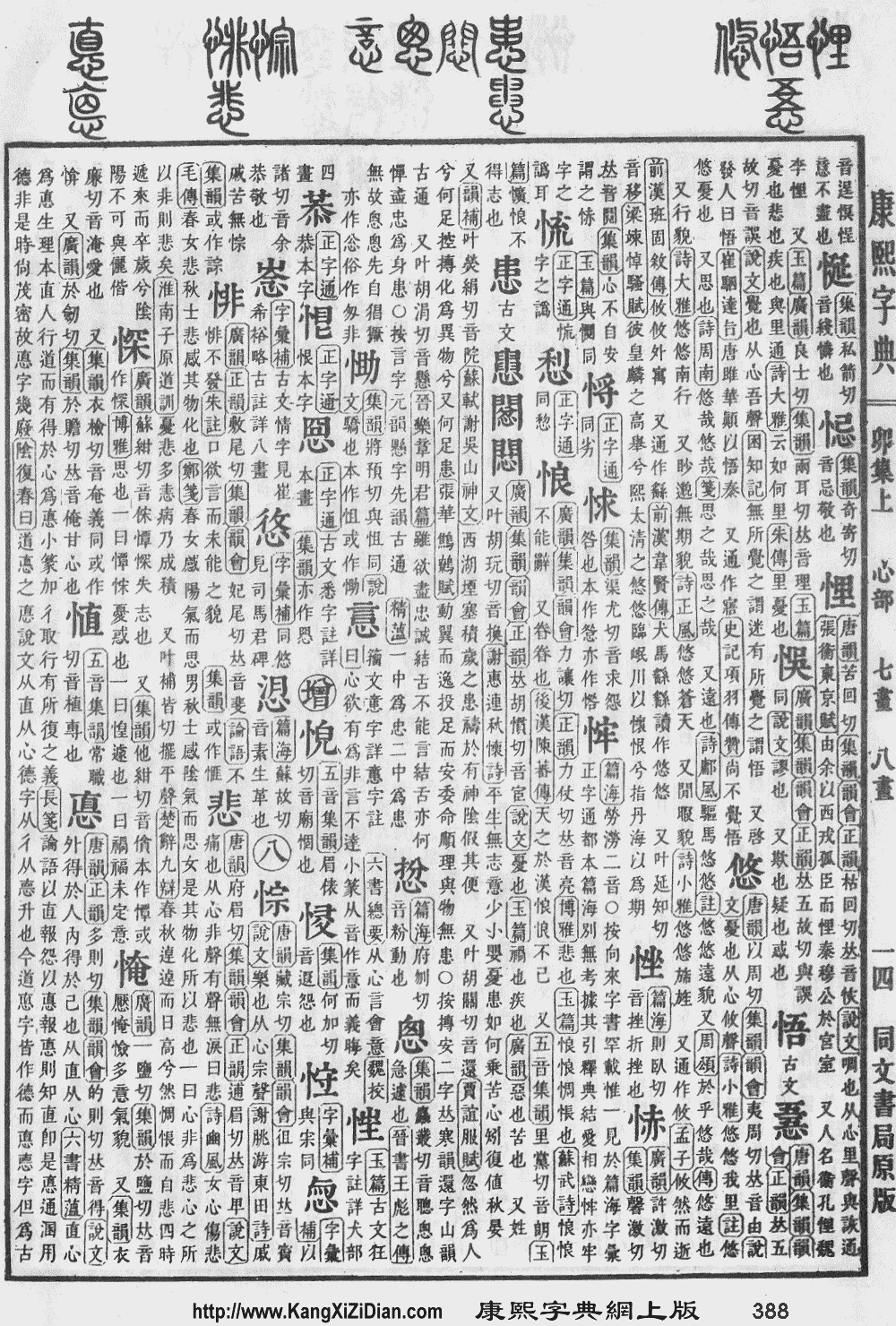
- Kangxi Dictionary: page 388, character 16
- Dai Kanwa Jiten: character 10691
- Dae Jaweon: page 721, character 8
- Hanyu Da Zidian (first edition): volume 4, page 2300, character 9
- Unihan data for U+60A3
Chinese
| simp. and trad. |
患 | |
|---|---|---|
| alternative forms | 𢠶 𢤒 | |
Glyph origin
Characters in the same phonetic series (患) (Zhengzhang, 2003)
Phono-semantic compound (形聲/形声, OC *ɡroːns) : phonetic 串 (OC *kroːns, *kʰjons) + semantic 心 (“heart”).
Since Shuowen does not have the character 串, it interprets the character as phonetic 吅 (OC *qʰon, *sqʰon, *sɢoŋs) + semantic 丨 + semantic 心 (“heart”) – to pierce through something from the heart. Duan Yucai claims in his commentary that older copies of Shuowen actually have phonetic 毌 (OC *koːn, *koːns, “to pierce through”) + semantic 心 (“heart”) instead.
Pronunciation
Definitions
患
Synonyms
- (to contract an illness):
Dialectal synonyms of 生病 (“to fall ill; to be ill”) [map]
- (disease):
- (to worry):
- 怕
- 急 (jí)
- 急眼 (jíyǎn) (colloquial)
- 恐怕 (kǒngpà)
- 愁 (chóu)
- 憂心/忧心 (yōuxīn)
- 憂慮/忧虑 (yōulǜ)
- 懸心/悬心 (xuánxīn)
- 掛心/挂心 (guàxīn)
- 掛礙/挂碍 (guà'ài)
- 揪心 (jiūxīn)
- 擔心/担心 (dānxīn)
- 擔憂/担忧 (dānyōu)
- 燒心/烧心 (shāoxīn) (regional or dated)
- 犯愁 (fànchóu)
- 疑慮/疑虑 (yílǜ)
- 發急/发急 (fājí)
- 發愁/发愁 (fāchóu)
- 發極/发极 (7faq 8jiq) (Wu)
- 著急/着急 (zháojí)
- 起急 (qǐjí) (colloquial)
- 顧慮/顾虑 (gùlǜ)
- (disaster):
- 亂兒/乱儿 (luànr) (dialectal)
- 人禍/人祸 (rénhuò) (man-made disaster)
- 劫 (jié) (Buddhism)
- 劫煞 (Hokkien)
- 劫難/劫难 (jiénàn)
- 厄 (literary, or in compounds)
- 大禍/大祸 (dàhuò) (major catastrophe)
- 大難/大难 (dànàn) (major catastrophe)
- 天災/天灾 (tiānzāi) (natural disaster)
- 央厄 (yāng'è) (literary)
- 奇禍/奇祸 (qíhuò) (literary, unexpected disaster)
- 巨禍/巨祸 (jùhuò) (literary)
- 慘事/惨事 (cǎnshì)
- 慘劇/惨剧 (cǎnjù)
- 慘禍/惨祸 (cǎnhuò) (tragic accident)
- 沙𧐔 (Teochew)
- 浩劫 (hàojié)
- 災/灾 (zāi) (literary, or in compounds)
- 災劫/灾劫 (zāijié) (literary)
- 災厄/灾厄 (zāi'è) (literary)
- 災害/灾害 (zāihài)
- 災殃/灾殃 (zāiyāng)
- 災禍/灾祸 (zāihuò)
- 災變/灾变 (zāibiàn) (literary, natural disaster)
- 災難/灾难 (zāinàn)
- 癰疽/痈疽 (yōngjū) (figurative)
- 眚沴 (shěnglì) (literary)
- 禍/祸 (huò) (literary, or in compounds)
- 禍事/祸事 (huòshì)
- 禍害/祸害 (huòhài)
- 禍息/祸息 (ho5 si6) (Xiang)
- 禍患/祸患 (huòhuàn)
- 禍殃/祸殃 (huòyāng)
Compounds
- 不患
- 人之患在好為人師/人之患在好为人师 (rén zhī huàn zài hàowéirénshī)
- 人滿為患/人满为患 (rénmǎnwéihuàn)
- 備嘗憂患/备尝忧患
- 傷患/伤患
- 內患/内患
- 內憂外患/内忧外患 (nèiyōuwàihuàn)
- 共患
- 共患難/共患难 (gònghuànnàn)
- 分憂共患/分忧共患 (fēnyōu gòng huàn)
- 外患 (wàihuàn)
- 弭患
- 弭患無形/弭患无形
- 後患/后患 (hòuhuàn)
- 後患無窮/后患无穷 (hòuhuànwúqióng)
- 後顧之患/后顾之患
- 心腹之患 (xīnfùzhīhuàn)
- 心腹大患 (xīnfùdàhuàn)
- 心腹重患
- 患害
- 患得患失 (huàndéhuànshī)
- 患病 (huànbìng)
- 患者 (huànzhě)
- 患苦
- 患處/患处 (huànchù)
- 患難/患难 (huànnàn)
- 患難之交/患难之交 (huànnànzhījiāo)
- 患難夫妻/患难夫妻
- 患難相恤/患难相恤
- 患難相扶/患难相扶
- 患難相死/患难相死
- 患難與共/患难与共 (huànnànyǔgòng)
- 患難見真情/患难见真情 (huànnàn jiàn zhēnqíng)
- 慮患/虑患
- 憂患/忧患 (yōuhuàn)
- 憂患意識/忧患意识
- 救災恤患/救灾恤患
- 有備無患/有备无患 (yǒubèiwúhuàn)
- 未形之患
- 杜絕後患/杜绝后患
- 民患淡食
- 水患 (shuǐhuàn)
- 河患 (héhuàn)
- 河魚之患/河鱼之患
- 火患 (huǒhuàn)
- 災患/灾患
- 為民除患/为民除患
- 無患/无患 (wúhuàn)
- 無患子/无患子 (wúhuànzǐ)
- 疾患 (jíhuàn)
- 病患 (bìnghuàn)
- 病患狀/病患状
- 禍患/祸患 (huòhuàn)
- 絕後患/绝后患
- 罹患 (líhuàn)
- 肘腋之患
- 腹心之患
- 西患
- 覆餗之患/覆𫗧之患
- 言出患入
- 辟惡除患
- 邊患/边患 (biānhuàn)
- 重患
- 防患未然 (fánghuànwèirán)
- 除患興利/除患兴利
- 陽侯之患/阳侯之患
- 隱患/隐患 (yǐnhuàn)
- 飽經憂患/饱经忧患
- 養癰成患/养痈成患
- 養癰自患/养痈自患
- 養癰貽患/养痈贻患
- 養癰遺患/养痈遗患
- 養虎留患/养虎留患
- 養虎貽患/养虎贻患
- 養虎遺患/养虎遗患 (yǎnghǔyíhuàn)
Further reading
- “患”, in 漢語多功能字庫 (Multi-function Chinese Character Database), 香港中文大學 (the Chinese University of Hong Kong), 2014–
Japanese
Readings
References
- Matsumura, Akira, editor (2006), 大辞林 [Daijirin] (in Japanese), Third edition, Tōkyō: Sanseidō, →ISBN
Korean
Etymology
(This etymology is missing or incomplete. Please add to it, or discuss it at the Etymology scriptorium. Particularly: “Middle Korean readings, if any”)
Pronunciation
- (SK Standard/Seoul) IPA(key): [ɸwa̠n]
- Phonetic hangul: [환]
Vietnamese
This article is issued from Wiktionary. The text is licensed under Creative Commons - Attribution - Sharealike. Additional terms may apply for the media files.