愾

See also: 忾
愾 U+613E, 愾
CJK UNIFIED IDEOGRAPH-613E
← 愽
[U+613D]
CJK Unified Ideographs 愿 →
[U+613F]

Translingual

Han character

愾 (Kangxi radical 61, 心+10, 13 strokes, cangjie input 心人弓木 (POND), four-corner 98017, composition ⿰忄氣)

  1. anger, wrath, hatred, enmity

References

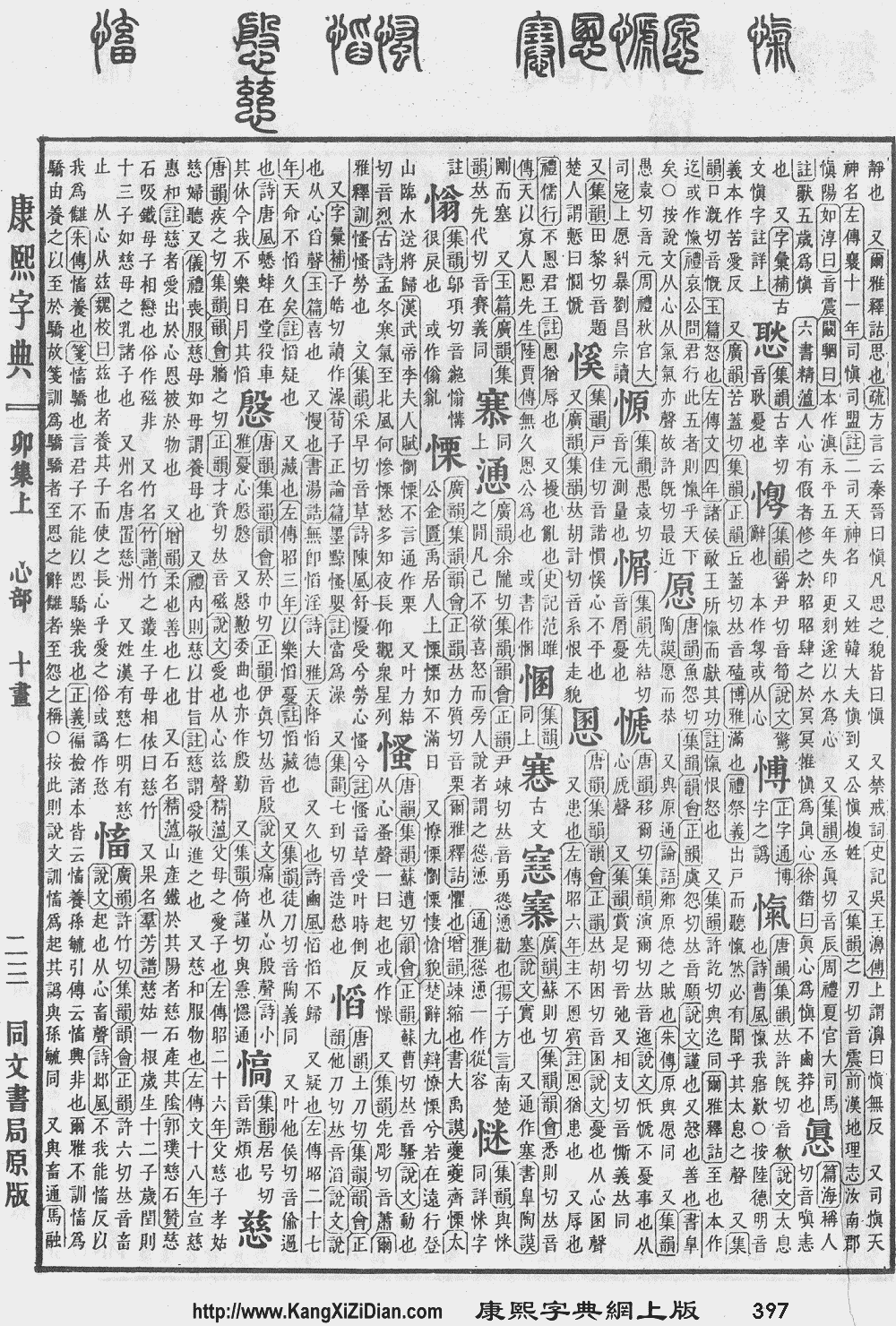
  • Kangxi Dictionary: page 397, character 5
  • Dai Kanwa Jiten: character 11029
  • Dae Jaweon: page 736, character 1
  • Hanyu Da Zidian (first edition): volume 4, page 2337, character 5
  • Unihan data for U+613E

Chinese

trad. 愾
simp. 忾

Glyph origin

Pronunciation 1


Rime
Character 愾
Reading # 2/2
Initial (聲) 溪 (29)
Final (韻) 咍 (41)
Tone (調) Departing (H)
Openness (開合) Open
Division (等) I
Fanqie 苦蓋切
Baxter khojH
Reconstructions
Zhengzhang
Shangfang
/kʰʌiH/
Pan
Wuyun
/kʰəiH/
Shao
Rongfen
/kʰɒiH/
Edwin
Pulleyblank
/kʰəjH/
Li
Rong
/kʰᴀiH/
Wang
Li
/kʰɒiH/
Bernard
Karlgren
/kʰɑ̆iH/
Expected
Mandarin
Reflex
kài
Expected
Cantonese
Reflex
hoi3
Baxter–Sagart system 1.1 (2014)
Character 愾
Reading # 1/1
Modern
Beijing
(Pinyin)
kài
Middle
Chinese
‹ xjɨjH ›
Old
Chinese
/*qʰəp-s/
English sigh; angry

Notes for Old Chinese notations in the Baxter–Sagart system:

* Parentheses "()" indicate uncertain presence;
* Square brackets "[]" indicate uncertain identity, e.g. *[t] as coda may in fact be *-t or *-p;
* Angle brackets "<>" indicate infix;
* Hyphen "-" indicates morpheme boundary;

* Period "." indicates syllable boundary.
Zhengzhang system (2003)
Character 愾
Reading # 1/2
No. 10136
Phonetic
component
气
Rime
group
隊
Rime
subdivision
1
Corresponding
MC rime
磕
Old
Chinese
/*kʰɯːds/

Definitions

愾

  1. (literary) to hate; to resent; to be angry

Compounds

Pronunciation 2


Rime
Character 愾
Reading # 1/2
Initial (聲) 曉 (32)
Final (韻) 微 (20)
Tone (調) Departing (H)
Openness (開合) Open
Division (等) III
Fanqie 許旣切
Baxter xj+jH
Reconstructions
Zhengzhang
Shangfang
/hɨiH/
Pan
Wuyun
/hɨiH/
Shao
Rongfen
/xiəiH/
Edwin
Pulleyblank
/hɨjH/
Li
Rong
/xiəiH/
Wang
Li
/xĭəiH/
Bernard
Karlgren
/xe̯iH/
Expected
Mandarin
Reflex
xì
Expected
Cantonese
Reflex
hei3
Baxter–Sagart system 1.1 (2014)
Character 愾
Reading # 1/1
Modern
Beijing
(Pinyin)
kài
Middle
Chinese
‹ xjɨjH ›
Old
Chinese
/*qʰəp-s/
English sigh; angry

Notes for Old Chinese notations in the Baxter–Sagart system:

* Parentheses "()" indicate uncertain presence;
* Square brackets "[]" indicate uncertain identity, e.g. *[t] as coda may in fact be *-t or *-p;
* Angle brackets "<>" indicate infix;
* Hyphen "-" indicates morpheme boundary;

* Period "." indicates syllable boundary.
Zhengzhang system (2003)
Character 愾
Reading # 2/2
No. 10145
Phonetic
component
气
Rime
group
隊
Rime
subdivision
1
Corresponding
MC rime
Old
Chinese
/*qʰɯds/

Definitions

愾

  1. † to sigh

Compounds

  • 愾歎/忾叹
  • 愾然/忾然

References

Japanese

Kanji

愾

(uncommon “Hyōgai” kanji)

  1. This term needs a translation to English. Please help out and add a translation, then remove the text {{rfdef}}.

Readings

Korean

Hanja

愾 • (gae, hui) (hangeul 개, 희, revised gae, hui, McCune–Reischauer kae, hŭi, Yale kay, huy)

  1. This term needs a translation to English. Please help out and add a translation, then remove the text {{rfdef}}.

Vietnamese

Han character

愾: Hán Nôm readings: khái

  1. This term needs a translation to English. Please help out and add a translation, then remove the text {{rfdef}}.

References

This article is issued from Wiktionary. The text is licensed under Creative Commons - Attribution - Sharealike. Additional terms may apply for the media files.