蓋
See also: 盖
| ||||||||
Translingual
Han character
蓋 (Kangxi radical 140, 艸+10, 14 strokes in traditional Chinese and Korean, 13 strokes in mainland China and Japanese, cangjie input 廿土戈廿 (TGIT), four-corner 44107, composition ⿱艹盍)
Derived characters
References
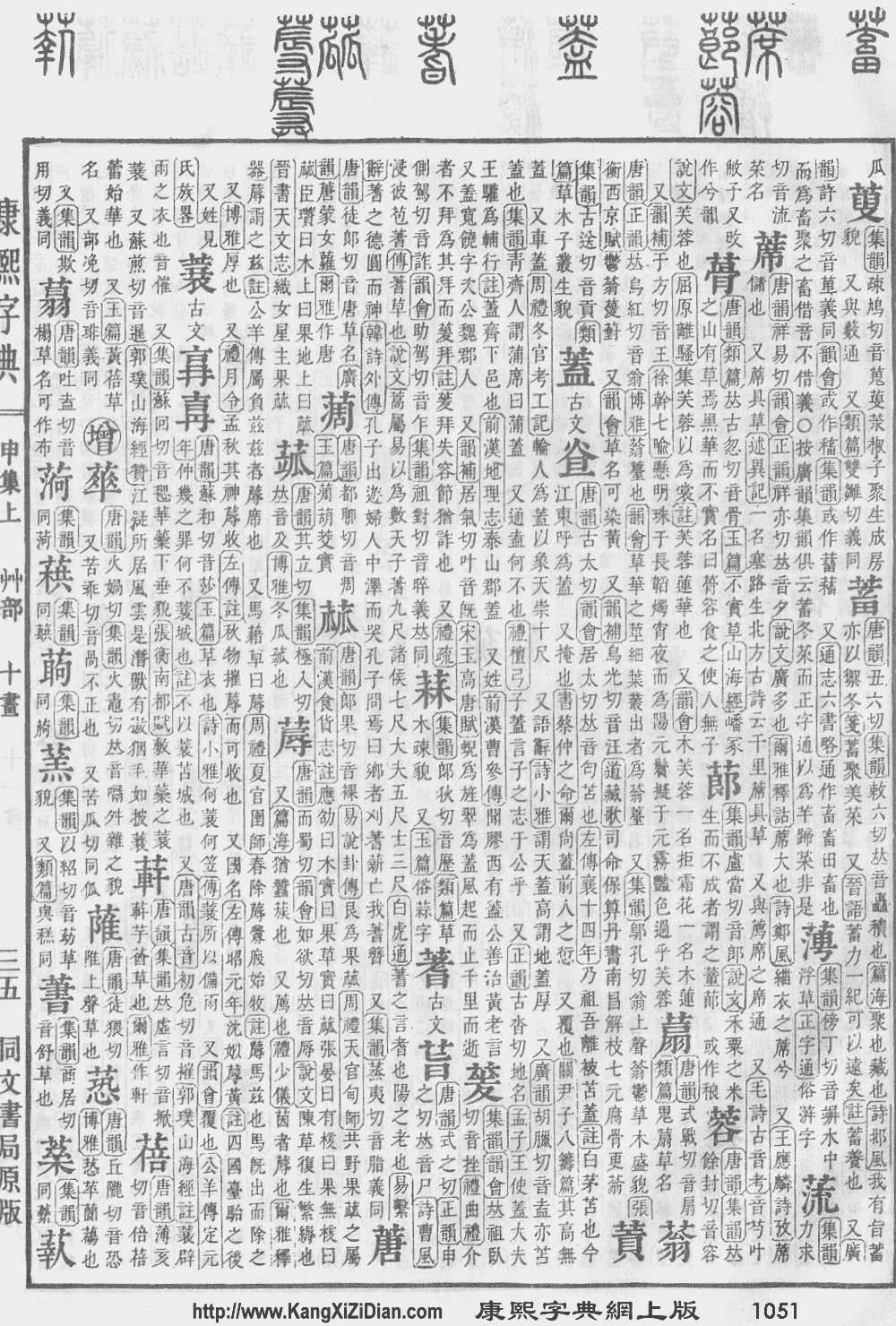
- Kangxi Dictionary: page 1051, character 12
- Dai Kanwa Jiten: character 31652
- Dae Jaweon: page 1513, character 9
- Hanyu Da Zidian (first edition): volume 5, page 3260, character 13
- Unihan data for U+84CB
Chinese
| trad. | 蓋 | |
|---|---|---|
| simp. | 盖 | |
| alternative forms | 乢 匼 葢 盖 | |
Glyph origin
| Historical forms of the character 蓋 | |||
|---|---|---|---|
| Western Zhou | Warring States | Shuowen Jiezi (compiled in Han) | Liushutong (compiled in Ming) |
| Bronze inscriptions | Chu slip and silk script | Small seal script | Transcribed ancient scripts |
 |
 |
 |
 |
Characters in the same phonetic series (盍) (Zhengzhang, 2003)
Phono-semantic compound (形聲/形声, OC *kaːbs, *kaːb, *ɡaːb) : semantic 艸 (“grass”) + phonetic 盍 (OC *ɡaːb) — a thatch.
盍 is the original character for the “cover” sense. However, because this original character was borrowed to mean “why not”, the scope of senses for 蓋 expanded to include the “cover” sense (and its extended meanings).
Pronunciation 1
Definitions
蓋
- to cover; to conceal
- 蓋被/盖被 [Hokkien] ― kah-phōe [Pe̍h-ōe-jī] ― to put on a blanket
- (figurative) to cover up; to conceal
- (Southern Min) to put on; to apply
- to stamp; to affix (a seal)
- to overwhelm; to surpass
- to build; to construct
- to talk nonsense; to chatter; to brag; to boast; to bluff
- cover; cap; lid
- shell (of a turtle, crab, etc.)
- † thatch; straw mat
- † canopy
- (dialectal) excellent; fantastic
- (Zhangzhou and Taiwanese Hokkien, Southern Sixian Hakka) very
- 該係蓋久蓋久个以前,𠊎還蓋細蓋細个時節,𠊎還蓋細蓋細个時節 [Sixian Hakka, trad.]
- From: 2006, 林姿君, 匍背 (Hunchback)
- Te he koi kiú koi kiú e yî-chhièn, ngài hàn koi se koi se e sṳ̀-chiet, ngài hàn koi se koi se e sṳ̀-chiet [Pha̍k-fa-sṳ]
- That is a very, very long time ago, when I was still very, very small, when I was still very, very small.
该系盖久盖久个以前,𠊎还盖细盖细个时节,𠊎还盖细盖细个时节 [Sixian Hakka, simp.]
- † probably; roughly
- † for; because
- a surname
Synonyms
Dialectal synonyms of 蓋 (“to cover; to conceal”) [map]
| Variety | Location | Words |
|---|---|---|
| Formal (Written Standard Chinese) | 蓋 | |
| Mandarin | Beijing | 蓋 |
| Taiwan | 蓋 | |
| Jinan | 蓋 | |
| Xi'an | 蓋 | |
| Wuhan | 蓋, 㝩, 垛 | |
| Chengdu | 蓋, 㝩 | |
| Yangzhou | 蓋 | |
| Hefei | 蓋 | |
| Singapore | 蓋 | |
| Cantonese | Guangzhou | 蓋, 冚, 扱 |
| Hong Kong | 冚, 扱 | |
| Yangjiang | 扱 | |
| Gan | Nanchang | 蓋, 㔶, 盍 |
| Hakka | Meixian | 蓋, 弇 |
| Miaoli (N. Sixian) | 弇 | |
| Pingtung (Neipu; S. Sixian) | 弇 | |
| Hsinchu County (Zhudong; Hailu) | 弇 | |
| Taichung (Dongshi; Dabu) | 弇 | |
| Hsinchu County (Qionglin; Raoping) | 弇 | |
| Yunlin (Lunbei; Zhao'an) | 揜 | |
| Jin | Taiyuan | 蓋 |
| Northern Min | Jian'ou | 㔶𱔴 |
| Eastern Min | Fuzhou | 㔶, 㪠 |
| Southern Min | Xiamen | 崁 |
| Quanzhou | 崁 | |
| Zhangzhou | 崁 | |
| Singapore (Hokkien) | 崁 | |
| Chaozhou | 蓋, 崁 | |
| Shantou | 蓋 | |
| Jieyang | 蓋, 崁 | |
| Wu | Suzhou | 蓋 |
| Wenzhou | 㔶, 蓋 | |
| Xiang | Changsha | 蓋 |
| Shuangfeng | 蓋, 㔶 | |
Dialectal synonyms of 蓋 (“to build; to construct (a building)”) [map]
Dialectal synonyms of 蓋子 (“cover; lid”) [map]
| Variety | Location | Words |
|---|---|---|
| Formal (Written Standard Chinese) | 蓋子, 蓋 | |
| Mandarin | Beijing | 蓋兒, 蓋子 |
| Taiwan | 蓋子 | |
| Singapore | 蓋 | |
| Cantonese | Guangzhou | 蓋 |
| Hong Kong | 蓋 | |
| Hakka | Miaoli (N. Sixian) | 蓋仔 |
| Pingtung (Neipu; S. Sixian) | 蓋仔 | |
| Hsinchu County (Zhudong; Hailu) | 蓋仔 | |
| Taichung (Dongshi; Dabu) | 蓋 | |
| Hsinchu County (Qionglin; Raoping) | 蓋仔 | |
| Yunlin (Lunbei; Zhao'an) | 蓋 | |
| Jin | Taiyuan | 蓋蓋 |
| Southern Min | Xiamen | 蓋, 崁 |
| Quanzhou | 蓋, 崁 | |
| Zhangzhou | 蓋, 崁 | |
| Tainan | 蓋 | |
| Penang (Hokkien) | 蓋 | |
| Singapore (Hokkien) | 蓋, 崁 | |
| Shantou | 蓋 | |
| Jieyang | 蓋 | |
Dialectal synonyms of 很 (“very”) [map]
Compounds
- 上蓋/上盖
- 亂蓋/乱盖
- 依蓋爾其/依盖尔其 (Yīgài'ěrqí)
- 修蓋/修盖
- 傾蓋/倾盖 (qīnggài)
- 傾蓋定交/倾盖定交
- 傾蓋相逢/倾盖相逢
- 傾蓋而語/倾盖而语
- 冠蓋/冠盖
- 冠蓋如雲/冠盖如云
- 冠蓋相屬/冠盖相属
- 冠蓋相望/冠盖相望
- 冠蓋雲集/冠盖云集
- 冠蓋高舉/冠盖高举
- 劈頭蓋臉/劈头盖脸 (pītóugàiliǎn)
- 區蓋/区盖 (ōugài)
- 口蓋/口盖 (kǒugài)
- 天地蓋載/天地盖载
- 天靈蓋/天灵盖 (tiānlínggài)
- 寶蓋/宝盖 (bǎogài)
- 寶蓋山/宝盖山
- 屋下蓋屋/屋下盖屋
- 帷蓋/帷盖
- 帷蓋不棄/帷盖不弃
- 幡蓋/幡盖
- 幢蓋/幢盖
- 拔山蓋世/拔山盖世
- 捂捂蓋蓋/捂捂盖盖 (wǔwǔgàigài)
- 捂蓋子/捂盖子
- 掖掖蓋蓋/掖掖盖盖
- 掩蓋/掩盖 (yǎngài)
- 捲鋪蓋/卷铺盖
- 揭蓋兒/揭盖儿
- 揭蓋子/揭盖子
- 摀蓋/𰓆盖
- 搭蓋/搭盖 (dāgài)
- 敷蓋物/敷盖物
- 方底圓蓋/方底圆盖
- 旛蓋/旛盖
- 明鋪夜蓋/明铺夜盖
- 曲蓋/曲盖
- 朱轓皂蓋/朱𰺜皂盖
- 杭蓋/杭盖 (Hánggài)
- 欲蓋彌彰/欲盖弥彰 (yùgàimízhāng)
- 氣蓋山河/气盖山河
- 波羅蓋/波罗盖 (bōluógài)
- 油蓋/油盖
- 涵蓋/涵盖 (hángài)
- 渾蓋/浑盖
- 漫天蓋地/漫天盖地
- 瓶蓋/瓶盖 (pínggài)
- 磕膝蓋/磕膝盖
- 程孔傾蓋/程孔倾盖
- 穴寶蓋兒/穴宝盖儿
- 立馬蓋橋/立马盖桥
- 籠蓋/笼盖
- 羽蓋/羽盖
- 翠蓋/翠盖
- 翻蓋/翻盖 (fāngài)
- 膝蓋/膝盖 (xīgài)
- 膝蓋骨/膝盖骨 (xīgàigǔ)
- 臭蓋/臭盖
- 菌蓋/菌盖 (jūngài)
- 華蓋/华盖 (huágài)
- 蓋世/盖世 (gàishì)
- 蓋世之才/盖世之才
- 蓋世功勛/盖世功勋
- 蓋世太保/盖世太保 (Gàishìtàibǎo)
- 蓋世無雙/盖世无双
- 蓋世雄才/盖世雄才
- 蓋人/盖人
- 蓋代/盖代
- 蓋仙/盖仙
- 蓋住/盖住
- 蓋印/盖印 (gàiyìn)
- 蓋喧
- 蓋壤/盖壤
- 蓋天板/盖天板
- 蓋子/盖子 (gàizi)
- 蓋孜力克/盖孜力克 (Gàizīlìkè)
- 蓋孜庫木/盖孜库木 (Gàizīkùmù)
- 蓋帽/盖帽 (gàimào)
- 蓋愆/盖愆
- 蓋抹/盖抹
- 蓋柿/盖柿
- 蓋棺事定/盖棺事定
- 蓋棺論定/盖棺论定 (gàiguānlùndìng)
- 蓋火/盖火
- 蓋火鍋/盖火锅
- 蓋然性/盖然性 (gàiránxìng)
- 蓋盅兒/盖盅儿
- 蓋碗/盖碗 (gàiwǎn)
- 蓋老/盖老
- 蓋臉/盖脸
- 蓋菜/盖菜 (gàicài)
- 蓆蓋子/席盖子
- 蓋藏/盖藏
- 蓋覆/盖覆
- 蓋造/盖造
- 蓋闕/盖阙
- 蓋章/盖章 (gàizhāng)
- 蓋頭/盖头 (gàitou)
- 蓋飯/盖饭 (gàifàn)
- 覆蓋/覆盖 (fùgài)
- 跛羅蓋子/跛罗盖子
- 車蓋/车盖 (chēgài)
- 遮天蓋地/遮天盖地
- 遮天蓋日/遮天盖日
- 遮蓋/遮盖 (zhēgài)
- 鋪天蓋地/铺天盖地 (pūtiāngàidì)
- 鍋蓋/锅盖 (guōgài)
- 雨蓋/雨盖
- 靈蓋/灵盖
- 頭蓋骨/头盖骨 (tóugàigǔ)
- 飛蓋/飞盖
- 馬子蓋/马子盖
- 馬桶蓋/马桶盖 (mǎtǒnggài)
- 馬蓋先/马盖先
- 鰓蓋/鳃盖
- 鳳蓋/凤盖
- 麥蓋提/麦盖提 (Màigàití)
- 麾蓋/麾盖
- 黃旗紫蓋/黄旗紫盖
- 黃沙蓋面/黄沙盖面
- 黃蓋/黄盖 (huánggài)
- 鼎蓋/鼎盖 (tiáⁿ-kòa) (Min Nan)
See also
- 捂 (wǔ)
Descendants
- → Japanese: 蓋し (kedashi) (calque)
Pronunciation 2
Definitions
蓋
Pronunciation
Definitions
蓋
- (~邑) (historical) Ge (a city in the ancient state of Qi in modern-day Yishui County, Shandong)
- a surname
Pronunciation
Definitions
蓋
- (obsolete) Alternative form of 盍 (hé, “how; why”)
- (obsolete) Alternative form of 盍 (hé, “why not”)
- 晉獻公將殺其世子申生,公子重耳謂之曰:「子蓋言子之志於公乎?」 [Classical Chinese, trad.]
- From: The Book of Rites, c. 4th – 2nd century BCE
- Jìn Xiàn Gōng jiāng shā qí shì zǐ Shēnshēng, gōngzǐ Chóng'ěr wèi zhī yuē: “Zǐ hé yán zǐ zhī zhì yú gōng hū?” [Pinyin]
- Duke Xian of Jin, intending to put to death his heir-son Shen-sheng, another son, Chong-er, said to the latter, "Why do you not tell what is in your mind to the duke?"
晋献公将杀其世子申生,公子重耳谓之曰:「子盖言子之志于公乎?」 [Classical Chinese, simp.]- 子貢曰:「夫子之道至大也,故天下莫能容夫子。夫子蓋少貶焉?」 [Classical Chinese, trad.]
- From: The Records of the Grand Historian, by Sima Qian, c. 91 BCE
- Zǐgòng yuē: “Fūzǐ zhī dào zhì dà yě, gù tiānxià mò néng róng fūzǐ. Fūzǐ hé shǎo biǎn yān?” [Pinyin]
- Zigong said, "Master, your philosophy is the greatest, and thus no one in the world can accept you. Why do you, Master, not slightly lower your standards?"
子贡曰:「夫子之道至大也,故天下莫能容夫子。夫子盖少贬焉?」 [Classical Chinese, simp.]
Pronunciation
References
- “Entry #10820”, in 臺灣閩南語常用詞辭典 [Dictionary of Frequently-Used Taiwan Minnan] (overall work in Mandarin and Hokkien), Ministry of Education, R.O.C., 2023.
Japanese
Readings
Etymology
| Kanji in this term |
|---|
| 蓋 |
| ふた Grade: S |
| kun’yomi |
From Old Japanese. Used in the Man'yōshū of circa 759 CE to phonetically spell Mount Futagami as 蓋上山. In turn, from Proto-Japonic *pota.
Noun
蓋 or 蓋 • (futa)
- lid; cap; cover; (malacology) operculum
- 箱のふた ― hako no futa ― box lid
- ビンの蓋 ― bin no futa ― cap of a bottle
References
- Matsumura, Akira, editor (2006), 大辞林 [Daijirin] (in Japanese), Third edition, Tōkyō: Sanseidō, →ISBN
Vietnamese
This article is issued from Wiktionary. The text is licensed under Creative Commons - Attribution - Sharealike. Additional terms may apply for the media files.