旅
| ||||||||
 | ||||||||
Translingual
Han character
旅 (Kangxi radical 70, 方+6, 10 strokes, cangjie input 卜尸人竹女 (YSOHV), four-corner 08232, composition ⿸𭤨⿸⿱丿𠄌⿺乀丿 or ⿰方⿱𠂉𧘇)
References
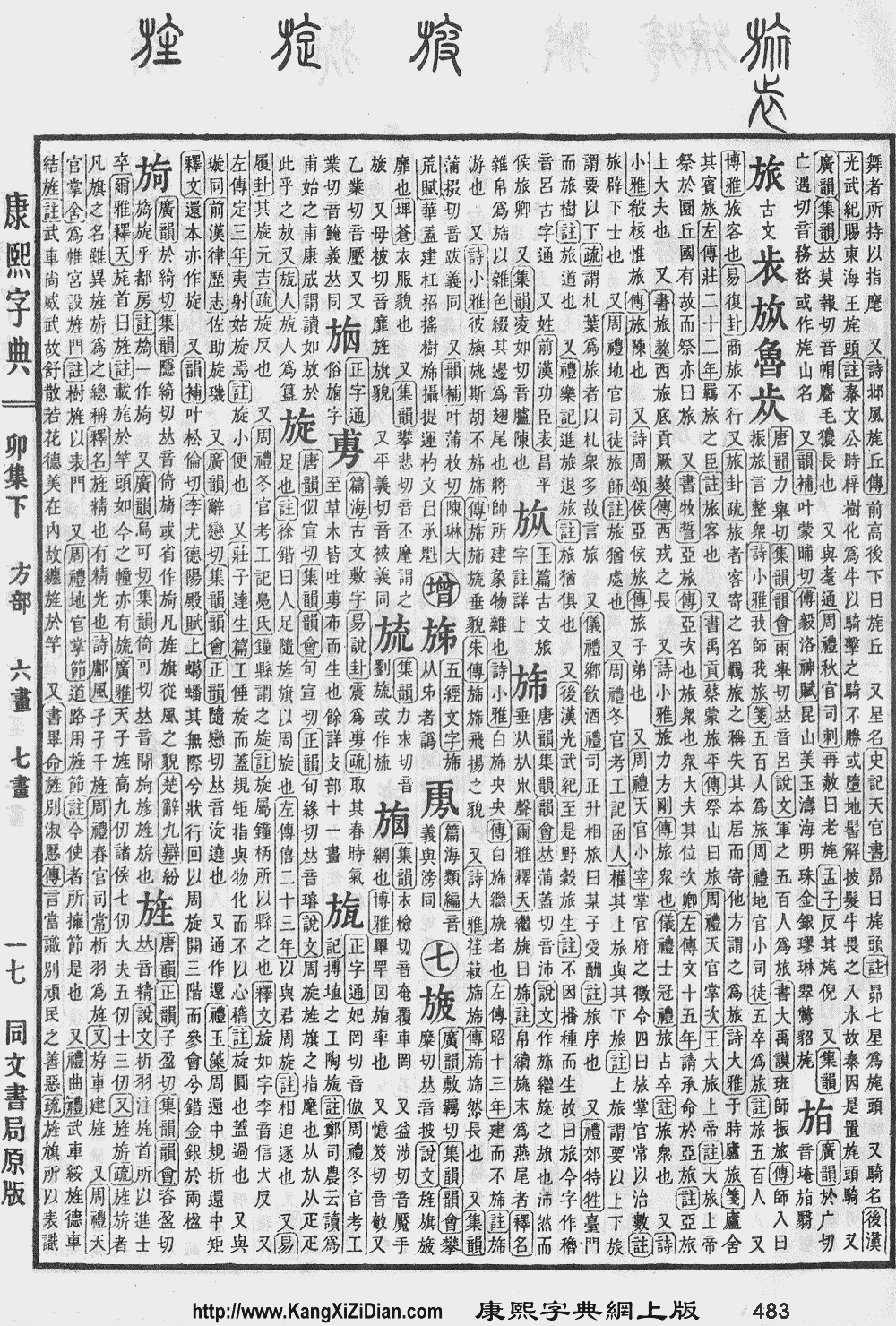
- Kangxi Dictionary: page 483, character 2
- Dai Kanwa Jiten: character 13644
- Dae Jaweon: page 845, character 2
- Hanyu Da Zidian (first edition): volume 3, page 2178, character 7
- Unihan data for U+65C5
- Unihan data for U+F983
Bailang
Etymology
Compare Burmese လဲ (lai:, “to change”), Old Chinese 易 (OC *leɡ).
Chinese
| simp. and trad. |
旅 | |
|---|---|---|
| 2nd round simp. | 吕 | |
| alternative forms | 祣 | |
Glyph origin
| Historical forms of the character 旅 | |||
|---|---|---|---|
| Shang | Western Zhou | Shuowen Jiezi (compiled in Han) | Liushutong (compiled in Ming) |
| Oracle bone script | Bronze inscriptions | Small seal script | Transcribed ancient scripts |
 |
 |
 |
 |
Ideogrammic compound (會意/会意) : 㫃 (“flag”) + 从 (“together”) – brigade.
Etymology
- anything lined up in a regular fashion > one after another > line up in a row, set forth; troops, multitude
- From Proto-Sino-Tibetan *g-ra-t (“bone”) (STEDT, Schuessler, 2007)
- guest, stranger, lodging
- Unrelated to sense ‘arrange in a series, etc.’ but from Proto-Sino-Tibetan *d-gra (“stranger, enemy”) (STEDT; Bodman, 1980; Schuessler, 2007); Schuessler additionally thinks this may belong to a larger group which includes 格 (OC *klaːɡ, *kraːɡ, “to go, to come”).
Pronunciation
Definitions
旅
- (military) brigade
- † army; troops
- † an army consisting of 500 soldiers
- 我徒我御,我師我旅。 [Pre-Classical Chinese, trad.]
- From: The Classic of Poetry, c. 11th – 7th centuries BCE, translated based on James Legge's version
- Wǒ tú wǒ yù, wǒ shī wǒ lǚ. [Pinyin]
- We went along on foot; we rode in our chariots; our 2500-strong regiment, and our 500-strong battalions.
我徒我御,我师我旅。 [Pre-Classical Chinese, simp.]
- † traveller
- 旅貞吉也。 [Pre-Classical Chinese, trad.]
- From: I Ching, 11th – 8th century BCE, translated based on James Legge's version
- Lǚ zhēn jí yě. [Pinyin]
- If the stranger or traveller be firm and correct as he ought to be, there will be good fortune.
旅贞吉也。 [Pre-Classical Chinese, simp.]
- journey; trip
- † hotel
- to travel
- 56th hexagram of the I Ching
- a surname
Usage notes
- (military): Under the National Revolutionary Army, a brigade was composed of two regiments (團). In turn, two brigades formed a division (整編師), a square division.
Compounds
- 一成一旅
- 住宅旅社
- 公文旅行
- 勁旅/劲旅 (jìnglǜ)
- 商旅 (shānglǚ)
- 商旅店
- 單車旅行/单车旅行
- 套裝旅遊/套装旅游 (tàozhuāng lǚyóu)
- 客旅
- 差旅費/差旅费 (chāilǚfèi)
- 師旅/师旅
- 庭實旅百/庭实旅百
- 徒步旅行
- 振旅
- 文件旅遊/文件旅游
- 旅人 (lǚrén)
- 旅人蕉
- 旅伴 (lǚbàn)
- 旅力
- 旅夜書懷/旅夜书怀
- 旅客 (lǚkè)
- 旅居 (lǚjū)
- 旅店 (lǚdiàn)
- 旅思
- 旅次
- 旅歷/旅历
- 旅生
- 旅社 (lǚshè)
- 旅祉
- 旅程 (lǚchéng)
- 旅舍 (lǚshè)
- 旅行 (lǚxíng)
- 旅行劇團/旅行剧团
- 旅行包
- 旅行團/旅行团 (lǚxíngtuán)
- 旅行支票 (lǚxíng zhīpiào)
- 旅行社 (lǚxíngshè)
- 旅行車/旅行车 (lǚxíngchē)
- 旅費/旅费 (lǚfèi)
- 旅途 (lǚtú)
- 旅進旅退/旅进旅退
- 旅遊/旅游 (lǚyóu)
- 旅遊手冊/旅游手册
- 旅遊業/旅游业 (lǚyóuyè)
- 旅邸
- 旅酬
- 旅長/旅长 (lǚzhǎng)
- 旅順/旅顺 (Lǚshùn)
- 旅食
- 旅館/旅馆 (lǚguǎn)
- 旅館業/旅馆业
- 旅鼠 (lǚshǔ)
- 汽車旅館/汽车旅馆 (qìchē lǚguǎn)
- 畢業旅行/毕业旅行
- 知性之旅
- 羇旅
- 羈旅/羁旅 (jīlǚ)
- 自主旅遊/自主旅游
- 自助旅行
- 自助旅遊/自助旅游
- 虎旅
- 行旅
- 觀光旅館/观光旅馆
- 賓旅/宾旅
- 赤軍旅/赤军旅
- 軍旅/军旅 (jūnlǚ)
- 逆旅 (nìlǚ)
- 陳師鞠旅/陈师鞠旅
- 鞠旅
Japanese
| Shinjitai | 旅 |  |
| Kyūjitai [1][2][3] |
旅 旅or 旅+ ︀? |
|
| 旅󠄁 旅+ 󠄁?(Adobe-Japan1) | ||
| 旅󠄃 旅+ 󠄃?(Hanyo-Denshi) (Moji_Joho) | ||
| The displayed kanji may be different from the image due to your environment. See here for details. | ||
Alternative forms
Readings
Compounds
- 旅先 (tabisaki, “destination”)
- 旅路 (tabiji, “route, itinerary; journey”)
- 旅立ち (tabidachi, “departure (on a trip)”)
- 旅人 (tabibito, “traveller”)
- 旅衣 (ryoi)
- 旅逸 (ryoitsu)
- 旅飲 (ryoin)
- 旅鬱 (ryōtsu)
- 旅懐 (ryokai)
- 旅客 (ryokaku, “passenger”)
- 旅宦 (ryokan)
- 旅館 (ryokan, “inn”)
- 旅雁 (ryogan)
- 旅客 (ryokyaku)
- 旅況 (ryokyō)
- 旅銀 (ryogin)
- 旅具 (ryogu)
- 旅寓 (ryogū)
- 旅見 (ryoken)
- 旅券 (ryoken, “passport”)
- 旅行 (ryokō, “trip, travel, voyage”)
- 旅魂 (ryokon)
- 旅恨 (ryokon)
- 旅祭 (ryosai)
- 旅思 (ryoshi)
- 旅次 (ryoji)
- 旅舎 (ryosha)
- 旅愁 (ryoshū)
- 旅酬 (ryoshū)
- 旅宿 (ryoshuku)
- 旅順 (Ryojun)
- 旅商 (ryoshō)
- 旅情 (ryojō)
- 旅食 (ryoshoku)
- 旅信 (ryoshin)
- 旅人 (ryojin)
- 旅炊 (ryosui)
- 旅帥 (ryosui)
- 旅生 (ryosei)
- 旅荘 (ryosō)
- 旅装 (ryosō)
- 旅僧 (ryosō)
- 旅大 (Ryodai)
- 旅団 (ryodan, “brigade”)
- 旅中 (ryochū)
- 旅鳥 (ryochō)
- 旅枕 (ryochin)
- 旅陳 (ryochin)
- 旅程 (ryotei)
- 旅亭 (ryotei)
- 旅店 (ryoten)
- 旅途 (ryoto)
- 旅囊 (ryonō)
- 旅泊 (ryohaku)
- 旅伴 (ryohan)
- 旅費 (ryohi, “travel expenses”)
- 旅夢 (ryomu)
- 旅夜 (ryoya)
- 旅用 (ryoyō)
- 旅路 (ryoryo)
- 旅力 (ryoryoku) (膂力)
- 亜旅 (aryo)
- 逸旅 (itsuryo)
- 客旅 (kakuryo)
- 羇旅, 羈旅 (kiryo)
- 彊旅 (kyōryo)
- 軍旅 (gunryo)
- 逆旅 (gekiryo)
- 行旅 (kōryo)
- 戎旅 (jūryo)
- 師旅 (shiryo)
- 商旅 (shōryo)
- 振旅 (shinryo)
- 晨旅 (shinryo)
- 征旅 (seiryo)
- 儔旅
- 賓旅 (hinryo)
- 船旅 (funatabi, “traveling by boat; cruise”)
- 遊旅 (yūryo)
- 盧旅 (roryo)
Etymology 1
| Kanji in this term |
|---|
| 旅 |
| りょ Grade: 3 |
| kan’on |
From Middle Chinese 旅 (MC ljoX, “a military unit of 500 men; to go [on a sortie; on a trip or journey]”).
Noun
- in ancient China, a military unit of 500 soldiers
- one of the I Ching hexagrams: sojourning (I Ching hexagram interpretation on Wikipedia here)
Usage notes
The prefix usage only ever appears in kanji compounds.
Etymology 2
| Kanji in this term |
|---|
| 旅 |
| たび Grade: 3 |
| kun’yomi |
/tabi1/ → /tabi/
From Old Japanese.[5] Appears in the Man'yōshū, completed no earlier than 759 and one of the oldest extant texts in the Japanese language.
May be cognate with 度 (tabi, “the time when something happens”); both terms have the same pitch accent, the same ancient vowel values, and some semantic overlap.
Noun
Conjugation
| Katsuyōkei ("stem forms") | ||||
|---|---|---|---|---|
| Mizenkei ("imperfective") | 旅し | たびし | tabi shi | |
| Ren’yōkei ("continuative") | 旅し | たびし | tabi shi | |
| Shūshikei ("terminal") | 旅する | たびする | tabi suru | |
| Rentaikei ("attributive") | 旅する | たびする | tabi suru | |
| Kateikei ("hypothetical") | 旅すれ | たびすれ | tabi sure | |
| Meireikei ("imperative") | 旅せよ¹ 旅しろ² |
たびせよ¹ たびしろ² |
tabi seyo¹ tabi shiro² | |
| Key constructions | ||||
| Passive | 旅される | たびされる | tabi sareru | |
| Causative | 旅させる 旅さす |
たびさせる たびさす |
tabi saseru tabi sasu | |
| Potential | 旅できる | たびできる | tabi dekiru | |
| Volitional | 旅しよう | たびしよう | tabi shiyō | |
| Negative | 旅しない | たびしない | tabi shinai | |
| Negative continuative | 旅せず | たびせず | tabi sezu | |
| Formal | 旅します | たびします | tabi shimasu | |
| Perfective | 旅した | たびした | tabi shita | |
| Conjunctive | 旅して | たびして | tabi shite | |
| Hypothetical conditional | 旅すれば | たびすれば | tabi sureba | |
| ¹ Written imperative ² Spoken imperative | ||||
References
- 白川静 (Shirakawa Shizuka) (2014) “旅”, in 字通 (Jitsū) (in Japanese), popular edition, Tōkyō: Heibonsha, →ISBN
- Haga, Gōtarō (1914) 漢和大辞書 [The Great Kanji-Japanese Dictionary] (in Japanese), Fourth edition, Tōkyō: Kōbunsha, , page 1042 (paper), page 572 (digital)
- Shōundō Henshūjo, editor (1927), 新漢和辞典 [The New Kanji-Japanese Dictionary] (in Japanese), Ōsaka: Shōundō, , page 632 (paper), page 329 (digital)
- Matsumura, Akira, editor (2006), 大辞林 [Daijirin] (in Japanese), Third edition, Tōkyō: Sanseidō, →ISBN
- Shōgaku Tosho (1988) 国語大辞典(新装版) [Unabridged Dictionary of Japanese (Revised Edition)] (in Japanese), Tōkyō: Shogakukan, →ISBN
- Yamada, Tadao et al., editors (2011), 新明解国語辞典 [Shin Meikai Kokugo Jiten] (in Japanese), Seventh edition, Tōkyō: Sanseidō, →ISBN
Korean
Etymology
From Middle Chinese 旅 (MC ljoX). Recorded as Middle Korean 려 (lye) (Yale: lye) in Hunmong Jahoe (訓蒙字會 / 훈몽자회), 1527.