也
| ||||||||
Translingual
| Stroke order | |||
|---|---|---|---|
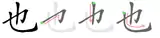 | |||
| Stroke order | |||
|---|---|---|---|
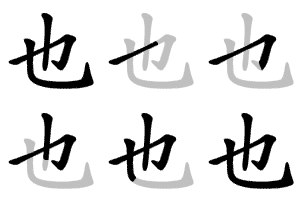 | |||
Han character
也 (Kangxi radical 5, 乙+2, 3 strokes, cangjie input 心木 (PD), four-corner 44712, composition ⿻乜丨)
Derived characters
Descendants
- ㄝ (Zhuyin alphabet)
- ㆤ (Zhuyin alphabet)
- や (Hiragana character derived from Man'yōgana)
- ヤ (Katakana character derived from Man'yōgana)
References
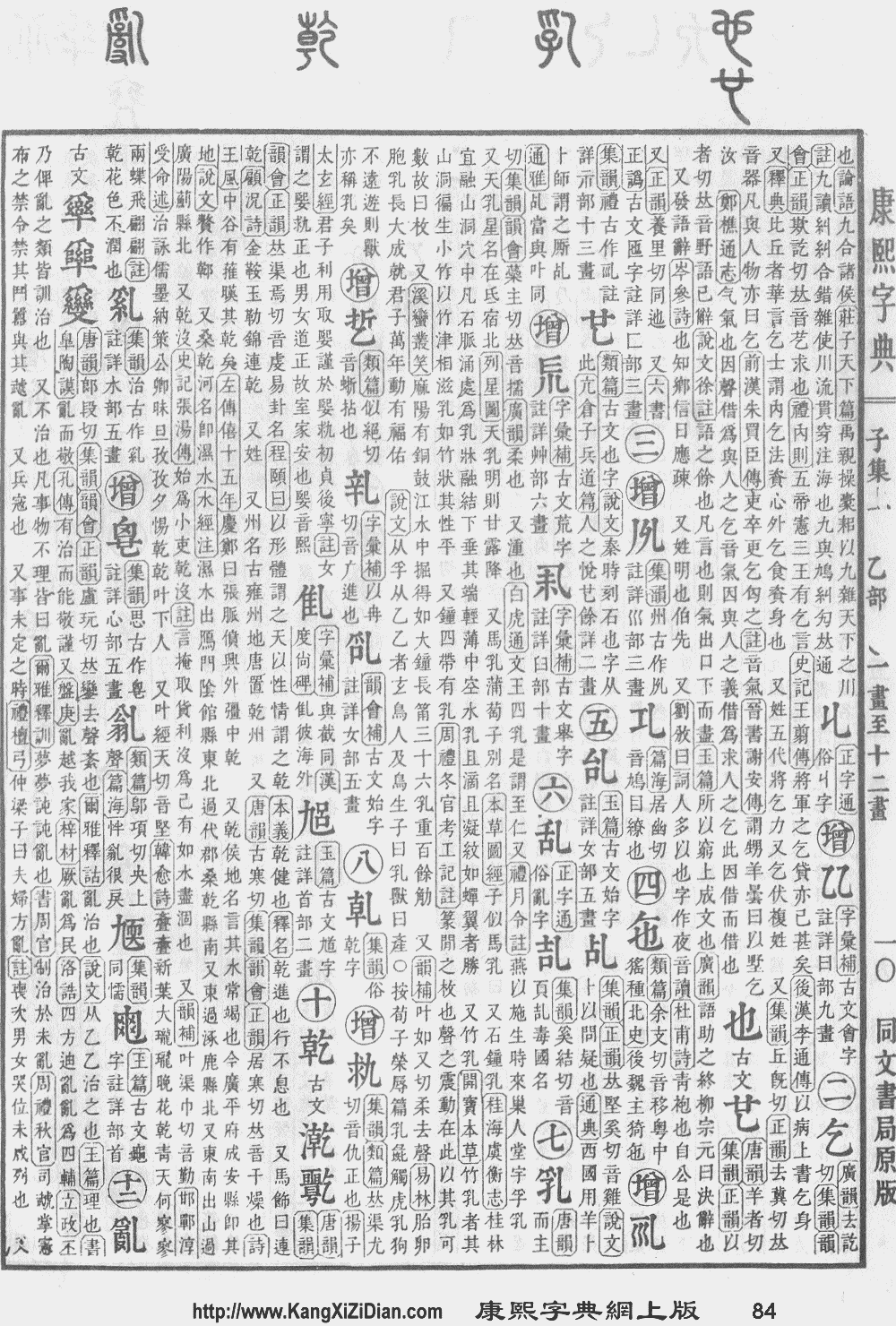
- Kangxi Dictionary: page 84, character 4
- Dai Kanwa Jiten: character 171
- Dae Jaweon: page 170, character 4
- Hanyu Da Zidian (first edition): volume 1, page 50, character 5
- Unihan data for U+4E5F
Chinese
| trad. | 也 | |
|---|---|---|
| simp. # | 也 | |
| alternative forms | ||
Glyph origin
| Historical forms of the character 也 | ||||||||||||||||
|---|---|---|---|---|---|---|---|---|---|---|---|---|---|---|---|---|
| Spring and Autumn | Warring States | Shuowen Jiezi (compiled in Han) | Liushutong (compiled in Ming) | |||||||||||||
| Bronze inscriptions | Chu slip and silk script | Small seal script | Transcribed ancient scripts | |||||||||||||
 |
 |
 |
 | |||||||||||||
|||
|
References: Mostly from Richard Sears' Chinese Etymology site (authorisation),
| ||||||||||||||||


| Old Chinese | |
|---|---|
| 他 | *l̥ʰaːl |
| 拖 | *l̥ʰaːl, *l̥ʰaːls |
| 駞 | *l'aːl |
| 池 | *l'aːl, *l'al |
| 灺 | *ljalʔ |
| 鍦 | *ɦljaːl, *hljal, *hljals |
| 虵 | *ɦljal, *laːlʔ, *lal |
| 也 | *laːlʔ |
| 忚 | *hleːl |
| 髢 | *l'eːls |
| 杝 | *l̥ʰalʔ, *l'alʔ, *lal |
| 肔 | *l̥ʰalʔ, *lalʔ |
| 馳 | *l'al |
| 阤 | *l'alʔ, *hljalʔ |
| 施 | *hljal, *hljals |
| 絁 | *hljal |
| 葹 | *hljal |
| 弛 | *hljalʔ |
| 箷 | *lal |
| 衪 | *lel, *lalʔ |
| 暆 | *lel |
| 迆 | *lal, *lalʔ |
| 酏 | *lal, *lalʔ |
| 匜 | *lal, *lalʔ |
| 迤 | *lalʔ |
| 扡 | *lalʔ |
| 崺 | *lalʔ |
| 貤 | *lals, *ɦljels, *lels |
| 地 | *l'els |
Uncertain. There are various possible explanations:
- The traditional glyph origin given in Shuowen explains the character to be a pictogram (象形) of female genitalia.
- It is possibly a pictogram (象形) of an ancient funnel or wash basin. It may be an early form of 匜.
- It was once interchangeable with 它 and may have originated as a simplification.
- It may have been created to represent the modal particle (語氣詞/语气词 (yǔqìcí)). In some bronze inscriptions, it appears to be a mouth (口) with a curved line descending from it to represent air coming out of the mouth.
- It may have signified a big-headed scorpion with its legs flattened, signifying as something very "flat" or "stretched out".
Etymology
- classical sentence-ending copulative particle, topic particle
Unclear. Possibly Sino-Tibetan, connectable to Tibetan ལ (la), which is often used as a marker (for oblique locative, dative, possessor in constructions with a copula verb, etc.) but also a topicalizer like ནི (ni, “as for”) (Schuessler, 2007).
On the other hand, Pulleyblank (1995) notes the similarity with anteclassical 唯 (OC *ɢʷi) as a copula and a topicalizer.
- also, too, as well
This etymology is incomplete. You can help Wiktionary by elaborating on the origins of this term.
Pronunciation
Definitions
也
- also; too; as well; (in negative sentences) neither; either
- Used for emphasis.
- (Classical) Particle used at the end of copular constructions involving a nominal predicate; to be (although not grammatically a verb)
- 我亦人也。 [Literary Chinese] ― Wǒ yì rén yě. [Pinyin] ― I am a person, too.
- Often used more loosely than the English copula to indicate a cause or relation.
- 桀紂之失天下也,失其民也;失其民者,失其心也。 [Classical Chinese, trad.]
- From: Mencius, c. 4th century BCE
- Jié Zhòu zhī shī tiānxià yě, shī qí mín yě; shī qí mín zhě, shī qí xīn yě. [Pinyin]
- That Jie and Zhou lost the empire was because they lost their people; that they lost their people was because they lost their hearts.
桀纣之失天下也,失其民也;失其民者,失其心也。 [Classical Chinese, simp.]
- (Classical) Topic-marking particle used at the end of noun phrases.
- Synonym: 者 (zhě)
- 人之生也,固若是芒乎!其我獨芒,而人亦有不芒者乎! [Classical Chinese, trad.]
- From: Zhuangzi, circa 3rd – 2nd centuries BCE
- Rén zhī shēng yě, gù ruò shì máng hū! Qí wǒ dú máng, ér rén yì yǒu bù máng zhě hū! [Pinyin]
- As for a man's life, is it hazy like this all along? Or is it mine alone which is hazy, and there are others who are not?
人之生也,固若是芒乎!其我独芒,而人亦有不芒者乎! [Classical Chinese, simp.]- 凡法術之難行也,不獨萬乘,千乘亦然。 [Classical Chinese, trad.]
- From: Han Feizi, circa 2nd century BCE
- Fán fǎshù zhī nán xíng yě, bù dú wànchéng, qiānchéng yì rán. [Pinyin]
- Generally concerning the difficulty of carrying out the law, not only the imperial realm but kingdoms are also [faced with] this.
凡法术之难行也,不独万乘,千乘亦然。 [Classical Chinese, simp.]
- when, at the time of; especially commonly used for temporal topics, often as 及其……也.
- 昔者,魯昭公少喪其母,有慈母良。及其死也,公弗忍也。 [Classical Chinese, trad.]
- From: The Book of Rites, c. 4th – 2nd century BCE
- Xīzhě, Lǔ Zhāogōng shào sàng qí mǔ, yǒu címǔ liáng. Jí qí sǐ yě, gōng fú rěn yě. [Pinyin]
- Duke Zhao of Lu was once bereaved of his mother when he was a child, and had a foster mother who was kind. When she died, the Duke could not bear it.
昔者,鲁昭公少丧其母,有慈母良。及其死也,公弗忍也。 [Classical Chinese, simp.]
- (Classical) Verb phrase-final particle marking continuous aspect, especially common for assertions of unchanging fact.
- 當是之時,堅車良馬不知貴也,刻鏤文采不知喜也。 [Classical Chinese, trad.]
- From: Mozi, c. 4th century BCE
- Dāngshì zhī shí, jiānchē liángmǎ bù zhī guì yě, kèlòu wéncǎi bù zhī xǐ yě. [Pinyin]
- In that age, they did not find value in sturdy chariots and good horses; they did not find pleasure in carvings and adornments.
当是之时,坚车良马不知贵也,刻镂文采不知喜也。 [Classical Chinese, simp.]
- (Teochew) if
- a surname. Ye
Synonyms
Compounds
- 之乎者也 (zhīhūzhěyě)
- 也不盡然/也不尽然
- 也不見得/也不见得
- 也先
- 也克先拜巴扎 (Yěkèxiān Bàibāzhā)
- 也可
- 也好 (yěhǎo)
- 也是 (yěshì)
- 也曾
- 也未可知
- 也波
- 也罷/也罢 (yěbà)
- 也行
- 也許/也许 (yěxǔ)
- 也速該/也速该
- 也須/也须
- 也麼哥/也么哥
- 可也
- 撥風也似/拨风也似
- 斯也克 (Sīyěkè)
- 暴雷也似
- 死也瞑目
- 溜之乎也
- 潑天也似/泼天也似
- 空空如也 (kōngkōngrúyě)
- 箭也似的
- 維也納/维也纳 (Wéiyěnà)
- 色也克 (Sèyěkè)
- 英也爾/英也尔 (Yīngyě'ěr)
- 莫予毒也 (mòyúdúyě)
- 莫余毒也 (mòyúdúyě)
- 說也奇怪/说也奇怪
- 阿也
- 雞屎落塗,也有三寸煙/鸡屎落涂,也有三寸烟 (ke sái lo̍h thô͘, iā ū saⁿ chhùn ian) (Min Nan)
- 飛也似的/飞也似的
Japanese
Readings
As an alternative form of 迆:
Etymology 1
| Kanji in this term |
|---|
| 也 |
| なり Jinmeiyō |
| kun’yomi |
Glyph origin
Orthographic borrowing from Literary Chinese 也 (yě, copula).
Definitions
| For pronunciation and definitions of 也 – see the following entry. | ||
| ||
| (This term, 也, is an alternative spelling (terminal form) of the above term.) |
Etymology 2
| Kanji in this term |
|---|
| 也 |
| また Jinmeiyō |
| kun’yomi |
Korean
Hanja
- This term needs a translation to English. Please help out and add a translation, then remove the text
{{rfdef}}.
- This term needs a translation to English. Please help out and add a translation, then remove the text
{{rfdef}}.
也 (eumhun 잇달을 야 (itdareul ya))
- This term needs a translation to English. Please help out and add a translation, then remove the text
{{rfdef}}.
Vietnamese
Han character
也: Hán Việt readings: giã, dã
也: Nôm readings: dạ, dã, giã, rã
- This term needs a translation to English. Please help out and add a translation, then remove the text
{{rfdef}}.
References
- Hồ Lê (1976). Bảng Tra Chữ Nôm. Hanoi: Viện Ngôn Ngữ Học.
- Nguyễn, Quang Hồng (2014). Tự Điển Chữ Nôm Dẫn Giải (Nôm Characters with Quotations and Annotations). Hanoi: Nhà xuất bản Khoa học Xã hội (Social Sciences Publishing House).
- Williams, Noriko Kurosawa (2010). "The Key to Kanji". Boston: Cheng & Tsui Company, Inc.