昭
| ||||||||
Translingual
| Stroke order | |||
|---|---|---|---|
 | |||
Han character
昭 (Kangxi radical 72, 日+5, 9 strokes, cangjie input 日尸竹口 (ASHR), four-corner 67062, composition ⿰日召)
Derived characters
- 𡎣, 𣸬, 𧼹, 𭫁, 𤋜, 照
References
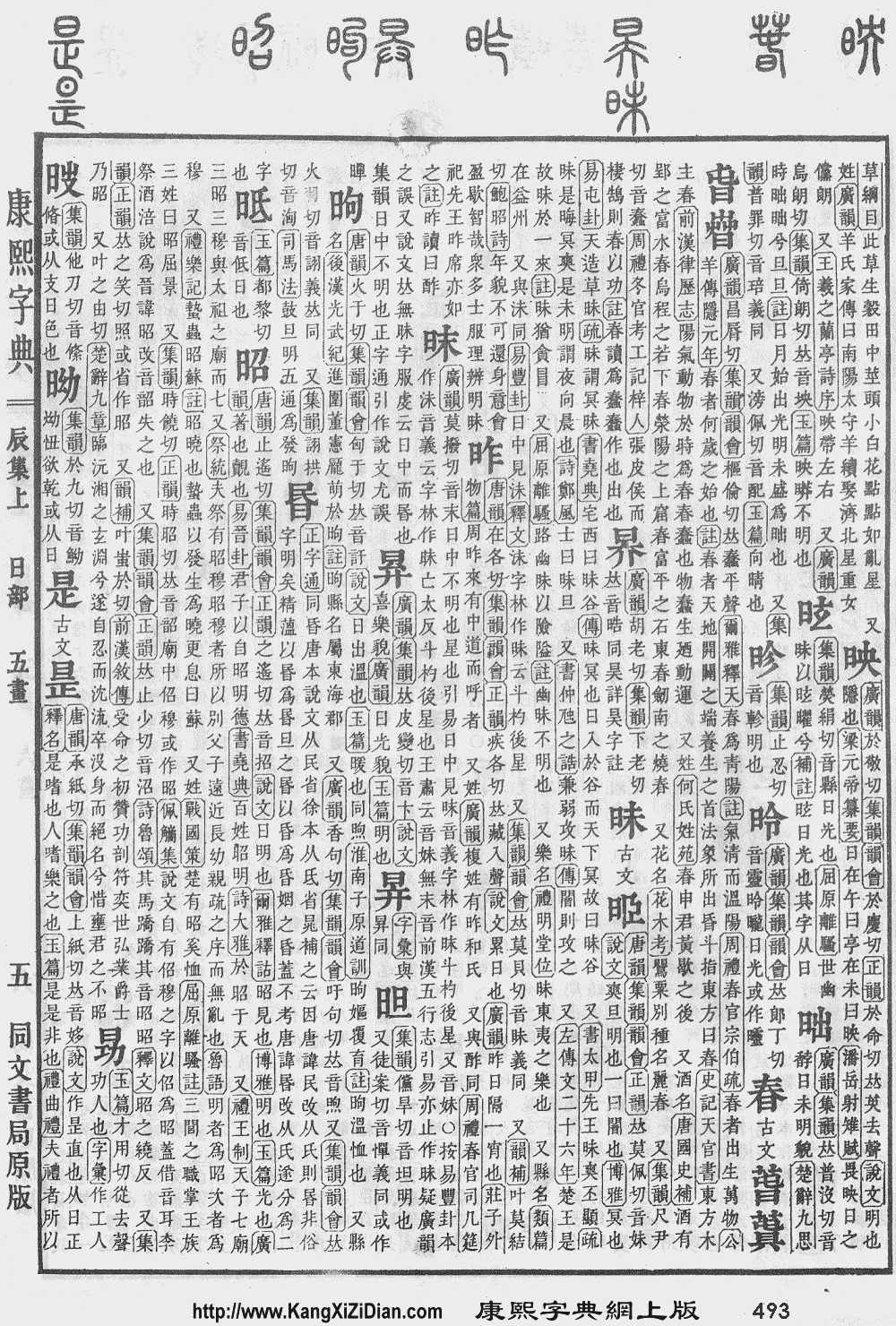
- Kangxi Dictionary: page 493, character 22
- Dai Kanwa Jiten: character 13855
- Dae Jaweon: page 858, character 2
- Hanyu Da Zidian (first edition): volume 2, page 1504, character 9
- Unihan data for U+662D
Chinese
| simp. and trad. |
昭 | |
|---|---|---|
Glyph origin
Characters in the same phonetic series (刀) (Zhengzhang, 2003)
| Old Chinese | |
|---|---|
| 刀 | *taːw |
| 忉 | *taːw |
| 魛 | *taːw |
| 舠 | *taːw |
| 朷 | *taːw, *moːɡ |
| 叨 | *tuːw, *l̥ʰaːw |
| 倒 | *taːwʔ, *taːws |
| 到 | *taːws |
| 菿 | *taːws, *rtaːwɢ |
| 鞀 | *deːw |
| 鳭 | *rteːw, *teːw |
| 灱 | *hreːw |
| 菬 | *sdew, *tjewʔ |
| 超 | *tʰew |
| 怊 | *tʰew, *tʰjew |
| 欩 | *tʰew |
| 召 | *dews, *djews |
| 昭 | *tjew |
| 招 | *tjew |
| 鉊 | *tjew |
| 沼 | *tjewʔ |
| 照 | *tjews |
| 詔 | *tjews |
| 炤 | *tjews |
| 弨 | *tʰjew, *tʰjewʔ |
| 眧 | *tʰjewʔ |
| 韶 | *djew |
| 佋 | *djew, *djewʔ |
| 軺 | *djew, *lew |
| 玿 | *djew |
| 柖 | *djew |
| 紹 | *djewʔ |
| 袑 | *djewʔ |
| 綤 | *djewʔ |
| 邵 | *djews |
| 劭 | *djews |
| 卲 | *djews |
| 刁 | *teːw |
| 芀 | *teːw, *deːw |
| 貂 | *teːw |
| 蛁 | *teːw |
| 迢 | *deːw |
| 苕 | *deːw |
| 髫 | *deːw |
| 岧 | *deːw |
Phono-semantic compound (形聲/形声, OC *tjew) : semantic 日 (“sun”) + phonetic 召 (OC *dews, *djews).
Etymology
照 (OC *tjews, “to shine”) is the exoactive of 昭 (OC *tjew, “bright”) (Schuessler, 2007). Compare with Burmese တောက် (tauk, “bright, brilliant, shining”).
Pronunciation
Definitions
昭
Compounds
- 仁昭法外
- 光昭
- 劣跡昭著/劣迹昭著
- 含冤昭雪
- 哭昭陵
- 天理昭彰
- 天理昭昭
- 天理昭然
- 德業長昭/德业长昭
- 惡名昭彰/恶名昭彰 (èmíngzhāozhāng)
- 懿範長昭/懿范长昭
- 昭代
- 昭儀/昭仪 (zhāoyí)
- 昭冤申枉
- 昭告
- 昭君 (Zhāojūn)
- 昭君出塞
- 昭君和番
- 昭君怨
- 昭和 (Zhāohé)
- 昭和草
- 昭回 (zhāohuí)
- 昭如日星
- 昭彰 (zhāozhāng)
- 昭披耶河 (Zhāopīyéhé)
- 昭明 (zhāomíng)
- 昭明文選/昭明文选
- 昭昭 (zhāozhāo)
- 昭灼
- 昭然 (zhāorán)
- 昭然若揭 (zhāoránruòjiē)
- 昭王墜屨/昭王坠屦
- 昭示 (zhāoshì)
- 昭穆
- 昭華/昭华
- 昭著 (zhāozhù)
- 昭通 (Zhāotōng)
- 昭關/昭关
- 昭陵
- 昭陵六駿/昭陵六骏
- 昭陽/昭阳 (zhāoyáng)
- 昭陽殿/昭阳殿 (Zhāoyáng Diàn)
- 昭雪 (zhāoxuě)
- 昭顯/昭显
- 楚昭萍實/楚昭萍实
- 沉冤昭雪 (chényuānzhāoxuě)
- 燕昭築臺/燕昭筑台
- 眾目昭彰/众目昭彰
- 罪惡昭著/罪恶昭著 (zuì'èzhāozhù)
- 臭名昭彰
- 臭名昭著 (chòumíngzhāozhù)
- 跌宕昭彰
- 道範長昭/道范长昭
- 鄭昭宋聾/郑昭宋聋
Japanese
Readings
Etymology 1
| Kanji in this term |
|---|
| 昭 |
| しょう Grade: 3 |
| on’yomi |
/seu/ → /ɕeu/ → /ɕʲoː/
From Middle Chinese 昭 (MC tsyew).
Korean
Vietnamese
This article is issued from Wiktionary. The text is licensed under Creative Commons - Attribution - Sharealike. Additional terms may apply for the media files.