浴
| ||||||||
Translingual
Han character
浴 (Kangxi radical 85, 水+7, 10 strokes, cangjie input 水金人口 (ECOR), four-corner 38168, composition ⿰氵谷)
References
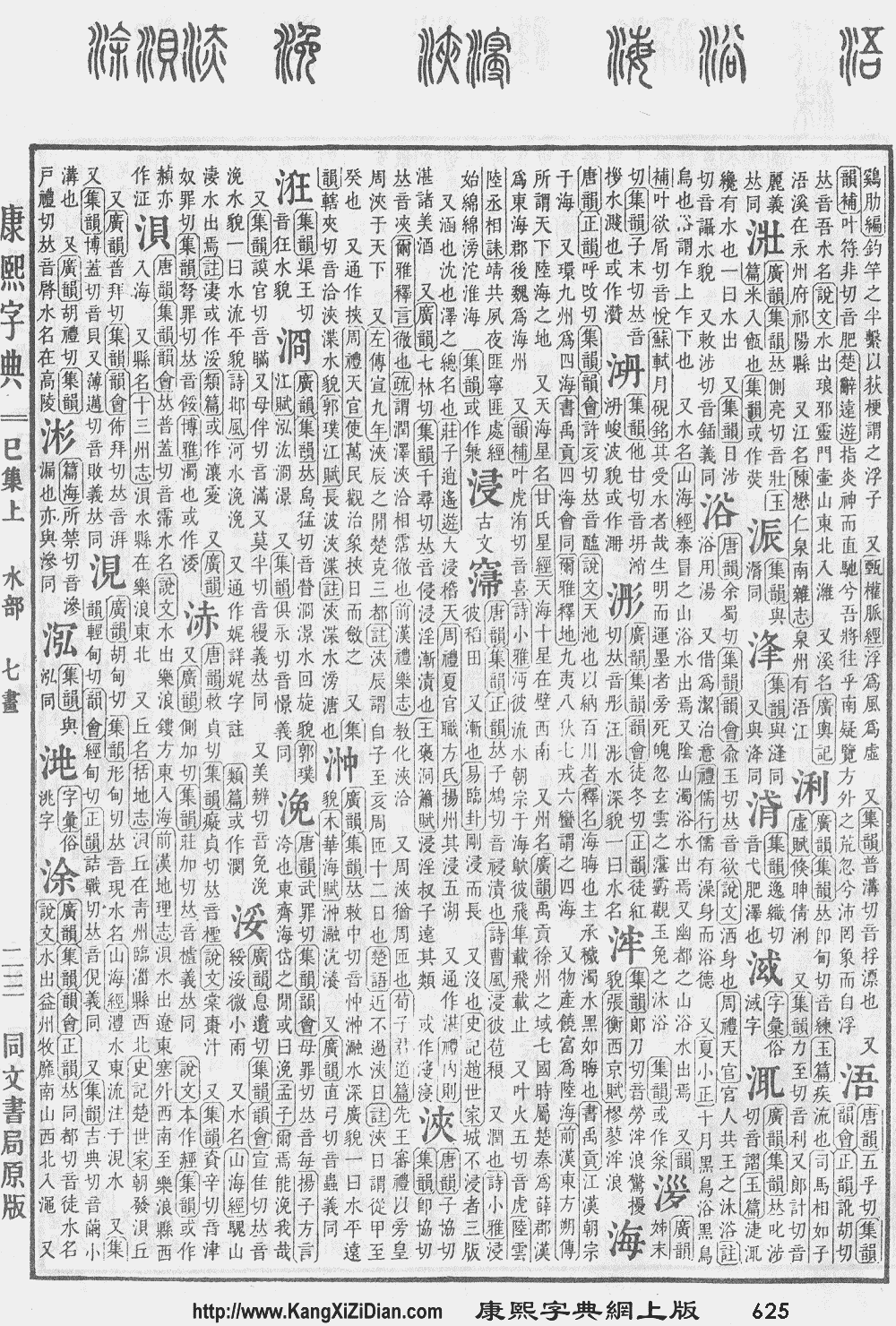
- Kangxi Dictionary: page 625, character 9
- Dai Kanwa Jiten: character 17496
- Dae Jaweon: page 1023, character 6
- Hanyu Da Zidian (first edition): volume 3, page 1629, character 3
- Unihan data for U+6D74
Chinese
| simp. and trad. |
浴 | |
|---|---|---|
Glyph origin
| Historical forms of the character 浴 | |
|---|---|
| Warring States | Shuowen Jiezi (compiled in Han) |
| Chu slip and silk script | Small seal script |
 |
 |
Phono-semantic compound (形聲/形声, OC *loɡ) : semantic 氵 (“water”) + phonetic 谷 (OC *ɦkroːɡ, *kloːɡ, *ɡ·loːɡ) – bathe in water.
Etymology
Schuessler (2007) considers it to be an area word.
Within Sino-Tibetan, Chinese, Tibetan, and Tani have a final *-k, while other Tibeto-Burman languages have open syllables; compare Tibetan ལྡུགས (ldugs, “to pour”), Proto-Tani *lɯk (“to pour”), Proto-Sino-Tibetan *r-lu(w) (“to pour; to bathe”) (whence Angami [script needed] (rəlu, “to pour”), Garo rua (“to pour”), S'gaw Karen [script needed] (lu, “to pour”), Karbi [Term?] (iŋ lú, “to bathe; to wash”)) (Schuessler, 2007; STEDT).
Outside of Sino-Tibetan, compare words in the Pearic languages, such as Chong [script needed] (kʰruk, “to pour”) (Schuessler, 2007).
It is unclear how and whether 冶 (OC *laːʔ, “to smelt; to cast”) is related (Schuessler, 2007).
Pronunciation
Compounds
- 三浴三熏
- 三釁三浴/三衅三浴
- 公共浴場/公共浴场
- 冷水浴 (lěngshuǐyù)
- 冷浴
- 出浴
- 土耳其浴 (tǔ'ěrqí yù)
- 坐浴
- 日光浴 (rìguāngyù)
- 桑那浴
- 森林浴 (sēnlínyù)
- 永浴愛河/永浴爱河
- 汏浴
- 沐浴 (mùyù)
- 沐浴春風/沐浴春风
- 沐浴焚香
- 沐浴露 (mùyùlù)
- 沐浴鹽/沐浴盐
- 泡沫浴
- 洗浴 (xǐyù)
- 浴主
- 浴佛 (yùfó)
- 浴堂 (yùtáng)
- 浴場/浴场 (yùchǎng)
- 浴室 (yùshì)
- 浴巾 (yùjīn)
- 浴布
- 浴帽 (yùmào)
- 浴德
- 浴斛
- 浴日
- 海水浴 (hǎishuǐyù)
- 海水浴場/海水浴场 (hǎishuǐ yùchǎng)
- 浴池 (yùchí)
- 浸浴 (jìnyù)
- 浴液 (yùyè)
- 浴火重生 (yùhuǒchóngshēng)
- 浴療/浴疗 (yùliáo)
- 浴盆 (yùpén)
- 浴缸 (yùgāng)
- 浴蘭時節/浴兰时节
- 浴血 (yùxuè)
- 浴血奮戰/浴血奋战
- 浴衣 (yùyī)
- 浴袍 (yùpáo)
- 浴鐵/浴铁
- 浴鼓
- 淨浴/净浴
- 淴浴 (hūyù)
- 淋浴 (línyù)
- 溫泉浴/温泉浴
- 澡身浴德
- 蒸氣浴/蒸气浴
- 空氣浴/空气浴
- 芬蘭浴/芬兰浴 (fēnlányù)
- 藥浴/药浴
- 衛浴設備/卫浴设备
- 補天浴日/补天浴日
- 避火浴血
- 釁浴/衅浴
- 風浴/风浴
- 齋戒沐浴/斋戒沐浴 (zhāijièmùyù)
References
- “浴”, in 漢語多功能字庫 (Multi-function Chinese Character Database), 香港中文大學 (the Chinese University of Hong Kong), 2014–
Japanese
Readings
Korean
Etymology
(This etymology is missing or incomplete. Please add to it, or discuss it at the Etymology scriptorium. Particularly: “Middle Korean readings, if any”)
Pronunciation
- (SK Standard/Seoul) IPA(key): [jok̚]
- Phonetic hangul: [욕]