容
| ||||||||
Translingual
| Stroke order | |||
|---|---|---|---|
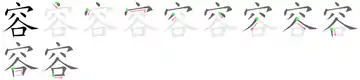 | |||
Han character
容 (Kangxi radical 40, 宀+7, 10 strokes, cangjie input 十金人口 (JCOR), four-corner 30608, composition ⿱宀谷)
Derived characters
References
- Kangxi Dictionary: page 287, character 3
- Dai Kanwa Jiten: character 7172
- Dae Jaweon: page 567, character 3
- Hanyu Da Zidian (first edition): volume 2, page 933, character 17
- Unihan data for U+5BB9

Chinese
| simp. and trad. |
容 | |
|---|---|---|
| alternative forms | 㝐 ancient 頌 “looks” 𠕺 | |
Glyph origin
| Historical forms of the character 容 | |||
|---|---|---|---|
| Western Zhou | Warring States | Shuowen Jiezi (compiled in Han) | Liushutong (compiled in Ming) |
| Bronze inscriptions | Bronze inscriptions | Small seal script | Transcribed ancient scripts |
 |
|
 |
 |
Characters in the same phonetic series (谷) (Zhengzhang, 2003)
Phono-semantic compound (形聲/形声, OC *loŋ) : semantic 宀 + phonetic 公 (OC *kloːŋ) – to hold; to contain.
容 has also largely supplanted 頌 (OC *sɢloŋs, *loŋ) for the sense of “appearance”.
Etymology
- “ronna-”
- Phono-semantic matching of English ronna-. Coined by the China National Committee for Terminology in Science and Technology and the State Administration for Market Regulation on World Metrology Day in 2023 (20 May 2023).
Pronunciation
Definitions
容
- to hold; to contain
- to tolerate; to stand
- to allow; to permit
- (literary) perhaps; maybe
- facial appearance; looks
- bearing; posture
- 市容 ― shìróng ― appearance of a city
- Used in 容易 (róngyì) and 容與/容与.
- Used in 容容.
- a surname
- 容國團/容国团 ― Róng Guótuán ― Rong Guotuan (Chinese table tennis player)
- (~縣) Rong County, Yulin, Guangxi
- (Mainland China) ronna- (SI unit prefix)
Compounds
- 不容 (bùróng)
- 不容人
- 不容分說/不容分说 (bùróngfēnshuō)
- 不容情
- 不容易 (bùróngyì)
- 不容物
- 不容置喙 (bùróngzhìhuì)
- 不容置疑 (bùróngzhìyí)
- 不相容
- 不輕容易/不轻容易
- 九畹遺容/九畹遗容 (Jiǔ Wǎn Yíróng)
- 以容取人
- 依阿取容
- 修容
- 倦容 (juànróng)
- 倉容/仓容 (cāngróng)
- 偷合取容
- 偷合苟容
- 僅容旋馬/仅容旋马
- 儀容/仪容 (yíróng)
- 優容/优容
- 先容
- 內容/内容 (nèiróng)
- 公路容量
- 兼容並蓄/兼容并蓄
- 兼容并包
- 冶容 (yěróng)
- 冶容誨淫/冶容诲淫
- 刻不容緩/刻不容缓 (kèbùrónghuǎn)
- 動容/动容 (dòngróng)
- 包容 (bāoróng)
- 取容
- 吐舊容新/吐旧容新
- 咕容
- 和容悅色/和容悦色
- 喜容
- 回容
- 國容/国容
- 大度包容
- 天地不容 (tiāndìbùróng)
- 天容
- 太容
- 天理不容 (tiānlǐbùróng)
- 天理難容/天理难容 (tiānlǐnánróng)
- 失容
- 夸容
- 好不容易 (hǎobùróngyì)
- 好容易 (hǎoróngyì)
- 婦容/妇容
- 婉容
- 媮合苟容/偷合苟容
- 容不下 (róngbùxià)
- 容乞
- 容俟
- 容儀/容仪 (róngyí)
- 容允
- 容光 (róngguāng)
- 容光煥發/容光焕发 (róngguānghuànfā)
- 容冶
- 容刀
- 容受 (róngshòu)
- 容器 (róngqì)
- 容城 (Róngchéng)
- 容容
- 容忍 (róngrěn)
- 容恕 (róngshù)
- 容悅/容悦
- 容情 (róngqíng)
- 容態/容态 (róngtài)
- 容成
- 容或
- 容敘/容叙
- 容日
- 容易
- 容止
- 容留 (róngliú)
- 容積/容积 (róngjī)
- 容積率/容积率
- 容範/容范
- 容納/容纳 (róngnà)
- 容美 (Róngměi)
- 容膝
- 容臭 (róngxiù)
- 容與/容与
- 容色
- 容華/容华
- 容表
- 容裔 (róngyì)
- 容觀/容观
- 容許/容许 (róngxǔ)
- 容讓/容让
- 容貌 (róngmào)
- 容質/容质
- 容足地
- 容身 (róngshēn)
- 容身之地
- 容身之所
- 容車/容车
- 容輝/容辉
- 家道從容/家道从容
- 容量 (róngliàng)
- 容長臉/容长脸
- 容閎/容闳
- 容隱/容隐
- 容順/容顺
- 容頭過身/容头过身
- 容顏/容颜 (róngyán)
- 容飾/容饰
- 容齋隨筆/容斋随笔
- 寬容/宽容 (kuānróng)
- 尊容 (zūnróng)
- 小針美容/小针美容
- 市容 (shìróng)
- 幸為先容/幸为先容
- 廠容/厂容
- 形容 (xíngróng)
- 形容句
- 形容枯槁 (xíngróng kūgǎo)
- 形容盡致/形容尽致
- 形容詞/形容词 (xíngróngcí)
- 御容
- 從容/从容
- 從容不迫/从容不迫
- 從容就義/从容就义
- 從容自在/从容自在
- 從容自若/从容自若
- 從從容容/从从容容 (cōngcōngróngróng)
- 德容兩全/德容两全
- 德容兼備/德容兼备
- 德容言功
- 德言容功
- 悛容
- 情理難容/情理难容
- 愁容 (chóuróng)
- 慍容/愠容 (yùnróng)
- 慕容 (Mùróng)
- 戚容
- 持祿取容/持禄取容
- 換容/换容
- 收容 (shōuróng)
- 收容所 (shōuróngsuǒ)
- 改容
- 改容加飾/改容加饰
- 整容 (zhěngróng)
- 整容術/整容术
- 整衣斂容/整衣敛容
- 斂容/敛容 (liǎnróng)
- 斂衽正容/敛衽正容
- 易容
- 昌容
- 曲媚取容
- 月貌花容
- 有容乃大
- 村容 (cūnróng)
- 標容/标容
- 毀容/毁容 (huǐróng)
- 比熱容/比热容 (bǐrèróng)
- 水火不容 (shuǐhuǒbùróng)
- 求容取媚
- 汽車美容/汽车美容
- 涵容
- 淚容/泪容
- 滿面愁容/满面愁容
- 滿面笑容/满面笑容 (mǎnmiànxiàoróng)
- 潘安容儀/潘安容仪
- 無以自容/无以自容
- 無地自容/无地自容 (wúdìzìróng)
- 無容/无容
- 無所不容/无所不容
- 熱容/热容 (rèróng)
- 熱容量/热容量
- 玉容 (yùróng)
- 玉貌花容
- 理容
- 理容院
- 理所不容
- 病容 (bìngróng)
- 直道不容
- 相容 (xiāngróng)
- 相容產品/相容产品
- 相容網路/相容网路
- 睟容
- 神理不容
- 視端容寂/视端容寂
- 積不相容/积不相容
- 笑容 (xiàoróng)
- 笑容可掬 (xiàoróngkějū)
- 笑容滿面/笑容满面
- 細不容髮/细不容发
- 縱容/纵容 (zòngróng)
- 罪不容誅/罪不容诛 (zuìbùróngzhū)
- 美容 (měiróng)
- 美容師/美容师 (měiróngshī)
- 美容術/美容术
- 美容院 (měiróngyuàn)
- 美容體操/美容体操 (měiróng tǐcāo)
- 義不取容/义不取容
- 義不容辭/义不容辞 (yìbùróngcí)
- 聲容/声容
- 聲容宛在/声容宛在
- 舂容
- 舉止形容/举止形容
- 花容
- 花容失色
- 花容月貌 (huāróngyuèmào)
- 花容玉貌
- 苟合取容
- 苟容
- 苟容曲從/苟容曲从
- 華容/华容 (Huáróng)
- 行不苟容
- 言容 (yánróng)
- 記憶容量/记忆容量
- 誼不容辭/谊不容辞
- 談何容易/谈何容易 (tánhéróngyì)
- 諂諛取容/谄谀取容
- 變容/变容
- 變色易容/变色易容
- 豐容靚飾/丰容靓饰
- 貪位取容/贪位取容
- 跑道容量
- 車容/车容 (chēróng)
- 軍容/军容 (jūnróng)
- 道路容量
- 遺容/遗容 (yíróng)
- 鄒容/邹容
- 鈞容直/钧容直
- 間不容息/间不容息
- 間不容髮/间不容发
- 阿諛取容/阿谀取容
- 阿順取容/阿顺取容
- 陣容/阵容 (zhènróng)
- 雍容 (yōngróng)
- 雍容文雅
- 雍容爾雅
- 雍容華貴/雍容华贵
- 雍容閒雅
- 雍容雅步
- 難容/难容
- 電容/电容 (diànróng)
- 電容器/电容器 (diànróngqì)
- 非同容易
- 面不改容 (miànbùgǎiróng)
- 面容 (miànróng)
- 面帶憂容/面带忧容
- 革容
- 音容 (yīnróng)
- 音容如在
- 音容宛在
- 音容淒斷/音容凄断
- 音容笑貌 (yīnróngxiàomào)
- 體內美容/体内美容
- 齠容/龆容
Japanese
Readings
Usage notes
Formerly used as man'yōgana for the back-vowel variant 甲類 (kōrui) of よ (yo).
Compounds
Etymology 2
| Kanji in this term |
|---|
| 容 |
| よう Grade: 5 |
| kan’on |
References
- Matsumura, Akira, editor (2006), 大辞林 [Daijirin] (in Japanese), Third edition, Tōkyō: Sanseidō, →ISBN
Korean
Etymology
From Middle Chinese 容 (MC yowng). Recorded as Middle Korean 요ᇰ (yong) (Yale: yong) in Hunmong Jahoe (訓蒙字會 / 훈몽자회), 1527.
Compounds
Compounds
- 내용 (內容, naeyong)
- 수용 (受容, suyong)
- 허용 (許容, heoyong)
- 용서 (容恕, yongseo)
- 용납 (容納, yongnap)
- 용인 (容認, yong'in)
- 포용 (包容, poyong)
- 관용 (寬容, gwanyong)
- 수용 (收容, suyong)
- 형용 (形容, hyeong'yong)
- 용기 (容器, yonggi)
- 용량 (容量, yongnyang)
- 종용 (從容, jong'yong)
- 용안 (容顔, yong'an)
- 위용 (威容, wiyong)
- 미용 (美容, miyong)
- 용모 (容貌, yongmo)
- 용의자 (容疑者, yong'uija)
Vietnamese
Han character
容: Hán Nôm readings: dung, dong, dông, gióng, giông, ròng, rông, rung
- This term needs a translation to English. Please help out and add a translation, then remove the text
{{rfdef}}.
References
This article is issued from Wiktionary. The text is licensed under Creative Commons - Attribution - Sharealike. Additional terms may apply for the media files.