谷
| ||||||||
| ||||||||
Translingual
| Stroke order | |||
|---|---|---|---|
 | |||
| Stroke order | |||
|---|---|---|---|
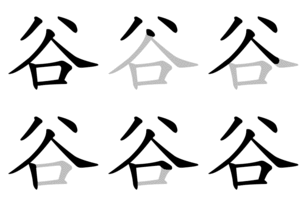 | |||
Han character
谷 (Kangxi radical 150, 谷+0, 7 strokes, cangjie input 金人口 (COR), four-corner 80608, composition ⿳八人口)
- Kangxi radical #150, ⾕.
Derived characters
References
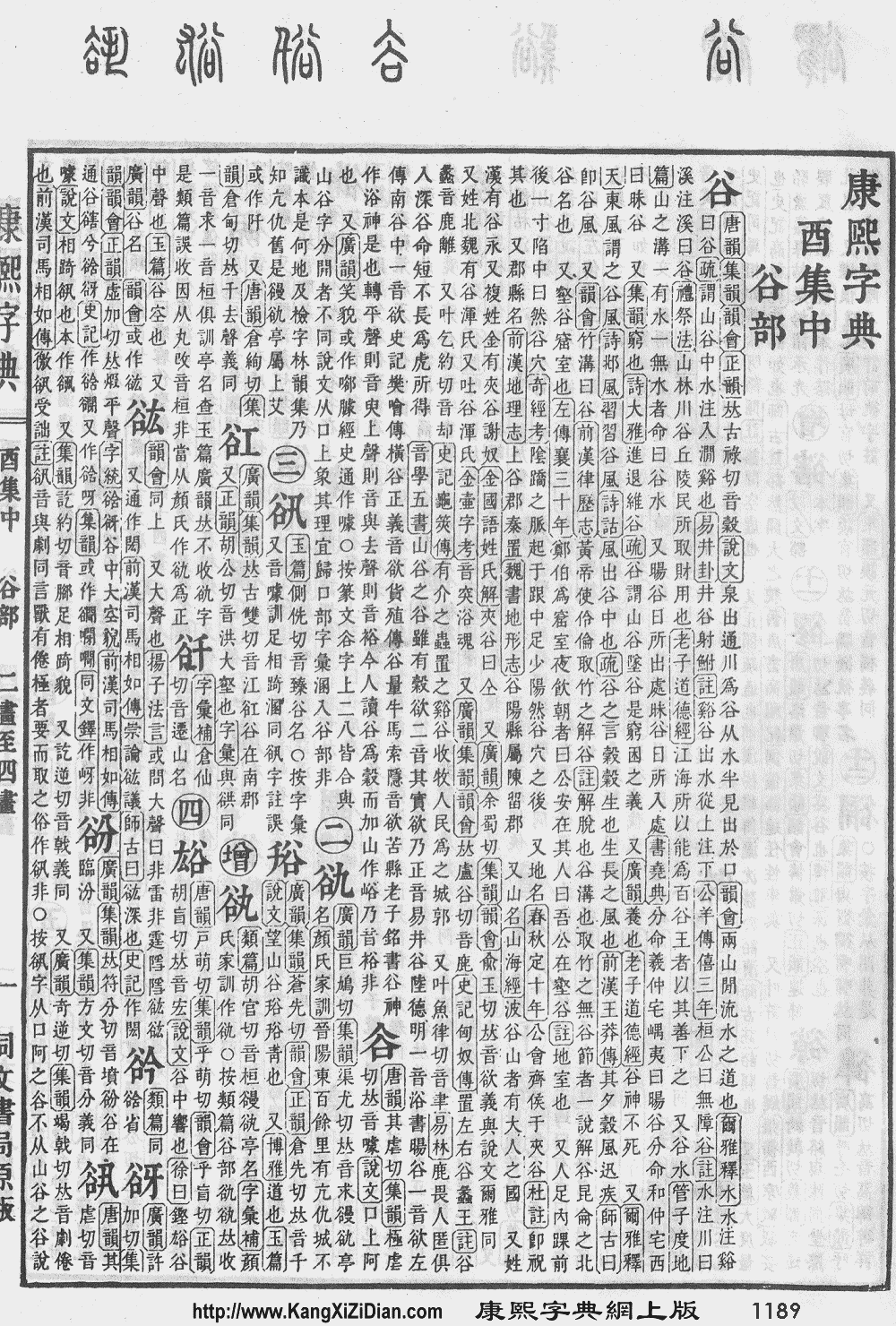
- Kangxi Dictionary: page 1189, character 1
- Dai Kanwa Jiten: character 36182
- Dae Jaweon: page 1652, character 19
- Hanyu Da Zidian (first edition): volume 6, page 3902, character 1
- Unihan data for U+8C37
Chinese
Glyph origin
| Historical forms of the character 谷 | |||
|---|---|---|---|
| Shang | Western Zhou | Shuowen Jiezi (compiled in Han) | Liushutong (compiled in Ming) |
| Oracle bone script | Bronze inscriptions | Small seal script | Transcribed ancient scripts |
 |
 |
 |
 |
Etymology 1
| simp. and trad. |
谷 | |
|---|---|---|
From Proto-Sino-Tibetan *kl(j)u(ŋ/k) (“river; gorge”). Cognate with Tibetan ལྗོངས (ljongs), Tibetan ཀླུང (klung) and Tibetan ལུང་པ (lung pa).
Pronunciation
Definitions
谷
- valley; gorge; ravine
- 孔明棄車步行。忽到一山,望見一谷,形如長蛇,皆危峭石壁,並無樹木。 [Written Vernacular Chinese, trad.]
- From: Romance of the Three Kingdoms, circa 14th century CE
- Kǒng Míng qì chē bùxíng. Hū dào yī shān, wàngjiàn yī gǔ, xíng rú cháng shé, jiē wēiqiào shíbì, bìng wú shùmù. [Pinyin]
- (please add an English translation of this usage example)
孔明弃车步行。忽到一山,望见一谷,形如长蛇,皆危峭石壁,并无树木。 [Written Vernacular Chinese, simp.]
- river or stream between two mountains; (in general) stream or river
- (figurative) difficult position; predicament
- a surname
Compounds
- 下谷坪 (Xiàgǔpíng)
- 中谷有蓷
- 伊犁縱谷/伊犁纵谷
- 低谷 (dīgǔ)
- 出谷遷喬/出谷迁乔
- 函谷關/函谷关 (Hángǔ Guān)
- 包谷 (bāogǔ)
- 包谷花
- 千巖萬谷/千岩万谷
- 厓谷
- 合谷
- 嘴答谷
- 壑谷
- 大峽谷/大峡谷 (Dàxiágǔ)
- 太谷
- 太谷燈/太谷灯
- 如臨淵谷/如临渊谷
- 如臨深谷/如临深谷
- 山棲谷飲/山栖谷饮
- 山谷 (shāngǔ)
- 峽谷/峡谷 (xiágǔ)
- 崤谷
- 嶰谷
- 巔崖峻谷/巅崖峻谷
- 巖居谷飲/岩居谷饮
- 幽棲巖谷/幽栖岩谷
- 幽谷 (yōugǔ)
- 府谷 (Fǔgǔ)
- 張谷英/张谷英 (Zhānggǔyīng)
- 悲谷
- 愚公谷
- 斜谷
- 新鶯出谷/新莺出谷
- 方濟谷派/方济谷派
- 昧谷
- 暘谷/旸谷
- 曼谷 (Màngǔ)
- 泥封函谷
- 河谷 (hégǔ)
- 波谷 (bōgǔ)
- 海底峽谷/海底峡谷
- 海谷
- 深山窮谷/深山穷谷 (shēnshānqiónggǔ)
- 深谷 (shēngǔ)
- 溺谷
- 溪谷 (xīgǔ)
- 滿坑滿谷/满坑满谷
- 澥谷
- 甘谷 (Gāngǔ)
- 白駒空谷/白驹空谷
- 百谷王
- 盤谷/盘谷 (Pángǔ)
- 矽谷 (xīgǔ)
- 硅谷 (Guīgǔ)
- 硫磺谷
- 禺谷
- 穹谷
- 空谷
- 空谷傳聲/空谷传声
- 空谷傳響/空谷传响
- 空谷幽蘭/空谷幽兰
- 空谷足音
- 縱谷/纵谷 (zōnggǔ)
- 膠萊谷地/胶莱谷地
- 蒙谷
- 藏南縱谷/藏南纵谷
- 虛懷若谷/虚怀若谷 (xūhuáiruògǔ)
- 裂谷
- 西谷椰子
- 西谷米 (xīgǔmǐ)
- 谷中谷
- 谷口 (gǔkǒu)
- 谷口耕岩
- 谷地 (gǔdì)
- 谷底 (gǔdǐ)
- 谷樹皮/谷树皮
- 谷灣/谷湾
- 谷蠡 (lùlí)
- 谷谷
- 谷都
- 谷風/谷风 (gǔfēng)
- 谷飲/谷饮
- 谿谷 (xīgǔ)
- 跌至谷底
- 通谷 (tōnggǔ)
- 進退維谷/进退维谷 (jìntuìwéigǔ)
- 金谷
- 金谷園/金谷园
- 金谷墮樓/金谷堕楼
- 金谷酒數/金谷酒数
- 陵谷 (línggǔ)
- 隆河谷地
- 陽谷/阳谷
- 雲谷/云谷
- 飛谷/飞谷
- 高岸深谷
- 鬼谷子 (Guǐgǔzǐ)
- 鶯谷/莺谷
- 鹿谷 (Lùgǔ)
- 鹿谷鄉/鹿谷乡
- 黍谷生春
Pronunciation
Definitions
谷 (Cantonese)
Pronunciation
Compounds
Pronunciation
Definitions
谷
Pronunciation
Etymology 6
| For pronunciation and definitions of 谷 – see 穀 (“corn; grain; cereal; foxtail millet, the plant or the unhulled grain); etc.”). (This character is the simplified form of 穀). |
Notes:
|
Japanese
Readings
From Middle Chinese 谷 (MC kuwk, “valley, gorge”):
- Go-on: こく (koku, Jōyō)
- Kan-on: こく (koku, Jōyō)
- Kun: たに (tani, 谷, Jōyō); きわまる (kiwamaru, 谷まる)←きはまる (kifamaru, 谷まる, historical); や (ya, 谷); やつ (yatsu, 谷)
- Nanori: ひろ (hiro)
From Middle Chinese 谷 (MC yowk), as in 吐谷渾 (Toyokukon, “Tuyuhun”):
From Middle Chinese 谷 (MC luwk), as in 谷蠡 (Rokuri):
Compounds
Etymology 1
| Kanji in this term |
|---|
| 谷 |
| たに Grade: 2 |
| kun’yomi |
| Alternative spellings |
|---|
| 渓 谿 |
From Old Japanese, from Proto-Japonic *tani. Possibly cognate with Goguryeo *旦 (*tan, “valley”).[1]
Noun
谷 • (tani)
Derived terms
Derived terms
- 谷谷, 谷々 (yatsuyatsu)
- 谷七郷 (Yatsu Shichigō)
- 谷田 (yatsuda)
- 扇ヶ谷 (Ōgigayatsu)
- 葛西ヶ谷 (Kasaigayatsu)
- 亀ヶ谷 (Kamegayatsu)
- 桐ヶ谷 (Kirigayatsu)
- 月影ヶ谷 (Tsukikagegayatsu)
Derived terms
Etymology 4
| Kanji in this term |
|---|
| 谷 |
| やち Grade: 2 |
| irregular |
| Alternative spellings |
|---|
| 谷地 野地 |
Variant shift from yatsu above.
Etymology 5
| Kanji in this term |
|---|
| 谷 |
| やと Grade: 2 |
| irregular |
| Alternative spelling |
|---|
| 谷戸 |
Another variant shift from yatsu above.
Noun
谷 • (yato)
- Same as やつ (yatsu) above
Etymology 6
| Kanji in this term |
|---|
| 谷 |
| Grade: 2 |
| irregular |
| Alternative spelling |
|---|
| 迫 |
(This etymology is missing or incomplete. Please add to it, or discuss it at the Etymology scriptorium.)
References
- Vovin, Alexander (2017) “Origins of the Japanese Language”, in Oxford Research Encyclopedia of Linguistics,
- Matsumura, Akira, editor (2006), 大辞林 [Daijirin] (in Japanese), Third edition, Tōkyō: Sanseidō, →ISBN
Korean
Etymology 1
From Middle Chinese 谷 (MC kuwk). Recorded as Middle Korean 곡 (kwok) (Yale: kwok) in Hunmong Jahoe (訓蒙字會 / 훈몽자회), 1527.
Etymology 2
From Middle Chinese 谷 (MC yowk). Recorded as Middle Korean 욕〮 (yók) (Yale: yok) in Hunmong Jahoe (訓蒙字會 / 훈몽자회), 1527.
Hanja
Etymology 3
From Middle Chinese 谷 (MC luwk). Recorded as Middle Korean 록〮 (Yale: lwok) in Dongguk Jeongun (東國正韻 / 동국정운), 1448.