煩
See also: 烦
| ||||||||
Translingual
Han character
| Stroke order | |||
|---|---|---|---|
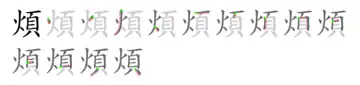 | |||
煩 (Kangxi radical 86, 火+9, 13 strokes, cangjie input 火一月金 (FMBC), four-corner 91886, composition ⿰火頁)
Derived characters
- 𫬆(𫫏), 𢶃, 𪹺, 𨆌, 𭆖, 薠(𮐚), 𨆜
Related characters
References
- Kangxi Dictionary: page 678, character 3
- Dai Kanwa Jiten: character 19229
- Dae Jaweon: page 1089, character 6
- Hanyu Da Zidian (first edition): volume 3, page 2216, character 5
- Unihan data for U+7169

Chinese
| trad. | 煩 | |
|---|---|---|
| simp. | 烦 | |
Glyph origin
| Historical forms of the character 煩 | |
|---|---|
| Warring States | Shuowen Jiezi (compiled in Han) |
| Qin slip script | Small seal script |
 |
 |
Pronunciation
Definitions
煩
Synonyms
- (to annoy):
- 告擾/告扰 (gàorǎo) (formal, humble, polite)
- 吵擾/吵扰 (chǎorǎo)
- 困擾/困扰 (kùnrǎo)
- 干擾 (gānrǎo)
- 打亂/打乱 (dǎluàn)
- 打擾/打扰 (dǎrǎo)
- 打攪/打搅 (dǎjiǎo)
- 搗/捣 (dǎo) (literary, or in compounds)
- 擾亂/扰乱 (rǎoluàn)
- 攪/搅 (jiǎo)
- 攪亂/搅乱 (jiǎoluàn)
- 攪動/搅动 (jiǎodòng)
- 攪吵/搅吵 (Hokkien)
- 攪擾/搅扰 (jiǎorǎo)
- 梟亂/枭乱 (xiāoluàn) (literary)
- 殽亂/淆乱 (xiáoluàn) (literary)
- 煩擾/烦扰 (fánrǎo)
- 糾紛/纠纷 (jiūfēn) (literary)
- 糾纏/纠缠 (jiūchán)
- 纏/缠 (chán)
- 纏擾/缠扰 (chánrǎo)
- 纏磨/缠磨 (chánmo) (colloquial)
- 纏繞/缠绕 (chánrào)
- 驚/惊 (jīng)
- 驚動/惊动 (jīngdòng)
- (to trouble someone to do something):
- 付託/付托 (fùtuō)
- 勞慰/劳慰 (nao2 wei4) (Sichuanese, polite)
- 勞累/劳累 (láolèi) (polite)
- 囑託/嘱托 (zhǔtuō)
- 委託/委托 (wěituō)
- 寄 (jì)
- 寄託/寄托 (jìtuō)
- 打擾/打扰 (dǎrǎo) (polite)
- 拜託/拜托 (bàituō) (polite)
- 相煩/相烦 (xiāngfán) (polite)
- 託付/托付 (tuōfù)
- 託管/托管 (tuōguǎn)
- 辛苦 (xīnkǔ) (polite)
- 麻煩/麻烦 (máfan) (polite)
- 齪嘈/龊嘈 (Zhangzhou Hokkien, Taiwanese Hokkien)
Compounds
- 不勝其煩/不胜其烦 (bùshèngqífán)
- 不厭其煩/不厌其烦 (bùyàn qí fán)
- 不奈煩/不奈烦
- 不憚其煩/不惮其烦
- 不憚煩/不惮烦
- 不煩/不烦
- 不煩惱/不烦恼
- 不耐心煩/不耐心烦
- 不耐煩/不耐烦 (bùnàifán)
- 內煩/内烦
- 動煩/动烦
- 厭煩/厌烦 (yànfán)
- 嘖有煩言/啧有烦言
- 央煩/央烦
- 奈煩/奈烦 (nàifán)
- 奉煩/奉烦
- 心煩/心烦 (xīnfán)
- 心煩意亂/心烦意乱 (xīnfányìluàn)
- 心煩慮亂/心烦虑乱
- 心煩技癢/心烦技痒
- 惹麻煩/惹麻烦 (rě máfan)
- 憂煩/忧烦 (yōufán)
- 憚煩/惮烦 (dànfán)
- 找麻煩/找麻烦
- 搗麻煩/捣麻烦
- 撥煩理劇/拨烦理剧
- 撥煩理難/拨烦理难
- 案牘勞煩/案牍劳烦
- 沒耐煩/没耐烦
- 滌煩/涤烦
- 激煩/激烦
- 煩亂/烦乱 (fánluàn)
- 煩人/烦人 (fánrén)
- 煩冗/烦冗 (fánrǒng)
- 煩冤/烦冤
- 煩劇/烦剧
- 煩勞/烦劳 (fánláo)
- 煩厭/烦厌 (fányàn)
- 煩吵/烦吵
- 煩問/烦问
- 煩囂/烦嚣
- 煩囂喧鬧/烦嚣喧闹
- 煩天惱地/烦天恼地
- 煩富/烦富
- 煩心/烦心 (fánxīn)
- 煩忙/烦忙 (fánmáng)
- 煩悶/烦闷 (fánmèn)
- 煩愁/烦愁
- 煩惱/烦恼 (fánnǎo)
- 煩想/烦想
- 煩惱絲/烦恼丝 (fánnǎosī)
- 煩慮/烦虑
- 煩懣/烦懑 (fánmèn)
- 煩擾/烦扰 (fánrǎo)
- 煩數/烦数
- 煩文/烦文
- 煩法/烦法
- 煩熱/烦热
- 煩猥/烦猥
- 煩瑣/烦琐 (fánsuǒ)
- 煩細/烦细
- 煩絮/烦絮
- 煩膩/烦腻
- 煩苛/烦苛
- 煩複/烦复
- 煩言/烦言 (fányán)
- 煩言碎語/烦言碎语
- 煩言碎辭/烦言碎辞
- 煩請/烦请 (fánqǐng)
- 煩費/烦费
- 煩躁/烦躁 (fánzào)
- 煩雜/烦杂 (fánzá)
- 煩難/烦难 (fánnán)
- 甄煩就簡/甄烦就简
- 發煩/发烦
- 相煩/相烦 (xiāngfán)
- 省煩從簡/省烦从简
- 磨煩/磨烦
- 累煩/累烦
- 絮煩/絮烦
- 耐煩/耐烦 (nàifán)
- 膩煩/腻烦 (nìfán)
- 自尋煩惱/自寻烦恼
- 自找麻煩/自找麻烦
- 要言不煩/要言不烦
- 話休絮煩/话休絮烦
- 起煩/起烦
- 車殆馬煩/车殆马烦
- 道煩惱/道烦恼
- 頻煩/频烦 (pínfán)
- 食少事煩/食少事烦
- 麻煩/麻烦 (máfan)
Japanese
Korean
Vietnamese
This article is issued from Wiktionary. The text is licensed under Creative Commons - Attribution - Sharealike. Additional terms may apply for the media files.