啊
| ||||||||
Translingual
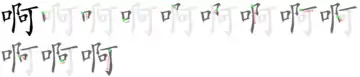
| Stroke order | |||
|---|---|---|---|
 | |||
Han character
啊 (Kangxi radical 30, 口+8, 11 strokes, cangjie input 口弓中口 (RNLR), four-corner 61020, composition ⿰口阿)
References
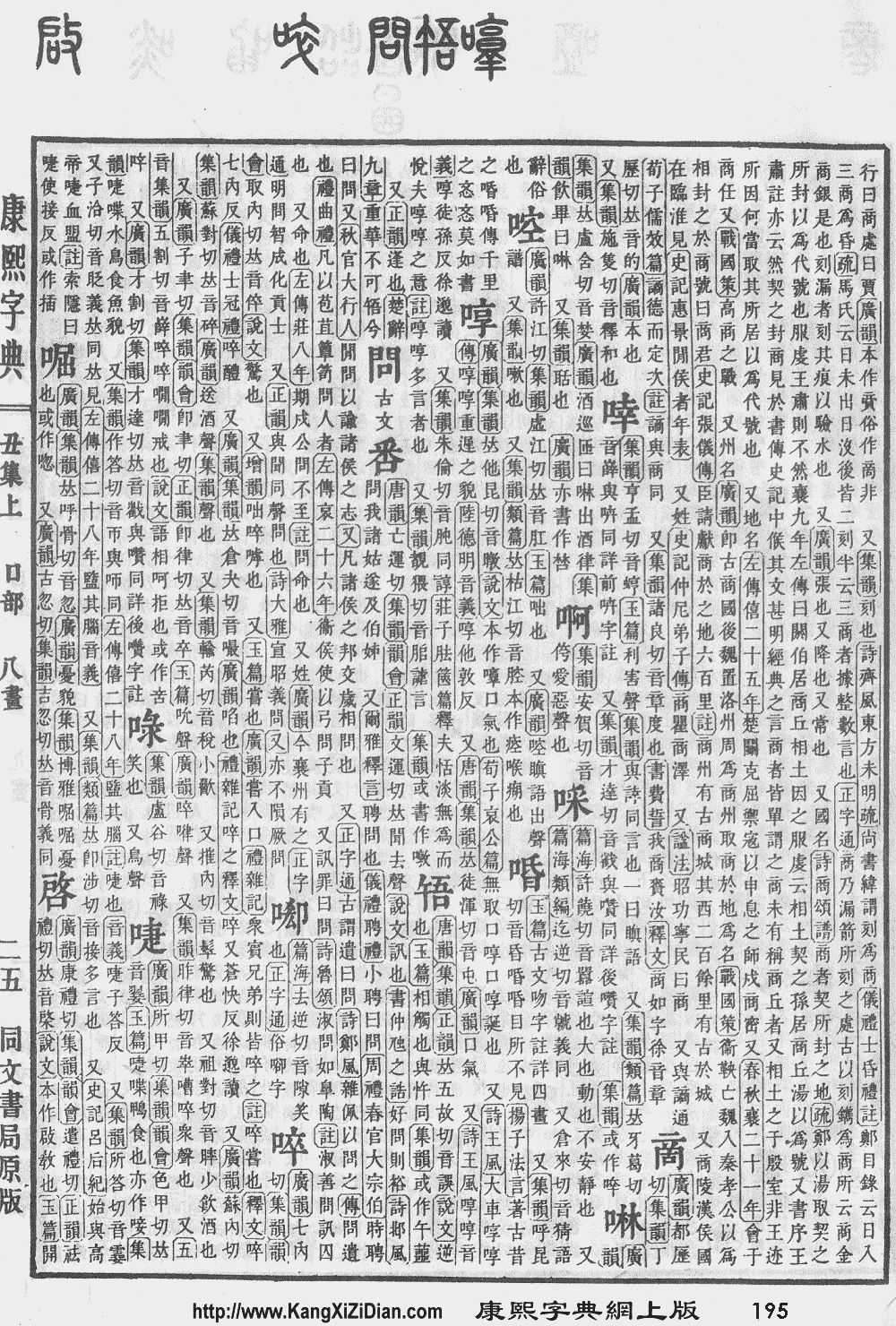
- Kangxi Dictionary: page 195, character 4
- Dai Kanwa Jiten: character 3808
- Dae Jaweon: page 416, character 5
- Hanyu Da Zidian (first edition): volume 1, page 634, character 18
- Unihan data for U+554A
Chinese
| simp. and trad. |
啊 | |
|---|---|---|
Glyph origin
Phono-semantic compound (形聲/形声) : semantic 口 (“mouth”) + phonetic 阿 (OC *qaːl).
Pronunciation 1
Definitions
啊
- Used by itself to express surprise. ah, oh, ha
- Used to express affirmation or exhortation.
- 我食飽咯啊 [Philippine Hokkien, trad.]
- Góa chia̍h-pá--lo͘--a [Pe̍h-ōe-jī]
- I've eaten already, OK. / I'm full now, alright.
我食饱咯啊 [Philippine Hokkien, simp.]
- 哎,你什麼時候抽空兒給我們佳佳複習複習功課,讓她提高提高學習水平啊! [MSC, trad.]
- From: 2004, 《家有儿女》, episode 15
- Āi, nǐ shénme shíhou chōu kòngr gěi wǒmen Jiājia fùxí fùxí gōngkè, ràng tā tígāo tígāo xuéxí shuǐpíng ā! [Pinyin]
- Hey, when you take the time to give our Jiajia review homework, let her improve her studies, eh?!
哎,你什么时候抽空儿给我们佳佳复习复习功课,让她提高提高学习水平啊! [MSC, simp.]
Pronunciation 2
Definitions
啊
Pronunciation 3
Definitions
啊
Pronunciation 4
Pronunciation 5
Definitions
啊
- Sentence-final particle expressing surprise.
- Sentence-final particle expressing exclamation, excitement or enthusiasm.
- Sentence-final particle softening the request.
- Used in enumerations, for confirmation (often untranslated).
- on and on, continuously
Usage notes
In Standard Mandarin, this toneless particle is found in complementary distribution with several other particles, governed by the nature of the preceding syllable. However, this distinction is not strictly reflected in writing, and 啊 tends to an all-encompassing particle. Thus it may carry the pronunciation of any of its variants below in actual speech:
Synonyms
- (Cantonese) 呀
Compounds
- 啊呀 (āyā)
- 啊哈 (āhā)
- 啊唷 (āyō)
- 啊喲/啊哟 (āyō)
- 嗯啊
- (Hokkien) 揀啊揀,揀著一個賣龍眼/揀啊揀,揀著一个賣龍眼/拣啊拣,拣着一个卖龙眼 (kéng--ah kéng, kéng-tio̍h chi̍t ê bē lêng-géng) (Min Nan)
Descendants
- → English: ah (Singapore, Malaysia)
References
- “Entry #7043”, in 臺灣閩南語常用詞辭典 [Dictionary of Frequently-Used Taiwan Minnan] (overall work in Mandarin and Hokkien), Ministry of Education, R.O.C., 2023.
Japanese
Vietnamese
Han character
啊: Hán Việt readings: a[2][3]
啊: Nôm readings: a[4][1], à[4][1], ơ[2], ạ[1]
- This term needs a translation to English. Please help out and add a translation, then remove the text
{{rfdef}}.
Interjection
啊
References
- Trần (2004).
- Nguyễn et al. (2009).
- Génibrel (1898).
- Nguyễn (2014).
This article is issued from Wiktionary. The text is licensed under Creative Commons - Attribution - Sharealike. Additional terms may apply for the media files.