秉

秉 U+79C9, 秉
CJK UNIFIED IDEOGRAPH-79C9
← 秈
[U+79C8]
CJK Unified Ideographs 秊 →
[U+79CA]

Translingual

Han character

秉 (Kangxi radical 115, 禾+3, 8 strokes, cangjie input 竹木中 (HDL) or 難竹木中 (XHDL), four-corner 20907, composition ⿱丿𣏃 or ⿻禾⺕)

Derived characters

  • 𠶏, 㨀, 𣶸, 棅, 𤊔, 𤦋, 𥪕, 𨧺, 𥡝, 𦱮

References

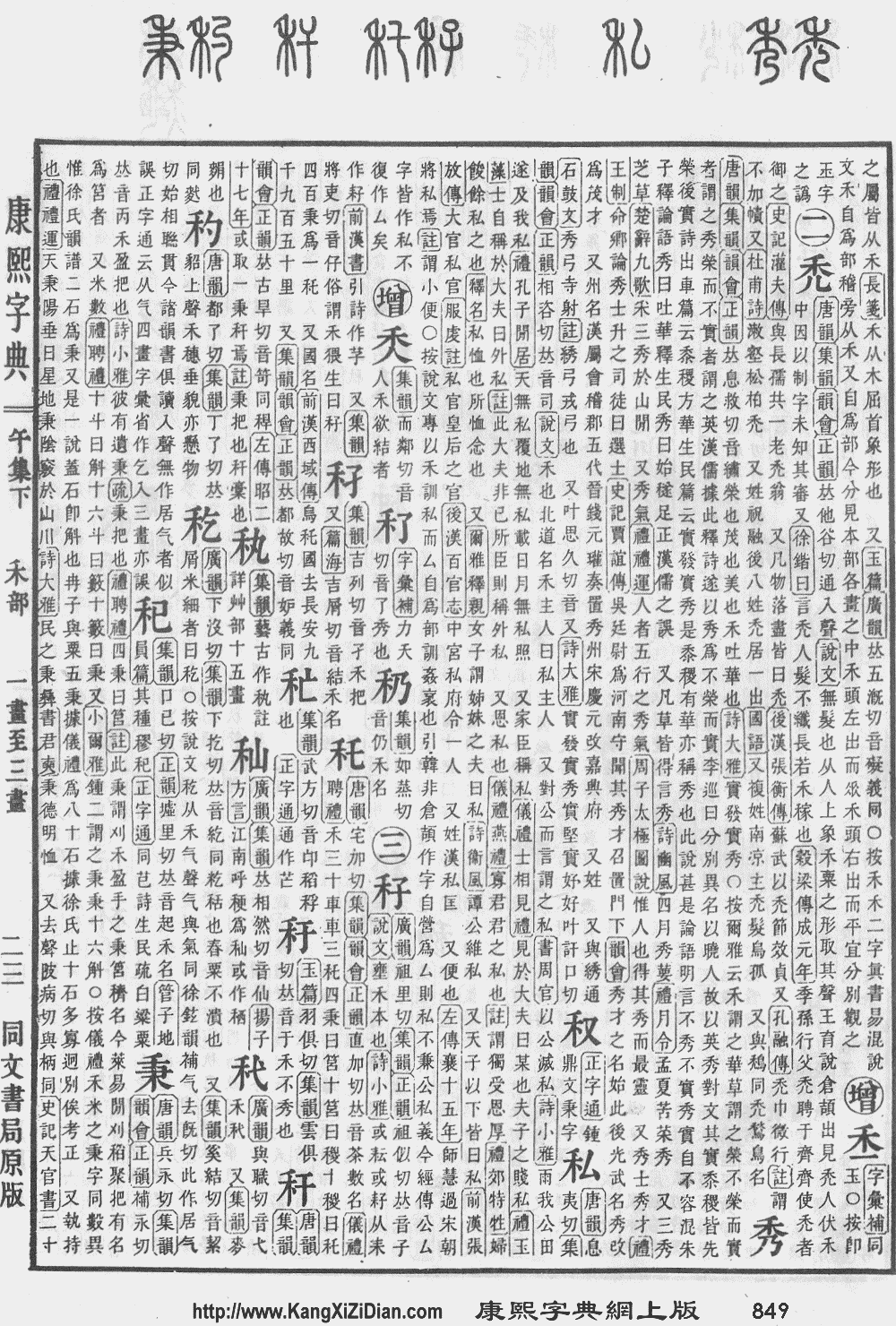
  • Kangxi Dictionary: page 849, character 21
  • Dai Kanwa Jiten: character 24932
  • Dae Jaweon: page 1272, character 17
  • Hanyu Da Zidian (first edition): volume 4, page 2592, character 5
  • Unihan data for U+79C9

Chinese

simp. and trad.
秉

Glyph origin

Historical forms of the character 秉
Shang Western Zhou Shuowen Jiezi (compiled in Han) Liushutong (compiled in Ming)
Oracle bone script Bronze inscriptions Small seal script Transcribed ancient scripts

Ideogrammic compound (會意/会意) : 禾 (“plant”) + 又 (“hand”) — a hand holding a plant by the stalk. Compare: 兼, a hand holding two plants.

Etymology

Cognate with 柄 (OC *praŋʔ, *praŋs, “a handle”), which is exopassive of 秉 (OC *praŋʔ, “to grasp”).

Pronunciation


Rime
Character 秉
Reading # 1/1
Initial (聲) 幫 (1)
Final (韻) 庚 (111)
Tone (調) Rising (X)
Openness (開合) Open
Division (等) III
Fanqie 兵永切
Baxter pjaengX
Reconstructions
Zhengzhang
Shangfang
/pˠiæŋX/
Pan
Wuyun
/pᵚiaŋX/
Shao
Rongfen
/piaŋX/
Edwin
Pulleyblank
/piajŋX/
Li
Rong
/piɐŋX/
Wang
Li
/pĭɐŋX/
Bernard
Karlgren
/pi̯ɐŋX/
Expected
Mandarin
Reflex
bǐng
Expected
Cantonese
Reflex
bing2
Baxter–Sagart system 1.1 (2014)
Character 秉
Reading # 1/1
Modern
Beijing
(Pinyin)
bǐng
Middle
Chinese
‹ pjængX ›
Old
Chinese
/*praŋʔ/
English grasp

Notes for Old Chinese notations in the Baxter–Sagart system:

* Parentheses "()" indicate uncertain presence;
* Square brackets "[]" indicate uncertain identity, e.g. *[t] as coda may in fact be *-t or *-p;
* Angle brackets "<>" indicate infix;
* Hyphen "-" indicates morpheme boundary;

* Period "." indicates syllable boundary.
Zhengzhang system (2003)
Character 秉
Reading # 1/1
No. 899
Phonetic
component
秉
Rime
group
陽
Rime
subdivision
0
Corresponding
MC rime
丙
Old
Chinese
/*praŋʔ/

Definitions

秉

  1. a handful of crops
  2. to grasp; to hold
  3. to preside over
  4. to persist in; to persevere

Compounds

  • 一秉至公
  • 伊秉綬/伊秉绶
  • 內秉堅孤/内秉坚孤
  • 公秉
  • 披秉
  • 當風秉燭/当风秉烛
  • 秉公 (bǐnggōng)
  • 秉公無私/秉公无私
  • 秉國/秉国 (bǐngguó)
  • 秉彝
  • 秉心
  • 秉性 (bǐngxìng)
  • 秉承 (bǐngchéng)
  • 秉持 (bǐngchí)
  • 秉文
  • 秉正 (bǐngzhèng)
  • 秉燭/秉烛 (bǐngzhú)
  • 秉燭夜遊/秉烛夜游
  • 秉燭達旦/秉烛达旦
  • 秉笏披袍
  • 秉筆/秉笔 (bǐngbǐ)
  • 秉筆直書/秉笔直书 (bǐngbǐzhíshū)
  • 秉臺衡/秉台衡
  • 秉要執本/秉要执本
  • 秉賦/秉赋 (bǐngfù)
  • 秉鈞/秉钧
  • 秉鉞/秉钺
  • 秉鐸/秉铎
  • 風中秉燭/风中秉烛

Japanese

Kanji

秉

(uncommon “Hyōgai” kanji)

  1. take
  2. cherish
  3. sheaf
  4. unit of volume (10 koku; 1,800 l)

Readings

  • Go-on: ひょう (hyō)
  • Kan-on: へい (hei)
  • Kun: とる (toru)

Korean

Hanja

秉 (eum 병 (byeong))

  1. This term needs a translation to English. Please help out and add a translation, then remove the text {{rfdef}}.

Vietnamese

Han character

秉: Hán Nôm readings: bỉnh, bảnh

  1. This term needs a translation to English. Please help out and add a translation, then remove the text {{rfdef}}.
This article is issued from Wiktionary. The text is licensed under Creative Commons - Attribution - Sharealike. Additional terms may apply for the media files.