又
| ||||||||
| ||||||||
Translingual
| Stroke order | |||
|---|---|---|---|
 | |||
| Stroke order | |||
|---|---|---|---|
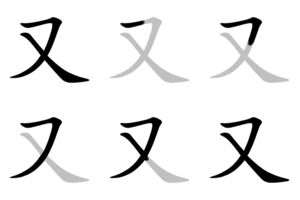 | |||
Han character
又 (Kangxi radical 29, 又+0, 2 strokes, cangjie input 弓大 (NK), four-corner 17400 or 77400, composition ⿻㇇㇏)
- Kangxi radical #29, ⼜.
- Shuowen Jiezi radical №76
Derived characters
- Appendix:Chinese radical/又
- 仅, 𠘫, 叹, 𪢲, 奴, 𫲡, 𡯉, 𫵴, 𢎤, 𭠎, 汉, 𨸕, 𡯅, 𪱙, 权, 𤕭, 𪻍, 𤰖, 𥃫, 𥝐, 𣦼, 𣦻, 𮕧, 𥸩, 臤, 𭁥, 𡊋, 𭐶, 𮍍, 𧺉, 𬩴, 𮮃, 𭰇, 𨥁, 𩚄, 𦒺, 𧆤, 馭(驭), 𬴲, 𩵎, 𣕒, 𧧙, 𪎳
- 𠚫, 劝, 𠨏, 对, 邓, 戏, 欢, 艰, 覌(观), 𪠂, 难, 𩑌, 鳮(鸡), 圣, 𠮢, 𡚩, 𤆆, 𦘬, 𦤵, 𧈡, 𧠈(𬢇), 𬥎
- 支, 攴, 殳, 𪠲, 㝊, 𭐟, 𦫿, 𤆌, 𠇀, 𤼦, 𥤦, 𡧌, 𢆼, 㝕, 隻, 𠵬, 𫳓, 曼, 䯭, 𥆣, 𦴋, 𡩠, 𣺎, 𤔪, 燮, 雙, 矍
- 㞋, 𭙎, 𤴨, 𧆛, 𮓚, 𤔔, 𤶯, 𪗅, 𭅄, 夃, 𠕀, 凤, 㘝
Further reading
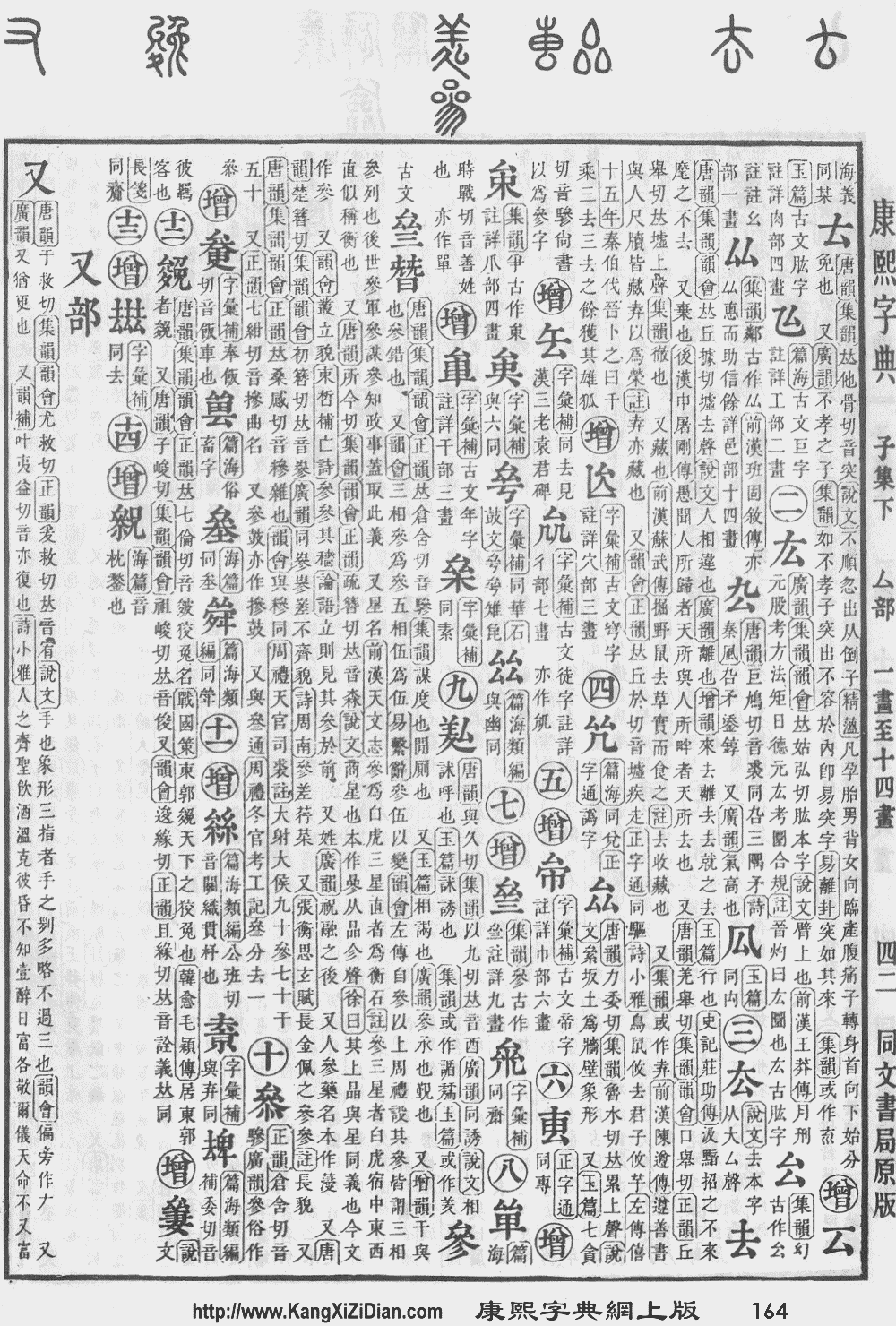
- Kangxi Dictionary: page 164, character 43
- Dai Kanwa Jiten: character 3115
- Dae Jaweon: page 374, character 14
- Hanyu Da Zidian (first edition): volume 1, page 390, character 1
- Unihan data for U+53C8
Chinese
| simp. and trad. |
又 | |
|---|---|---|
Glyph origin
| Historical forms of the character 又 | ||||
|---|---|---|---|---|
| Shang | Western Zhou | Warring States | Shuowen Jiezi (compiled in Han) | Liushutong (compiled in Ming) |
| Oracle bone script | Bronze inscriptions | Chu slip and silk script | Small seal script | Transcribed ancient scripts |
 |
 |
 |
 |
 |
Pictogram (象形) – a right hand. Original form of 右 (OC *ɢʷɯʔ, *ɢʷɯs, “right”).
Etymology
Adverbial derivation of 有 (OC *ɢʷɯʔ, “to have; there is”) (Schuessler, 2007).
Pronunciation
Definitions
又
- again; once more
- Used to express the coexistence of several conditions or qualities; both ... and ...
- also; in addition
- 神就造出大魚和水中所滋生各樣有生命的動物,各從其類。又造出各樣飛鳥,各從其類。神看著是好的。 [MSC, trad.]
- From: 新標點和合本 (Chinese Union Version with New Punctuation), 創世記 (Genesis) 1:21
- Shén jiù zào chū dà yú hé shuǐ zhōng suǒ zīshēng gèyàng yǒu shēngmìng de dòngwù, gè cóng qí lèi. Yòu zào chū gèyàng fēiniǎo, gè cóng qí lèi. Shén kàn zhuó shì hǎo de. [Pinyin]
- And God created great whales, and every living creature that moveth, which the waters brought forth abundantly, after their kind, and every winged fowl after his kind: and God saw that it was good.
神就造出大鱼和水中所滋生各样有生命的动物,各从其类。又造出各样飞鸟,各从其类。神看着是好的。 [MSC, simp.]
- Used between a whole number and a fraction
- but; on the other hand
- Used in negative statements and rhetorical questions for emphasis
Usage notes
Compared to 再 (zài) which is used for something that has not happened, 又 (yòu) is used for something that already happened.
Synonyms
| Variety | Location | Words |
|---|---|---|
| Formal (Written Standard Chinese) | 又 | |
| Mandarin | Beijing | 又 |
| Taiwan | 又 | |
| Jinan | 又 | |
| Xi'an | 又 | |
| Wuhan | 又 | |
| Chengdu | 又 | |
| Guilin | 又 | |
| Yangzhou | 又 | |
| Hefei | 又 | |
| Cantonese | Guangzhou | 又, 又試 |
| Hong Kong | 又, 又試 | |
| Yangjiang | 又 | |
| Gan | Nanchang | 又 |
| Hakka | Meixian | 又 |
| Jin | Taiyuan | 又 |
| Northern Min | Jian'ou | 又, 已 |
| Eastern Min | Fuzhou | 復 |
| Southern Min | Xiamen | 閣, 閣再, 又閣再, 又閣 |
| Quanzhou | 閣, 閣再, 又閣再, 又閣 | |
| Zhangzhou | 閣, 閣再, 又閣再, 又閣 | |
| Taipei | 閣 GT, 閣再 GT, 又閣 GT | |
| Singapore (Hokkien) | 閣, 閣再, 又閣 | |
| Manila (Hokkien) | 閣, 閣再 | |
| Chaozhou | 又, 又再 | |
| Shantou | 又 | |
| Wu | Shanghai | 再, 又 |
| Suzhou | 亦 | |
| Wenzhou | 亦 | |
| Xiang | Changsha | 又 |
| Shuangfeng | 又 | |
| Note | GT - General Taiwanese (no specific region identified) | |
See also
- (again): 再 (zài)
Compounds
- 一又
- 三又
- 卻又/却又
- 又且
- 又作別論/又作别论
- 又作馮婦/又作冯妇
- 又及
- 又双叒叕
- 又名 (yòumíng)
- 又好笑,又好氣/又好笑,又好气 (yòu hǎo xiào, yòu hǎo qì)
- 又弱一個/又弱一个
- 又急又氣/又急又气
- 又早
- 又是
- 又氣又急/又气又急
- 又生一秦
- 又當別論/又当别论
- 又紅又專/又红又专 (yòu hóng yòu zhuān)
- 又要
- 又試/又试
- 又說又笑/又说又笑
- 又讀/又读
- 又道是
- 又閣/又阁
- 又驚又喜/又惊又喜 (yòujīngyòuxǐ)
- 可又來/可又来
- 少之又少 (shǎozhīyòushǎo)
- 復又/复又
- 損之又損/损之又损
- 日新又新
- 欲言又止
- 玄之又玄 (xuánzhīyòuxuán)
- 賠了夫人又折兵/赔了夫人又折兵 (péi le fūrén yòu zhébīng)
Japanese
| Shinjitai | 又 |  |
| Kyūjitai [1][2][3] |
又󠄂 又+ 󠄂?(Moji_Joho) |
 |
| The displayed kanji may be different from the image due to your environment. See here for details. | ||
Definitions
| Kanji in this term |
|---|
| 又 |
| また Grade: S |
| kun’yomi |
| For pronunciation and definitions of 又 – see the following entry. | ||
| ||
| (This term, 又, is an alternative spelling of the above term.) |
References
- 白川静 (Shirakawa Shizuka) (2014) “又”, in 字通 (Jitsū) (in Japanese), popular edition, Tōkyō: Heibonsha, →ISBN
- Haga, Gōtarō (1914) 漢和大辞書 [The Great Kanji-Japanese Dictionary] (in Japanese), Fourth edition, Tōkyō: Kōbunsha, , page 389 (paper), page 244 (digital)
- Shōundō Henshūjo, editor (1927), 新漢和辞典 [The New Kanji-Japanese Dictionary] (in Japanese), Ōsaka: Shōundō, , page 268 (paper), page 146 (digital)
Korean
Etymology
From Middle Chinese 又 (MC hjuwH).
Pronunciation
- (SK Standard/Seoul) IPA(key): [u(ː)]
- Phonetic hangul: [우(ː)]
- Though still prescribed in Standard Korean, most speakers in both Koreas no longer distinguish vowel length.
Compounds
- 우황 (又況, uhwang)
Old Korean
Alternative forms
- 于 (*wu)
Etymology
Both John B. Whitman and Alexander Francis-Ratté speculate of a connection to Proto-Japonic *wa (“I; me”), although Whitman and Francis-Ratté's belief that Korean and Japanese are genetically linked does not have consensus in the field.
Pronoun
又 (*wu)
Usage notes
This term is given as a native Korean equivalent of the Chinese first-person pronouns 我 and 吾 in plural contexts (Chinese not making the distinction morphologically) in three different sources of Korean-language interpretive gugyeol glosses to the Buddhist canon, made between the tenth and thirteenth centuries. Interpretive gugyeol encodes guidelines by which a Korean speaker could have read out a Classical Chinese text in its native Korean translation, much like Japanese kanbun. These three sources accordingly instruct the Korean reader to pronounce the Chinese first-person pronouns as 又 or 于, allowing us to understand that this is the Old Korean word for "we; us".
The Middle Korean first-person plural pronoun 우리 (wuli, “we; us”) is almost certainly derived from it, although the second syllable remains as yet inexplicable.
Derived terms
- 吾里 (*WUli)
References
- 황선엽 (Hwang Seon-yeop), 이전경 (Yi Jeon-gyeong), 하귀녀 (Ha Gwi-nyeo), 이용 (Yi Yong), 박진호 (Park Jin-ho), 김성주 (Kim Seong-ju), 장경준 (Jang Gyeong-jun), 서민욱 (Seo Min-uk), 이지영 (Yi Ji-yeong), 서형국 (Seo Hyeong-guk). (2009) 석독구결사전/釋讀口訣辭典 [Dictionary of interpretive gugyeol], Bakmunsa, →ISBN
- 이병기 (Yi Byeong-gi) (2014) “구결자료의 어휘 [Gugyeol jaryo-ui eohwi, Vocabulary in the gugyeol sources]”, in Gugyeol Yeon'gu, volume 33, pages 23–61
Vietnamese
References
- Trần (2004).
- Bonet (1899).
- Génibrel (1898).
- Hồ (1976).
- Trần (1999).