羌

See also: 羗
羌 U+7F8C, 羌
CJK UNIFIED IDEOGRAPH-7F8C
← 羋
[U+7F8B]
CJK Unified Ideographs 羍 →
[U+7F8D]

Translingual

Han character

羌 (Kangxi radical 123, 羊+2 in traditional Chinese, 羊+1 in simplified Chinese, 8 strokes in traditional Chinese, 7 strokes in simplified Chinese, cangjie input 廿土竹山 (TGHU) or 廿手山 (TQU), four-corner 80211, composition ⿸⺶乚(G) or ⿱𦍌儿(HTJK))

Derived characters

References

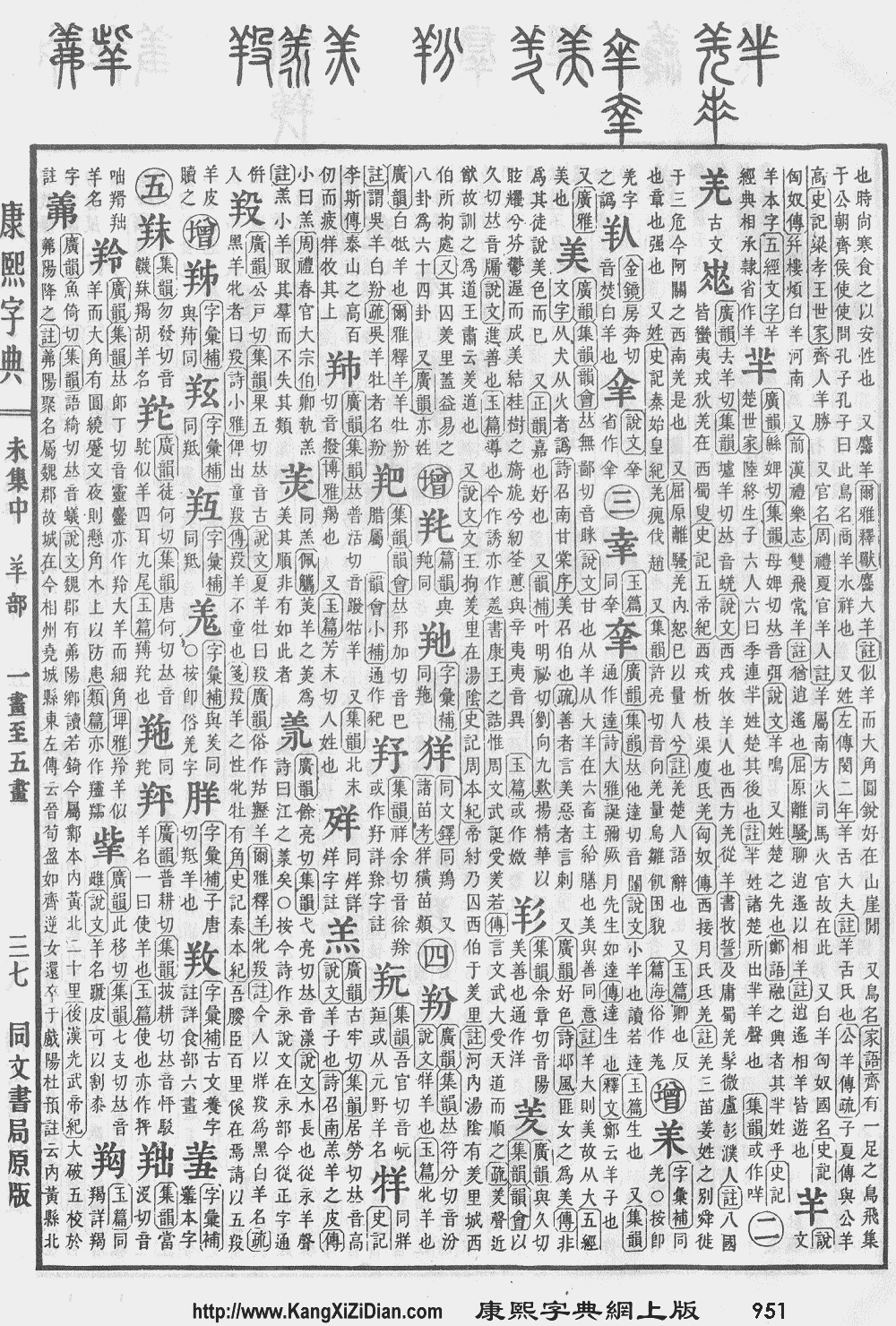
  • Kangxi Dictionary: page 951, character 3
  • Dai Kanwa Jiten: character 28429
  • Dae Jaweon: page 1393, character 11
  • Hanyu Da Zidian (first edition): volume 5, page 3125, character 3
  • Unihan data for U+7F8C

Chinese

trad. 羌
simp. # 羌
alternative forms
 
羗
𦍑
猐
𠒌
𡸓
羗
𦍑
猐
𠒌
𡸓
𡹽
𡺛
𦍎

Glyph origin

Etymology

Unclear.

Pulleyblank (1983) suggests a derivation from 羊 (OC *laŋ).

Schuessler (2007) prefers to relate it to Proto-Tibeto-Burman *s-klawŋ (“to guard; to herd; to tend (cattle); to graze; to be at leisure”), whence Tibetan སྐྱོང (skyong, “to guard; to nurture; to keep; to care for”), Asho Chin klóng (“to herd; to graze”), Burmese ကျောင်း (kyaung:, “to feed; to tend (cattle)”); then 羌 means "herders". Compare 養 (OC *laŋʔ, *laŋs, “to raise; to nourish”).

Beckwith (2009) proposes a possible Indo-European origin; compare Tocharian B klank- (“to ride; to go by chariot”).

Pronunciation


Rime
Character 羌
Reading # 1/1
Initial (聲) 溪 (29)
Final (韻) 陽 (105)
Tone (調) Level (Ø)
Openness (開合) Open
Division (等) III
Fanqie 去羊切
Baxter khjang
Reconstructions
Zhengzhang
Shangfang
/kʰɨɐŋ/
Pan
Wuyun
/kʰiɐŋ/
Shao
Rongfen
/kʰiɑŋ/
Edwin
Pulleyblank
/kʰɨaŋ/
Li
Rong
/kʰiaŋ/
Wang
Li
/kʰĭaŋ/
Bernard
Karlgren
/kʰi̯aŋ/
Expected
Mandarin
Reflex
qiāng
Expected
Cantonese
Reflex
hoeng1
Baxter–Sagart system 1.1 (2014)
Character 羌
Reading # 1/1
Modern
Beijing
(Pinyin)
qiāng
Middle
Chinese
‹ khjang ›
Old
Chinese
/*C.qʰaŋ/
English western tribes

Notes for Old Chinese notations in the Baxter–Sagart system:

* Parentheses "()" indicate uncertain presence;
* Square brackets "[]" indicate uncertain identity, e.g. *[t] as coda may in fact be *-t or *-p;
* Angle brackets "<>" indicate infix;
* Hyphen "-" indicates morpheme boundary;

* Period "." indicates syllable boundary.
Zhengzhang system (2003)
Character 羌
Reading # 1/1
No. 14531
Phonetic
component
羊
Rime
group
陽
Rime
subdivision
0
Corresponding
MC rime
羌
Old
Chinese
/*kʰlaŋ/

Definitions

羌

  1. (~族, ~人) Qiang people
  2. Name of a historical tribe in ancient China.
  3. muntjac (species of deer)
    山羌  ―  shānqiāng  ―  Reeves's muntjac
  4. (obsolete) Meaningless sentence-initial particle, often used in the Chuci.
  5. a surname

Compounds

Japanese

Kanji

羌

(uncommon “Hyōgai” kanji)

  1. This term needs a translation to English. Please help out and add a translation, then remove the text {{rfdef}}.

Readings

Korean

Hanja

羌 • (gang) (hangeul 강, revised gang, McCune–Reischauer kang, Yale kang)

  1. This term needs a translation to English. Please help out and add a translation, then remove the text {{rfdef}}.

Vietnamese

Han character

羌: Hán Nôm readings: cưng, gừng, khương

  1. This term needs a translation to English. Please help out and add a translation, then remove the text {{rfdef}}.
This article is issued from Wiktionary. The text is licensed under Creative Commons - Attribution - Sharealike. Additional terms may apply for the media files.