蛻

See also: 蜕
蛻 U+86FB, 蛻
CJK UNIFIED IDEOGRAPH-86FB
← 蛺
[U+86FA]
CJK Unified Ideographs 蛼 →
[U+86FC]

Translingual

Han character

蛻 (Kangxi radical 142, 虫+7, 13 strokes, cangjie input 中戈金口山 (LICRU), four-corner 58116, composition ⿰虫兌)

References

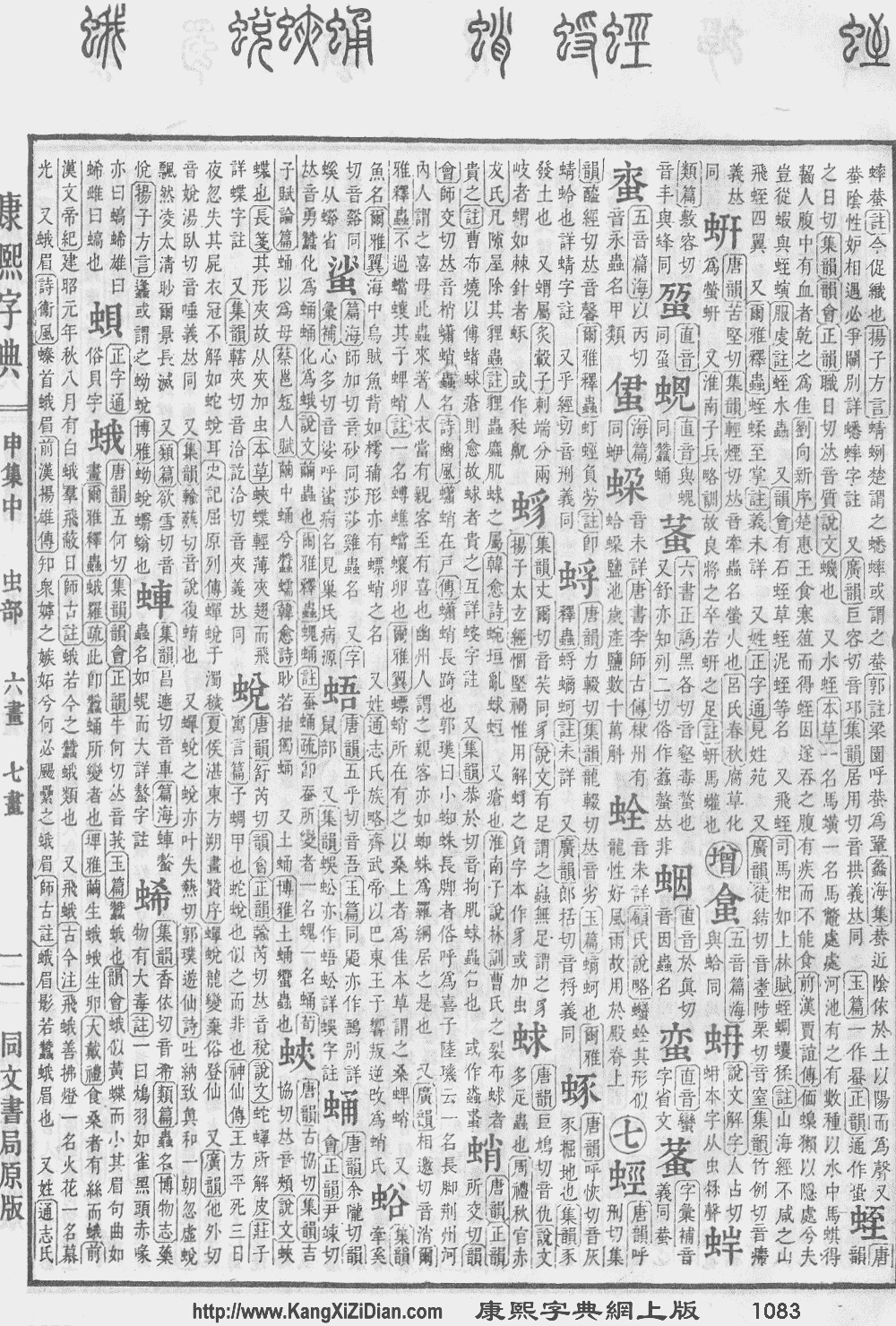
  • Kangxi Dictionary: page 1083, character 27
  • Dai Kanwa Jiten: character 33078
  • Dae Jaweon: page 1551, character 15
  • Hanyu Da Zidian (first edition): not present, would follow volume 4, page 2857, character 11
  • Unihan data for U+86FB

Chinese

trad. 蛻/蜕
simp. 蜕
alternative forms 脫/脱

Glyph origin

Etymology

From Proto-Sino-Tibetan *g/s-lwat (“free, release, slip, dislocate”) (STEDT).

Pronunciation 1


Note:
  • thòe - literary;
  • thuì - vernacular.
    • Wu
      • (Shanghai):
        • Wugniu: 5thoe
        • MiniDict: thoe去
        • Wiktionary Romanisation (Shanghai): 2thoe
        • Sinological IPA (Shanghai): /tʰø³⁴/

Rime
Character 蛻 蛻 蛻
Reading # 1/4 2/4 3/4
Initial (聲) 書 (26) 透 (6) 透 (6)
Final (韻) 祭 (36) 泰 (26) 戈 (95)
Tone (調) Departing (H) Departing (H) Departing (H)
Openness (開合) Closed Closed Closed
Division (等) III I I
Fanqie 舒芮切 他外切 湯卧切
Baxter sywejH thwajH thwaH
Reconstructions
Zhengzhang
Shangfang
/ɕiuᴇiH/ /tʰuɑiH/ /tʰuɑH/
Pan
Wuyun
/ɕʷiɛiH/ /tʰʷɑiH/ /tʰuɑH/
Shao
Rongfen
/ɕiuæiH/ /tʰuɑiH/ /tʰuɑH/
Edwin
Pulleyblank
/ɕwiajH/ /tʰwajH/ /tʰwaH/
Li
Rong
/ɕiuɛiH/ /tʰuɑiH/ /tʰuɑH/
Wang
Li
/ɕĭwɛiH/ /tʰuɑiH/ /tʰuɑH/
Bernard
Karlgren
/ɕi̯wɛiH/ /tʰuɑiH/ /tʰuɑH/
Expected
Mandarin
Reflex
shuì tuì tuò
Expected
Cantonese
Reflex
seoi3 teoi3 to3
Baxter–Sagart system 1.1 (2014)
Character 蛻
Reading # 1/2
Modern
Beijing
(Pinyin)
tuì
Middle
Chinese
‹ thwajH ›
Old
Chinese
/*l̥ˁot-s/
English exuviae of insects or reptiles

Notes for Old Chinese notations in the Baxter–Sagart system:

* Parentheses "()" indicate uncertain presence;
* Square brackets "[]" indicate uncertain identity, e.g. *[t] as coda may in fact be *-t or *-p;
* Angle brackets "<>" indicate infix;
* Hyphen "-" indicates morpheme boundary;

* Period "." indicates syllable boundary.
Zhengzhang system (2003)
Character 蛻 蛻 蛻
Reading # 1/5 2/5 3/5
No. 2542 2543 2554
Phonetic
component
兑 兑 兑
Rime
group
祭 祭 祭
Rime
subdivision
3 3 3
Corresponding
MC rime
娧 稅
Old
Chinese
/*l'oːds/ /*l̥ʰoːds/ /*hljods/

Definitions

蛻

  1. to shed; to molt; to exuviate
  2. exuviae; skin or shell that has been cast off
  3. to change; to metamorphose
  4. (Taoism, Buddhism) to die; to ascend; to depart for one's next life

Compounds

Pronunciation 2


Rime
Character 蛻
Reading # 4/4
Initial (聲) 以 (36)
Final (韻) 薛 (82)
Tone (調) Checked (Ø)
Openness (開合) Closed
Division (等) III
Fanqie 弋雪切
Baxter ywet
Reconstructions
Zhengzhang
Shangfang
/jiuᴇt̚/
Pan
Wuyun
/jʷiɛt̚/
Shao
Rongfen
/juæt̚/
Edwin
Pulleyblank
/jwiat̚/
Li
Rong
/iuɛt̚/
Wang
Li
/jĭuɛt̚/
Bernard
Karlgren
/i̯wɛt̚/
Expected
Mandarin
Reflex
yuè
Expected
Cantonese
Reflex
jyut6
Baxter–Sagart system 1.1 (2014)
Character 蛻
Reading # 2/2
Modern
Beijing
(Pinyin)
yuè
Middle
Chinese
‹ ywet ›
Old
Chinese
/*lot/
English exuviae of insects or reptiles

Notes for Old Chinese notations in the Baxter–Sagart system:

* Parentheses "()" indicate uncertain presence;
* Square brackets "[]" indicate uncertain identity, e.g. *[t] as coda may in fact be *-t or *-p;
* Angle brackets "<>" indicate infix;
* Hyphen "-" indicates morpheme boundary;

* Period "." indicates syllable boundary.
Zhengzhang system (2003)
Character 蛻 蛻
Reading # 4/5 5/5
No. 2574 2578
Phonetic
component
兑 兑
Rime
group
月 月
Rime
subdivision
3 3
Corresponding
MC rime
悅 悅
Old
Chinese
/*lod/ /*lod/

Definitions

蛻

  1. Only used in 蚴蛻/蚴蜕.

Japanese

Kanji

蛻

(uncommon “Hyōgai” kanji)

  1. exuvia, moult

Readings

Compounds

Etymology 1

Kanji in this term
蛻
もぬけ
Hyōgaiji
kun’yomi
For pronunciation and definitions of 蛻 – see the following entry.
【もぬけ】
[noun] exuvia, moult
Alternative spellings
蛻け, 藻抜け
(This term, 蛻, is an alternative spelling of the above term.)

Etymology 2

Kanji in this term
蛻
ぬけがら
Hyōgaiji
kun’yomi
For pronunciation and definitions of 蛻 – see the following entry.
【ぬけがら】
[noun] the molted exoskeleton of an insect or crustacean, exuvia; moult
[noun] hollowed remains (in general)
Alternative spellings
抜け殻, 脱け殻, 抜殻, 脱殻
(This term, 蛻, is an alternative spelling of the above term.)

Korean

Hanja

蛻 • (se) (hangeul 세, revised se, McCune–Reischauer se, Yale sey)

  1. This term needs a translation to English. Please help out and add a translation, then remove the text {{rfdef}}.
This article is issued from Wiktionary. The text is licensed under Creative Commons - Attribution - Sharealike. Additional terms may apply for the media files.