他
- Not to be confused with 也
| ||||||||
Translingual
| Stroke order | |||
|---|---|---|---|
 | |||
| Stroke order | |||
|---|---|---|---|
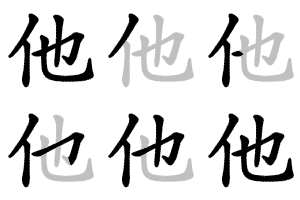 | |||
Han character
他 (Kangxi radical 9, 人+3, 5 strokes, cangjie input 人心木 (OPD), four-corner 24212, composition ⿰亻也)
References
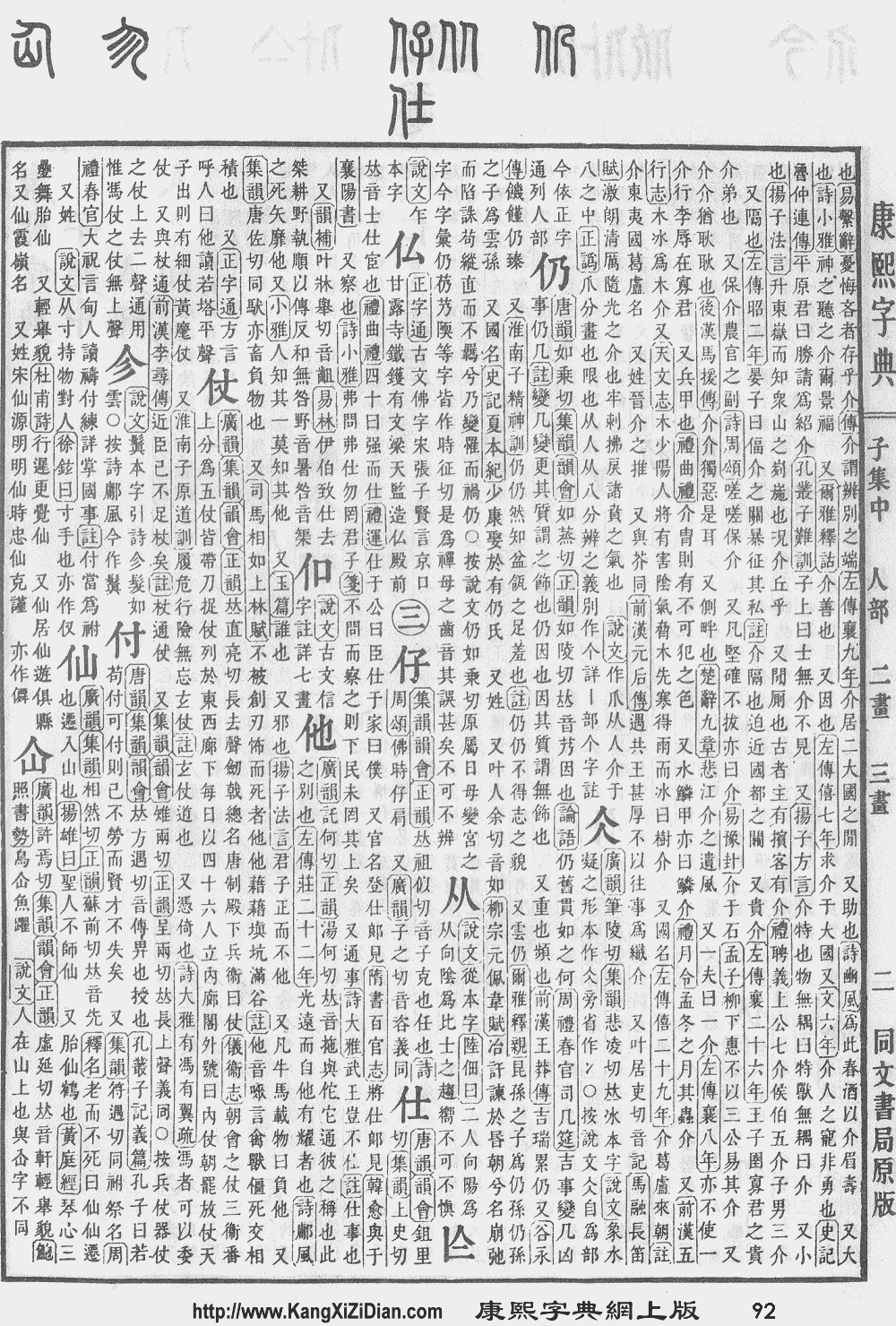
- Kangxi Dictionary: page 92, character 9
- Dai Kanwa Jiten: character 370
- Dae Jaweon: page 195, character 12
- Hanyu Da Zidian (first edition): volume 1, page 115, character 6
- Unihan data for U+4ED6
Chinese
| trad. | 他 | |
|---|---|---|
| simp. # | 他 | |
Glyph origin
| Old Chinese | |
|---|---|
| 他 | *l̥ʰaːl |
| 拖 | *l̥ʰaːl, *l̥ʰaːls |
| 駞 | *l'aːl |
| 池 | *l'aːl, *l'al |
| 灺 | *ljalʔ |
| 鍦 | *ɦljaːl, *hljal, *hljals |
| 虵 | *ɦljal, *laːlʔ, *lal |
| 也 | *laːlʔ |
| 忚 | *hleːl |
| 髢 | *l'eːls |
| 杝 | *l̥ʰalʔ, *l'alʔ, *lal |
| 肔 | *l̥ʰalʔ, *lalʔ |
| 馳 | *l'al |
| 阤 | *l'alʔ, *hljalʔ |
| 施 | *hljal, *hljals |
| 絁 | *hljal |
| 葹 | *hljal |
| 弛 | *hljalʔ |
| 箷 | *lal |
| 衪 | *lel, *lalʔ |
| 暆 | *lel |
| 迆 | *lal, *lalʔ |
| 酏 | *lal, *lalʔ |
| 匜 | *lal, *lalʔ |
| 迤 | *lalʔ |
| 扡 | *lalʔ |
| 崺 | *lalʔ |
| 貤 | *lals, *ɦljels, *lels |
| 地 | *l'els |
Phono-semantic compound (形聲/形声, OC *l̥ʰaːl) : semantic 亻 (“man”) + phonetic 也 (OC *laːlʔ).
Corrupted form of 佗 (OC *l̥ʰaːl, *l'aːl), which is found in Zuozhuan.
Etymology
Etymology not clear (Schuessler, 2007). Perhaps cognate with 誃 (OC *l'al, *l̥ʰjalʔ, “to separate”).
The modern sense of "he, she, it" only emerged after the Han period in colloquial passages, and displaced classical 其 (OC *ɡɯ) and 之 (OC *tjɯ) in mandarin dialects. (Pulleyblank, 1995)
The phonological development from Middle Chinese was irregular. The expected reflex is tuō, which is sometimes used in literary contexts for the classical "other" sense, but in most Mandarin dialects it is read like tā.
Pronunciation
Definitions
他
- (chiefly Mandarin, Jin, Xiang, dialectal Wu, originally gender-neutral; nowadays usually referring to males) he; him; she; her
- 萬物是藉著他造的;凡被造的,沒有一樣不是藉著他造的。 [MSC, trad.]
- From: 新標點和合本 (Chinese Union Version with New Punctuation), 約翰福音 (John) 1:3
- Wànwù shì jièzhe tā zào de; fán bèi zào de, méiyǒu yī yàng bùshì jièzhe tā zào de. [Pinyin]
- All things were made by him; and without him was not any thing made that was made.
万物是借着他造的;凡被造的,没有一样不是借着他造的。 [MSC, simp.]- 他也不怕狼蟲,不懼虎豹,登上山頂上觀看。 [Written Vernacular Chinese, trad.]
- From: Wu Cheng'en, Journey to the West, 16th century CE, translation from The Journey to the West (2012), by Anthony C. Yu
- Tā yě bù pà lángchóng, bù jù hǔbào, dēng shàng shāndǐng shàng guānkàn. [Pinyin]
- Since he was afraid neither of wolves and lizards nor of tigers and leopards, [he] went straight to the mountaintop to look around.
他也不怕狼虫,不惧虎豹,登上山顶上观看。 [Written Vernacular Chinese, simp.]- 我這女學生名叫黛玉。他讀書,凡『敏』字,他皆念作『密』字;寫字,遇著『敏』字亦減一二筆。 [Written Vernacular Chinese, trad.]
- From: Cao Xueqin, Dream of the Red Chamber, mid-18th century CE
- Wǒ zhè nǚxuéshēng míng jiào Dàiyù. Tā dú shū, fán ‘mǐn’ zì, tā jiē niàn zuò ‘mì’ zì; xiě zì, yù zhù ‘mǐn’ zì yì jiǎn yī'èr bǐ. [Pinyin]
- My current girl-pupil – named Daiyu, whenever she reads, she pronounces every character mǐn (敏 "hasty") as mì (密 "honey"); whenever [she] writes, [she] lessens every character 敏's number of strokes by one or two.
我这女学生名叫黛玉。他读书,凡『敏』字,他皆念作『密』字;写字,遇著『敏』字亦减一二笔。 [Written Vernacular Chinese, simp.]
- A dummy pronoun. Compare object pronoun 之 (zhī)
- other; another
- a surname
Usage notes
- (personal pronoun):
- Originally gender-neutral before the 1910s, when the character 她 (tā, “she; her”) was coined; now usually refers to males (also occasionally refers to females).
- This term can refer to a person of unknown gender or there is no need to mention gender of the person referred to, while 他/她 (gender binary) is also used; see also Internet slang TA (tā, “they (singular)”).
Synonyms
Most of the words in the table below are gender-neutral in spoken form.
See also
| Standard Mandarin Chinese personal pronouns | |||
|---|---|---|---|
| Person | Singular | Plural | |
| 1st | — | 我 (wǒ) | 我們/我们 (wǒmen) |
| inclusive | 咱們/咱们 (zánmen) | ||
| 2nd | male/indefinite | 你 (nǐ) | 你們/你们 (nǐmen) |
| female | 妳/你 (nǐ) | 妳們/你们 (nǐmen) | |
| deity | 祢 (nǐ) | 祢們/祢们 (nǐmen) | |
| polite | 您 (nín) | 你們/你们 (nǐmen) 您們/您们 (nínmen) | |
| 3rd | male/indefinite | 他 (tā) | 他們/他们 (tāmen) |
| female | 她 (tā) | 她們/她们 (tāmen) | |
| deity | 祂 (tā) | 祂們/祂们 (tāmen) | |
| animal | 牠/它 (tā) | 牠們/它们 (tāmen) | |
| inanimate | 它 (tā) | 它們/它们 (tāmen) | |
- 其 (qí)
Compounds
- 不他
- 世海他人
- 之死靡他
- 他事 (tāshì)
- 他人 (tārén)
- 他他籍籍
- 他他藉藉/他他借借
- 他他醬/他他酱 (tātājiàng)
- 他倆/他俩 (tā liǎ)
- 他們/他们
- 他們倆/他们俩 (tāmen liǎ)
- 他儂/他侬
- 他出
- 他力
- 他動/他动
- 他動詞/他动词 (tādòngcí)
- 他國/他国 (tāguó)
- 他大
- 他姓
- 他娘
- 他娘的
- 他媽/他妈 (tāmā)
- 他媽媽/他妈妈
- 他媽的/他妈的 (tāmāde)
- 他室
- 他家 (tājiā)
- 他家的事
- 他山
- 他山之攻
- 他山之石
- 他山攻錯/他山攻错
- 他岐
- 他己
- 他年
- 他律 (tālǜ)
- 他心 (tāxīn)
- 他心通
- 他志
- 他意 (tāyì)
- 他懣/他懑
- 他拉他拉
- 他故
- 他敘式/他叙式
- 他方 (tāfāng)
- 他方言語/他方言语
- 他方說/他方说
- 他日 (tārì)
- 他時/他时
- 他殺/他杀 (tāshā)
- 他每
- 他無所有/他无所有
- 他爹
- 他瑪羅池/他玛罗池
- 他生 (tāshēng)
- 他稱/他称 (tāchēng)
- 他端
- 他腸/他肠
- 他處/他处
- 他說/他说
- 他誰/他谁
- 他辰
- 他途
- 他適/他适
- 他遷/他迁
- 他鄉/他乡 (tāxiāng)
- 他鄉外府/他乡外府
- 他鄉外縣/他乡外县
- 他駱拔/他骆拔
- 伽他
- 依他性
- 依他起性
- 假手他人
- 其他 (qítā)
- 利他 (lìtā)
- 利他主義/利他主义 (lìtā zhǔyì)
- 別無他法/别无他法
- 北達科他/北达科他 (Běi-Dákētā)
- 匪他
- 吉他 (jítā)
- 四海他人
- 奢摩他
- 奶烏他/奶乌他
- 安非他命 (ānfēitāmìng)
- 尉他
- 巽他海峽/巽他海峡 (Xùntā Hǎixiá)
- 巽他群島/巽他群岛 (Xùntā Qúndǎo)
- 排他 (páitā)
- 排他性 (páitāxìng)
- 橐他
- 此他
- 水烏他/水乌他
- 潘他唑新
- 無他/无他
- 燕入他家
- 猶他/犹他 (Yóutā)
- 猶他州/犹他州
- 笑罵由他/笑骂由他
- 管他
- 管他的
- 維他命/维他命 (wéitāmìng)
- 自他
- 華他/华他
- 覺他/觉他
- 謾他/谩他
- 貝他係數/贝他系数
- 貝他射線/贝他射线
- 貝他蛻變/贝他蜕变
- 電吉他/电吉他 (diànjítā)
- 非他
- 靡他
- 顧而言他/顾而言他
- 馬爾他/马尔他 (Mǎ'ěrtā)
Descendants
- Wutunhua: ta (“he; she; it”)
References
- “他”, in 漢語多功能字庫 (Multi-function Chinese Character Database), 香港中文大學 (the Chinese University of Hong Kong), 2014–
Japanese
Readings
Compounds
- 他意 (tai, “another meaning (for one's behavior or speech)”)
- 他我 (taga, “other minds”)
- 他界 (takai, “the world after death”)
- 他殺 (tasatsu, “murder”)
- 他動詞 (tadōshi, “transitive verb”)
- 他人 (tanin, “unrelated person”)
- 他愛 (tāi, “altruism”)
- 他家 (take)
- 他覚症 (takakushō)
- 他覚的 (takakuteki)
- 他郷 (takyō)
- 他見 (taken)
- 他言 (tagon, “telling the other persons”)
- 他行 (tagyō)
- 他国 (takoku, “the other country”)
- 他山 (tazan)
- 他事 (taji)
- 他社 (tasha, “the other company”)
- 他者 (tasha)
- 他出 (tashutsu)
- 他所 (tasho)
- 他称 (tashō)
- 他心 (tashin)
- 他生 (tashō)
- 他薦 (tasen)
- 他念 (tanen)
- 他派 (taha)
- 他物 (tabutsu)
- 他聞 (tabun)
- 他方 (tahō)
- 他面 (tamen)
- 他律 (taritsu)
- 他流 (taryū)
- 他力 (tariki)
| Kanji in this term |
|---|
| 他 |
| ほか Grade: 3 |
| kun’yomi |
| Kanji in this term |
|---|
| 他 |
| た Grade: 3 |
| on’yomi |
Pronunciation
Noun
- another, other, some other
- この他にも行き先がありますか。
- Kono hoka ni mo yukisaki ga arimasu ka.
- Do you have any other destinations?
- この事業は他を利するために開始されました。
- Kono jigyō wa ta o risuru tame ni kaishi saremashita.
- This project was started in order to benefit others.
- 他にだれが手伝いに行きますか。
- Hoka ni dare ga tetsudai ni ikimasu ka.
- Who else will go to help you?
- この他にも行き先がありますか。
Idioms
- 他でもない (hoka de mo nai): “there isn't anything else” → “specifically what I want to say is...” (used to emphasize what one is about to say)
- 他に累を及ぼす (ta ni rui o oyobosu): “extend the involvement (entanglement) to others” → involve others in trouble
- 他に例を見ない (ta ni rei o minai): “an example not seen in others” → incomparable
- 他の言に惑わされる (ta no gen ni madowasareru): “to be led astray by others' words”
References
- Matsumura, Akira, editor (2006), 大辞林 [Daijirin] (in Japanese), Third edition, Tōkyō: Sanseidō, →ISBN
- NHK Broadcasting Culture Research Institute, editor (1998), NHK日本語発音アクセント辞典 [NHK Japanese Pronunciation Accent Dictionary] (in Japanese), Tōkyō: NHK Publishing, →ISBN
Korean
Vietnamese
Han character
他: Hán Nôm readings: tha, thà, thè, thơ
- This term needs a translation to English. Please help out and add a translation, then remove the text
{{rfdef}}.