釆
| ||||||||
| ||||||||
Translingual
| Stroke order | |||
|---|---|---|---|
 | |||
Han character
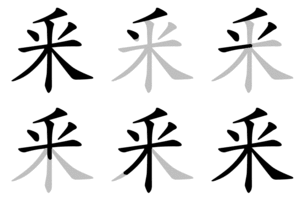
釆 (Kangxi radical 165, 釆+0, 7 strokes, cangjie input 竹火木 (HFD) or 難竹火木 (XHFD), four-corner 20909, composition ⿱丿米 or ⿻禾丷)
- Kangxi radical #165, ⾤.
- Shuowen Jiezi radical №17
Derived characters
References
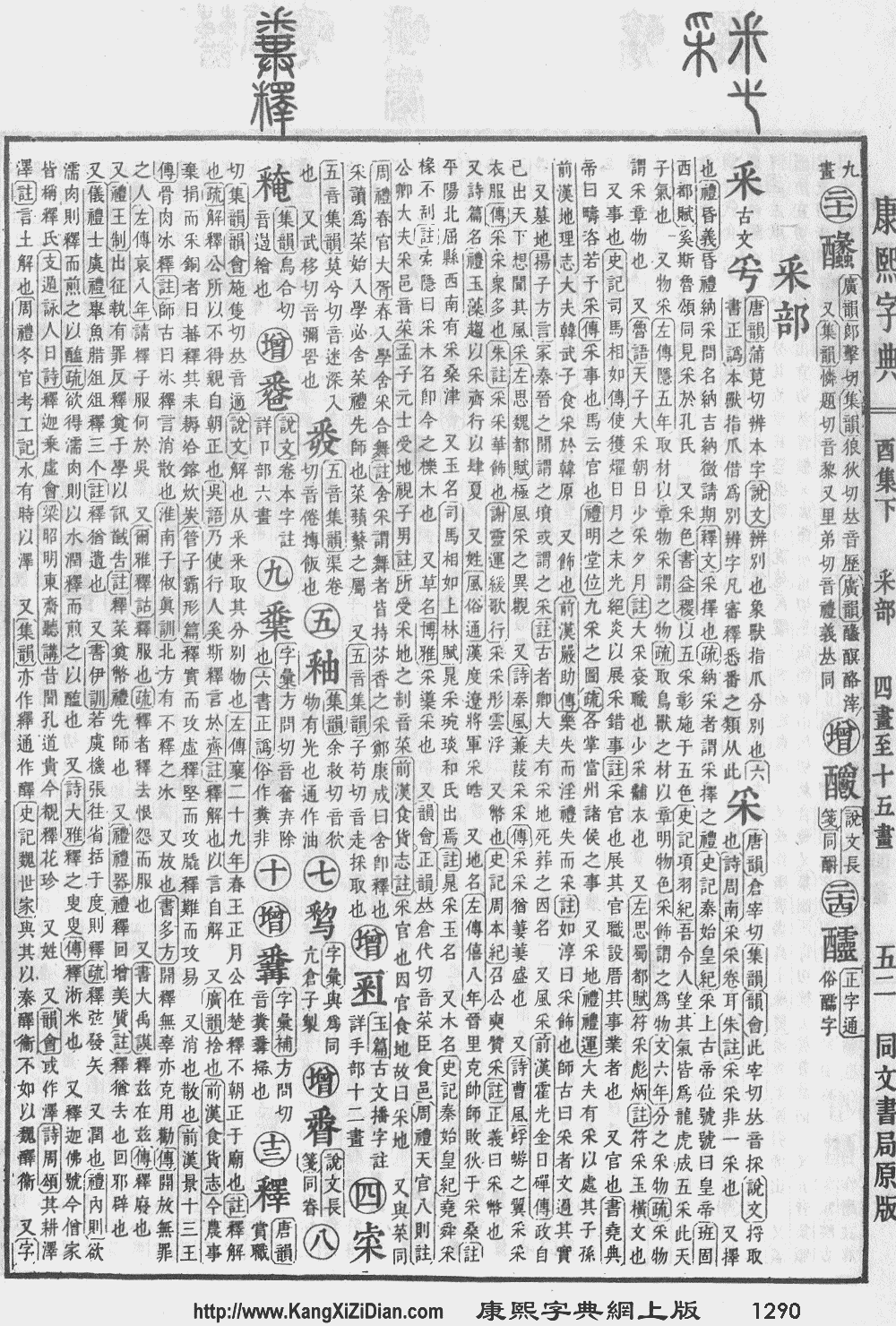
- Kangxi Dictionary: page 1290, character 4
- Dai Kanwa Jiten: character 40115
- Dae Jaweon: page 1790, character 8
- Hanyu Da Zidian (first edition): volume 6, page 3898, character 1
- Unihan data for U+91C6
Chinese
| simp. and trad. |
釆 | |
|---|---|---|
Glyph origin
| Historical forms of the character 釆 | |||
|---|---|---|---|
| Shang | Western Zhou | Shuowen Jiezi (compiled in Han) | Liushutong (compiled in Ming) |
| Oracle bone script | Bronze inscriptions | Small seal script | Transcribed ancient scripts |
 |
 |
 |
 |
Pictogram (象形) . An animal paw feeling for something.
Etymology
Exopassive of 辨 (OC *brenʔ, “to divide, distinguish, discriminate”); possibly in the same word-family as another exopassive 瓣 (OC *breːns, “what is divided”). These three thus may be related to either 班 (OC *praːn, “to distribute → to arrange, classify → class, group”) or Mizo pʰel (“to split, cut in halves”) (with medial *-r- dropped after labial initials according to Mizo phonotactics) (Schuessler, 2007).
Pronunciation
Japanese
Korean
Hanja
釆 • (byeon) (hangeul 변, revised byeon, McCune–Reischauer pyŏn, Yale pyen)
- distinguish
- KangXi radical 165
Vietnamese
This article is issued from Wiktionary. The text is licensed under Creative Commons - Attribution - Sharealike. Additional terms may apply for the media files.