班
| ||||||||
Translingual
| Stroke order | |||
|---|---|---|---|
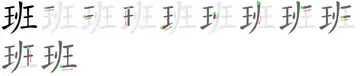 | |||
Han character
班 (Kangxi radical 96, 玉+6, 10 strokes, cangjie input 一土戈中土 (MGILG), four-corner 11114, composition ⿲𤣩刂王 or ⿴玨刂)
References
- Kangxi Dictionary: page 731, character 19
- Dai Kanwa Jiten: character 20976
- Dae Jaweon: page 1142, character 29
- Hanyu Da Zidian (first edition): volume 2, page 1113, character 3
- Unihan data for U+73ED

Chinese
| trad. | 班 | |
|---|---|---|
| simp. # | 班 | |
| alternative forms | 𤤻 𤦦 𣪂 𤼬 | |
Glyph origin
| Historical forms of the character 班 | ||
|---|---|---|
| Western Zhou | Shuowen Jiezi (compiled in Han) | Liushutong (compiled in Ming) |
| Bronze inscriptions | Small seal script | Transcribed ancient scripts |
 |
 |
 |
Ideogrammic compound (會意/会意) : 玨 (“two jade”) + 刀 (“knife”) – to cut jade to pieces with knife.
Etymology
From Proto-Sino-Tibetan *(b/p)ral (“to leave, depart, separate”) (STEDT). Cognate with Tibetan བྲལ་བ (bral ba, “to be separated”), འཕྲལ་བ ('phral ba, “to cause to be separated, to separate”), Miju phɑ̆l⁵³ (“to pull (weeds)”), phɹɯl⁵⁵ lɑ³⁵ (“to collapse”), Thulung phal si- (“to collapse”), Burmese ပြား (pra:, “various”), Jingpho pə³¹-ran³¹.
Karlgren (1933) grouped 班 (OC *praːn), 半 (OC *paːns), and 釆 (OC *brens) into one word family.
Schuessler (2007) also pointed to Austroasiatic comparanda semantically closer to Chinese; such as Khmer រាល (riəl, “to spread, extend, distribute”) and Khmer ព្រាល (priəl, “to spread”) with causative prefix *p-.
Possibly the same etymon as 斑 (OC *praːn, “variegated, spotted, striped”), which may be cognate to 羆 (OC *pral, “brown bear”) (Zhang, 2019).
Pronunciation
Definitions
班
- group; party; class
- (military) squad
- shift; work shift
- (dated) opera troupe
- 徽班 ― Huī bān ― Anhui troupe
- 班本 ― bānběn ― opera script
- (literary) to divide; to distribute
- 既葬,子碩欲以賻布之餘具祭器。子柳曰:「不可,吾聞之也:君子不家於喪。請班諸兄弟之貧者。」 [Classical Chinese, trad.]
- From: The Book of Rites, c. 4th – 2nd century BCE
- Jì zàng, Zǐshuò yù yǐ fùbù zhī yú jù jìqì. Zǐliǔ yuē: “Bùkě, wú wén zhī yě: jūnzǐ bù jiā yú sàng. Qǐng bān zhū xiōngdì zhī pín zhě.” [Pinyin]
- After the burial, Zi-shi wished to take what remained of the money and other things contributed towards their expenses, to provide sacrificial vessels; but Zi-liu said, 'Neither can that be done. I have heard that a superior man will not enrich his family by means of his mourning. Let us distribute it among the poor of our brethren.'
既葬,子硕欲以赙布之余具祭器。子柳曰:「不可,吾闻之也:君子不家于丧。请班诸兄弟之贫者。」 [Classical Chinese, simp.]
- (literary) to spread out
- 伍舉奔鄭,將遂奔晉,聲子將如晉,遇之於鄭郊,班荊相與食,而言復故。 [Classical Chinese, trad.]
- From: Commentary of Zuo, c. 4th century BCE
- Wǔ Jǔ bēn Zhèng, jiāng suì bēn Jìn, Shēngzǐ jiāng rú Jìn, yù zhī yú Zhèng jiāo, bān jīng xiāngyǔ shí, ér yán fù gù. [Pinyin]
- (please add an English translation of this usage example)
伍举奔郑,将遂奔晋,声子将如晋,遇之于郑郊,班荆相与食,而言复故。 [Classical Chinese, simp.]
- (literary) to rank; to arrange
- (literary) rank; grade
- (literary) equal; in the same rank
- (alt. form 頒/颁) (literary) to promulgate; to issue
- 是月也,天子乃教於田獵,以習五戎,班馬政。 [Classical Chinese, trad.]
- From: The Book of Rites, c. 4th – 2nd century BCE
- Shì yuè yě, tiānzǐ nǎi jiào yú tiánliè, yǐ xí wǔróng, bān mǎzhèng. [Pinyin]
- In this month the son of Heaven, by means of hunting, teaches how to use the five weapons of war, and the rules for the management of horses.
是月也,天子乃教于田猎,以习五戎,班马政。 [Classical Chinese, simp.]
- Classifier for a group of people.
- 可是一班別有心腸的人們,便竭力來阻遏它,要使孩子的世界中,沒有一絲樂趣。 [MSC, trad.]
- From: 1928, Lu Xun, 二十四孝圖
- Kěshì yī bān bié yǒu xīncháng de rénmen, biàn jiélì lái zǔ'è tā, yào shǐ háizǐ de shìjiè zhōng, méiyǒu yī sī lèqù. [Pinyin]
- (please add an English translation of this usage example)
可是一班别有心肠的人们,便竭力来阻遏它,要使孩子的世界中,没有一丝乐趣。 [MSC, simp.]
- Classifier for scheduled forms of transportation, such as flights and trains.
- (in compounds, of transport) regular; scheduled
- 班船 ― bānchuán ― scheduled ferry
- (Cantonese) Classifier for classes.
- (Cantonese, figurative) league; rank; level; ability; competence
- (Cantonese) to gather; to assemble
- (literary) to withdraw
- Alternative form of 斑 (bān, “spotted; striped”)
- a surname
- 班固 ― Bān Gù ― Ban Gu (historian)
Usage notes
- (military): Under the National Revolutionary Army, a platoon (排) was composed of three squads. With the infantry, the infantry squad would be composed of 14 soldiers, of 10 riflemen, and one light machine gun unit.
Compounds
- 一人班
- 一班
- 一班一輩/一班一辈
- 一班兒/一班儿
- 一班半點/一班半点
- 上班 (shàngbān)
- 下班 (xiàbān)
- 三班六房
- 上班族 (shàngbānzú)
- 中班 (zhōngbān)
- 交班 (jiāobān)
- 代班
- 仙班
- 值班 (zhíbān)
- 倒班
- 分班
- 分班序齒/分班序齿
- 加班 (jiābān)
- 加班車/加班车
- 包班制
- 升班 (shēngbān)
- 南班子
- 原班人馬/原班人马
- 同班 (tóngbān)
- 唱詩班/唱诗班 (chàngshībān)
- 塞班島/塞班岛 (Sàibān Dǎo)
- 夜班 (yèbān)
- 大夜班
- 大班 (dàbān)
- 女班頭/女班头
- 安親班/安亲班 (ānqīnbān)
- 小夜班
- 小班 (xiǎobān)
- 屈豔班香/屈艳班香
- 布利斯班
- 常態分班/常态分班
- 幫班/帮班
- 年班
- 序班
- 弄斧班門/弄斧班门
- 彈性上班/弹性上班
- 後段班/后段班
- 德爾班/德尔班
- 慢班 (mànbān)
- 戲班/戏班 (xìbān)
- 才藝班/才艺班
- 拖班
- 拿班
- 拿班作勢/拿班作势
- 按部就班 (ànbùjiùbān)
- 捐班
- 捉班做勢/捉班做势
- 接班 (jiēbān)
- 排班 (páibān)
- 探班 (tànbān)
- 掌班
- 接班人 (jiēbānrén)
- 插班 (chābān)
- 換班/换班 (huànbān)
- 搭班子
- 放牛班
- 早班 (zǎobān)
- 晚班 (wǎnbān)
- 暑修班
- 替班 (tìbān)
- 朝班
- 末班車/末班车 (mòbānchē)
- 林班
- 檔子班/档子班
- 歇班
- 清吟小班
- 減班/减班
- 班代
- 班代表
- 班克斯島/班克斯岛
- 班公錯/班公错 (Bāngōngcuò)
- 班兵
- 班列
- 班別/班别 (bānbié)
- 班功行賞/班功行赏
- 班史
- 班圖族/班图族
- 班基 (Bānjī)
- 班姬詠扇/班姬咏扇
- 班子 (bānzi)
- 班導師/班导师
- 班師/班师 (bānshī)
- 班師回朝/班师回朝 (bānshīhuícháo)
- 班師得勝/班师得胜
- 班序
- 班底 (bāndǐ)
- 班房 (bānfáng)
- 珠斗爛班
- 班會/班会 (bānhuì)
- 班機/班机 (bānjī)
- 班次 (bāncì)
- 班母 (bānmǔ)
- 班毛
- 班班 (bānbān)
- 班班可考
- 班禪/班禅 (bānchán)
- 班禪喇嘛/班禅喇嘛 (bānchán lǎma)
- 班竹 (Bānzhú)
- 班級/班级 (bānjí)
- 班組/班组 (bānzǔ)
- 班美之戰/班美之战
- 班艾島/班艾岛
- 班范
- 班荊/班荆
- 班荊道故/班荆道故
- 班荊道舊/班荆道旧
- 班蘭/班兰 (bānlán)
- 班行
- 班衣戲綵/班衣戏彩
- 班資/班资
- 班車/班车 (bānchē)
- 班軍/班军
- 班輩/班辈 (bānbèi)
- 班輪/班轮 (bānlún)
- 班迭棉吉 (Bāndié Miánjí)
- 班達海/班达海
- 班達群島/班达群岛
- 班部
- 班都斯山
- 班長/班长 (bānzhǎng)
- 班門弄斧/班门弄斧 (bānménnòngfǔ)
- 班際/班际
- 班頭/班头
- 班首
- 班香宋豔/班香宋艳
- 班馬/班马 (bānmǎ)
- 班馬文章/班马文章
- 班駁/班驳 (bānbó)
- 班鳩跌彈/班鸠跌弹
- 當班/当班 (dāngbān)
- 白班 (báibān)
- 益智班
- 研習班/研习班
- 秀出班行
- 科班 (kēbān)
- 站班
- 編班/编班 (biānbān)
- 老班底
- 能力分班
- 脫班/脱班 (tuōbān)
- 航班 (hángbān)
- 草臺班子/草台班子 (cǎotái bānzi)
- 虎體鵷班/虎体鹓班
- 蛾眉班
- 補班/补班 (bǔbān)
- 補習班/补习班 (bǔxíbān)
- 西班
- 西班牙 (Xībānyá)
- 西班牙港 (Xībānyágǎng)
- 西班牙語/西班牙语 (xībānyáyǔ)
- 該班/该班
- 調班/调班
- 豹尾班
- 跕班
- 跟班 (gēnbān)
- 跳班
- 輪班/轮班 (lúnbān)
- 速成班 (sùchéngbān)
- 道班
- 過班/过班
- 長班/长班
- 開班/开班 (kāibān)
- 領導班子/领导班子 (lǐngdǎo bānzi)
- 領班/领班 (lǐngbān)
- 風流班首/风流班首
- 馬戲班/马戏班
- 馬班/马班
- 魯班/鲁班 (Lǔbān)
- 魯班真人/鲁班真人
References
- “班”, in 漢語多功能字庫 (Multi-function Chinese Character Database), 香港中文大學 (the Chinese University of Hong Kong), 2014–
Japanese
| Shinjitai | 班 |  |
| Kyūjitai [1] |
班󠄁 班+ 󠄁?(Adobe-Japan1) |
 |
| 班󠄃 班+ 󠄃?(Hanyo-Denshi) (Moji_Joho) | ||
| The displayed kanji may be different from the image due to your environment. See here for details. | ||
Readings
References
- Haga, Gōtarō (1914) 漢和大辞書 [The Great Kanji-Japanese Dictionary] (in Japanese), Fourth edition, Tōkyō: Kōbunsha, , page 1431 (paper), page 766 (digital)
- Yamada, Tadao et al., editors (2011), 新明解国語辞典 [Shin Meikai Kokugo Jiten] (in Japanese), Seventh edition, Tōkyō: Sanseidō, →ISBN
- Matsumura, Akira, editor (2006), 大辞林 [Daijirin] (in Japanese), Third edition, Tōkyō: Sanseidō, →ISBN