番
| ||||||||
Translingual
| Stroke order | |||
|---|---|---|---|
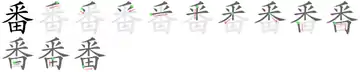 | |||
Han character
番 (Kangxi radical 102, 田+7, 12 strokes, cangjie input 竹木田 (HDW), four-corner 20609, composition ⿱釆田)
Derived characters
References
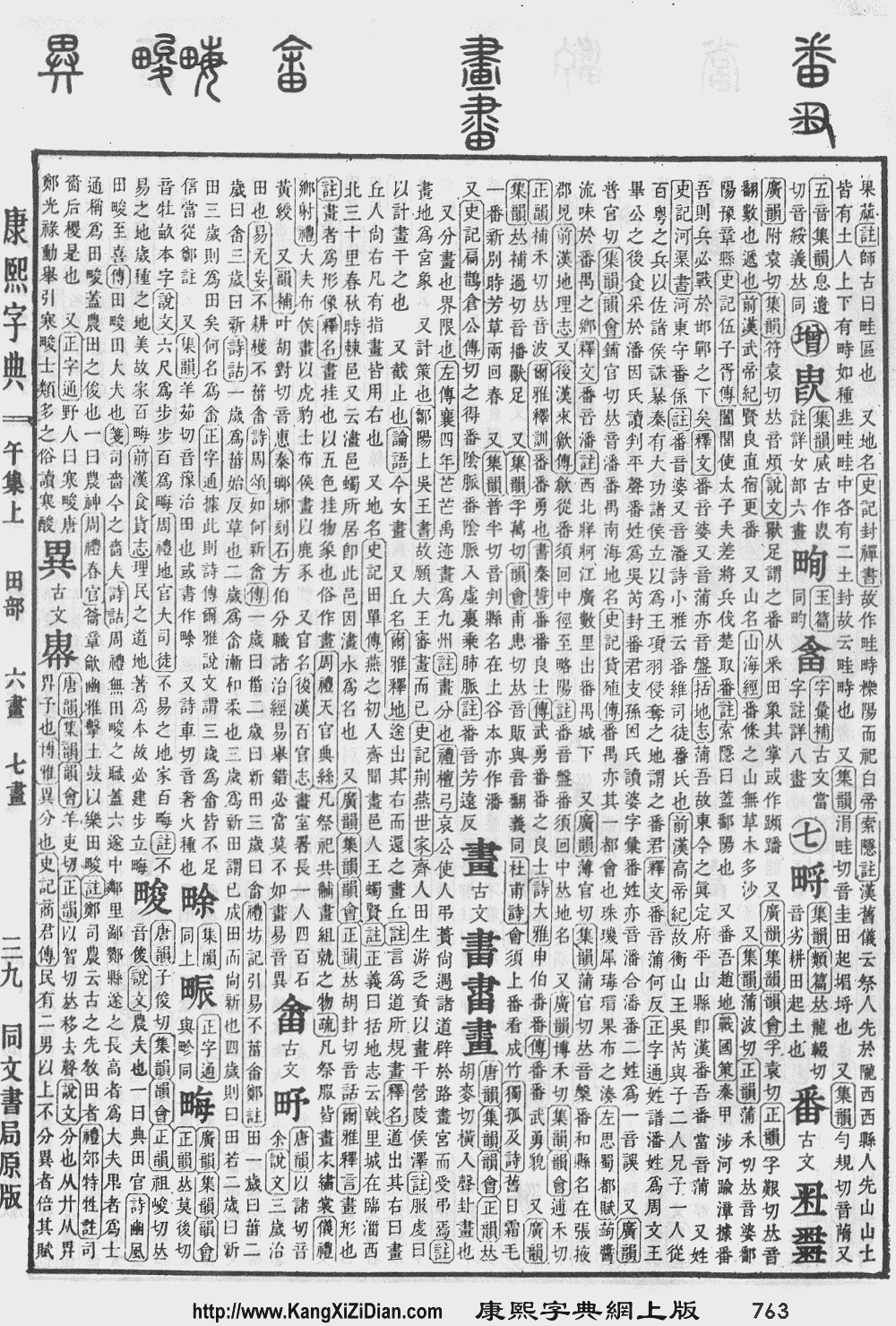
- Kangxi Dictionary: page 763, character 5
- Dai Kanwa Jiten: character 21858
- Dae Jaweon: page 1172, character 17
- Hanyu Da Zidian (first edition): volume 4, page 2543, character 4
- Unihan data for U+756A
Chinese
| trad. | 番 | |
|---|---|---|
| simp. # | 番 | |
Glyph origin
| Historical forms of the character 番 | ||
|---|---|---|
| Western Zhou | Shuowen Jiezi (compiled in Han) | Liushutong (compiled in Ming) |
| Bronze inscriptions | Small seal script | Transcribed ancient scripts |
 |
 |
 |
Characters in the same phonetic series (番) (Zhengzhang, 2003)
| Old Chinese | |
|---|---|
| 皤 | *paːl, *baːl |
| 嶓 | *paːl |
| 番 | *paːl, *paːls, *pʰaːn, *pʰan, *ban |
| 播 | *paːls |
| 譒 | *paːls |
| 鄱 | *baːl |
| 潘 | *pʰaːn |
| 蟠 | *baːn, *ban |
| 磻 | *baːn |
| 蕃 | *pan, *ban |
| 轓 | *pan, *pʰan |
| 鱕 | *pan |
| 鐇 | *pan, *ban |
| 藩 | *pan, *ban |
| 籓 | *pan |
| 橎 | *panʔ |
| 翻 | *pʰan |
| 幡 | *pʰan |
| 飜 | *pʰan |
| 旛 | *pʰan, *ban |
| 繙 | *pʰan, *ban |
| 燔 | *ban |
| 蹯 | *ban |
| 膰 | *ban |
| 羳 | *ban |
| 鷭 | *ban |
| 璠 | *ban |
| 襎 | *ban |
| 墦 | *ban |
Phono-semantic compound (形聲/形声, OC *paːl, *paːls, *pʰaːn, *pʰan, *ban) : phonetic 釆 () + semantic 田 – "animal's footprint in the field"; original form of 蹯 (fán).
Etymology
- “to do in turns; turn; time”
- Iterative of 反 (OC *panʔ, “to turn; to return”) by aspiration of the initial (Schuessler, 2007).
- “anime series”
- Back-formation from 新番 (xīnfān).
This etymology is incomplete. You can help Wiktionary by elaborating on the origins of this term.
Pronunciation 1
Definitions
番
- to do in turns; to take turns; to repeat
- Classifier for actions, deeds: a show of ...
- Classifier for the number of times an action has been performed: turn; time
- Classifier for different kinds of things: kind; type
- A generic term for the non-Han people in China's west in historical times; (by extension) non-Han people; foreign land; foreign; non-native; barbarian
- 番茄 ― fānqié ― tomato [lit. foreign eggplant]
- (Malaysian Hokkien) Muslim
- 入番 [Hokkien] ― ji̍p-hoan [Pe̍h-ōe-jī] ― to become a Muslim
- (ACG) anime series (Classifier: 部)
- (mahjong) points
Compounds
- 一番 (yīfān)
- 一番口舌
- 下番
- 三番五次 (sānfānwǔcì)
- 三番兩次/三番两次 (sānfānliǎngcì)
- 三番四復/三番四复
- 今番 (jīnfān)
- 兩次三番/两次三番 (liǎngcìsānfān)
- 前番 (qiánfān)
- 十番 (shífān)
- 半唐番 (bàntángfān, “a person of half-Chinese ancestry”)
- 吐魯番/吐鲁番 (Tǔlǔfān, “Turpan”)
- 和番
- 土番
- 土番鴨/土番鸭
- 大啖一番
- 小番子
- 屢次三番/屡次三番
- 山番 (shānfān)
- 平埔番
- 幾次三番/几次三番
- 幾番/几番 (jǐfān)
- 幾番家/几番家
- 押番
- 擺番/摆番
- 攧番/𭣇番
- 放番
- 昭君和番
- 更番 (gēngfān)
- 正番鴨/正番鸭
- 熟番 (shúfān, “Sinicized ethnic minority”)
- 理番通事
- 生番 (shēngfān, “non-Sinicized ethnic minority, barbarian”)
- 番人 (fānrén)
- 番仔 (“foreigner, barbarian”)
- 番代
- 番佛
- 番使
- 番來覆去/番来覆去
- 番儂/番侬
- 番囝
- 番國/番国
- 番地
- 番天覆地
- 番夷
- 番婆
- 番子 (fānzi)
- 番子手
- 番客 (fānkè)
- 番弓
- 番張跟斗
- 番役
- 番悔
- 番戍
- 番攤館/番摊馆
- 番木瓜 (fānmùguā, “papaya”)
- 番木鱉/番木鳖
- 番柿
- 番椒 (fānjiāo)
- 番檨 (fānshē)
- 番瓜 (fānguā, “papaya”)
- 番番
- 番番是福
- 番石榴 (fānshíliú, “guava”)
- 番社
- 番筧/番笕
- 番紅/番红
- 番羅/番罗
- 番船
- 番芋 (fānyù, “Alocasia cucullata”)
- 番茄 (fānqié, “tomato”)
- 番茄炒蛋 (fānqié chǎodàn, “stir-fried tomato and scrambled eggs”)
- 番茄素
- 番茄醬/番茄酱 (fānqiéjiàng, “ketchup”)
- 番荔枝 (fānlìzhī, “sugar-apple/sweet-sop”)
- 番菜
- 番菜館/番菜馆
- 番薯 (fānshǔ, “sweet potato”)
- 番藷/番薯 (fānshǔ)
- 番號/番号 (fānhào)
- 番話/番话 (“foreign language”)
- 番路 (Fānlù)
- 番邦 (fānbāng)
- 番錢/番钱
- 番騰/番腾
- 番鬼 (fānguǐ)
- 番鴨/番鸭 (fānyā)
- 番麥粒/番麦粒
- 當番/当番 (dāngfān)
- 紅毛番/红毛番 (hóngmáofān)
- 累次三番
- 翻兩番/翻两番
- 翻番 (fānfān)
- 者番
- 西番果
- 西番蓮/西番莲 (xīfānlián)
- 輪番/轮番 (lúnfān)
- 輪番上陣/轮番上阵
- 連番/连番
- 這番/这番
- 顛番面皮/颠番面皮
Pronunciation 2
Pronunciation 3
Definitions
番
Pronunciation 4
Definitions
番
Pronunciation 5
Japanese
Readings
Compounds
Etymology 1
| Kanji in this term |
|---|
| 番 |
| ばん Grade: 2 |
| on’yomi |
Noun
Suffix
Derived terms
- 番目 (-banme)
Korean
Etymology 1
From Middle Chinese 番 (MC phjon).
| Historical readings |
|---|
|
Pronunciation
- (SK Standard/Seoul) IPA(key): [pʌ̹n]
- Phonetic hangul: [번]
Compounds
Etymology 2
From Middle Chinese 番 (MC phan).
| Historical readings |
|---|
|
Pronunciation
- (SK Standard/Seoul) IPA(key): [pa̠n]
- Phonetic hangul: [반]
Hanja
Compounds
Compounds
- 반우 (番禹, banu)
Etymology 3
From Middle Chinese 番 (MC pa).
| Historical readings |
|---|
|
Compounds
Compounds
- 파파 (番番, papa)
Old Japanese
Etymology
From Middle Chinese 番 (MC bjon|phjon|phan|pa|paH).
Usage notes
Only used in the prose of the Kojiki of 712 CE (Miyake (2003) p. 254).
Further reading
- Miyake (2003) p. 254
Vietnamese
References
- Thiều Chửu : Hán Việt Tự Điển Hà Nội 1942
- Trần Văn Chánh: Từ Điển Hán Việt NXB Trẻ, Ho Chi Minh Ville, 1999
- Vũ Văn Kính: Đại Tự Điển Chữ Nôm, NXB Văn Nghệ, Ho Chi Minh Ville, 1999
This article is issued from Wiktionary. The text is licensed under Creative Commons - Attribution - Sharealike. Additional terms may apply for the media files.