陶
| ||||||||
Translingual
Han character
陶 (Kangxi radical 170, 阜+8, 11 strokes, cangjie input 弓中心人山 (NLPOU), four-corner 77220, composition ⿰阝匋)
Derived characters
- 𭲏, 𬞌, 𩍂, 𡒘
References
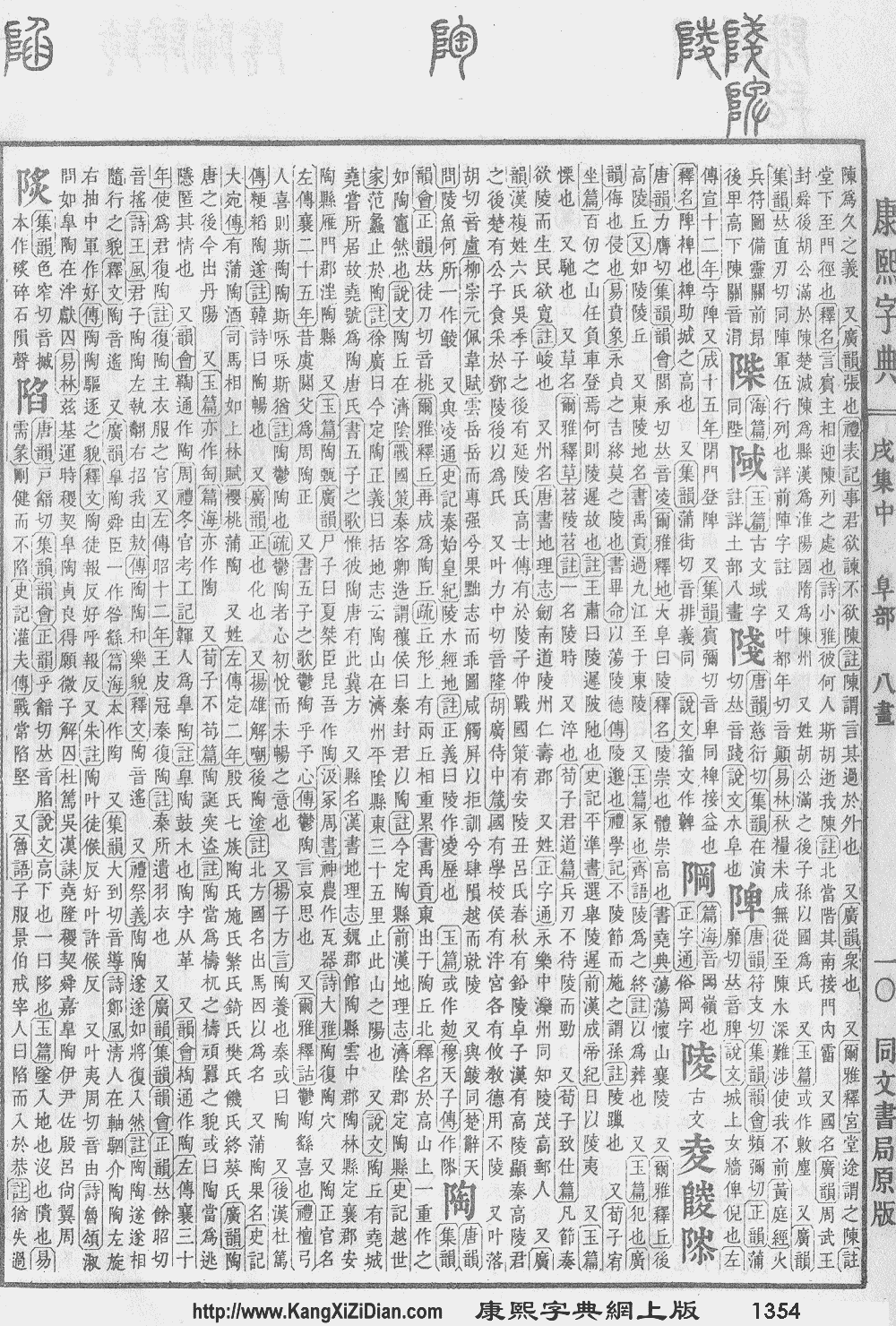
- Kangxi Dictionary: page 1354, character 10
- Dai Kanwa Jiten: character 41705
- Dae Jaweon: page 1858, character 1
- Hanyu Da Zidian (first edition): volume 6, page 4139, character 5
- Unihan data for U+9676
Chinese
| simp. and trad. |
陶 | |
|---|---|---|
Glyph origin
| Historical forms of the character 陶 | ||
|---|---|---|
| Western Zhou | Shuowen Jiezi (compiled in Han) | Liushutong (compiled in Ming) |
| Bronze inscriptions | Small seal script | Transcribed ancient scripts |
 |
 |
 |
In oracle bone and bronze inscriptions, ideogrammic compound (會意/会意) : a mound of dirt (阜) + two people (勹) + dirt (土) – "to dig", original character of 掏. The shapes beneath the outermost 勹 were corrupted in bamboo slips, arriving at the modern form 缶 in seal script.
Now a phono-semantic compound (形聲/形声, OC *bl'uː, *luː) and ideogrammic compound (會意/会意) : 阝 (“soil mountain”) + phonetic 匋 (OC *bl'uː, “pottery”).
Pronunciation 1
Definitions
陶
Compounds
- 交趾陶
- 奧陶紀/奥陶纪 (Àotáo Jì)
- 富埒陶白
- 富比陶衛/富比陶卫
- 彩陶 (cǎitáo)
- 彩陶文化
- 樂樂陶陶/乐乐陶陶
- 樂陶陶/乐陶陶 (lètáotáo)
- 灰陶
- 熏陶 (xūntáo)
- 甄陶
- 白陶 (báitáo)
- 白陶罍
- 立陶宛 (Lìtáowǎn)
- 粗陶
- 精密陶瓷
- 紅陶/红陶
- 紫砂陶
- 綠釉陶/绿釉陶
- 繪彩陶/绘彩陶
- 自我陶醉
- 薰陶 (xūntáo)
- 赤土陶器 (chì tǔ táoqì)
- 遣興陶情/遣兴陶情
- 金屬陶瓷/金属陶瓷
- 鈞陶/钧陶
- 阿克陶 (Ākètáo)
- 陶侃運甓/陶侃运甓
- 陶俑 (táoyǒng)
- 陶偶
- 陶兀
- 陶冶 (táoyě)
- 陶劉/陶刘 (Táoliú)
- 陶化
- 陶匠 (táojiàng)
- 陶唐
- 陶唐氏
- 陶器 (táoqì)
- 陶器婚
- 陶土 (táotǔ, “potter's clay”)
- 陶土製品/陶土制品
- 陶城 (Táochéng)
- 陶場/陶场 (Táochǎng)
- 陶塑 (táosù)
- 陶家嶺/陶家岭 (Táojiālǐng)
- 陶家河 (Táojiāhé)
- 陶寫/陶写
- 陶工 (táogōng, “potter”)
- 陶店 (Táodiàn)
- 陶庵夢憶/陶庵梦忆
- 陶成
- 陶文 (táowén)
- 陶染
- 陶業/陶业
- 陶泓
- 陶港 (Táogǎng)
- 陶潛三徑/陶潜三径
- 陶潛五柳/陶潜五柳
- 陶然 (táorán)
- 陶然亭 (Táorántíng)
- 陶然自得
- 陶犬瓦雞/陶犬瓦鸡
- 陶猗
- 陶猗之富
- 陶瓷 (táocí)
- 陶瓷器 (táocíqì)
- 陶瓷工 (táocígōng)
- 陶瓷材料
- 陶甄
- 陶真 (táozhēn)
- 陶石
- 陶硯/陶砚
- 陶笵
- 陶笛 (táodí)
- 陶笵法
- 陶藝/陶艺 (táoyì)
- 陶醉 (táozuì)
- 陶鈞/陶钧 (táojūn)
- 陶鎔/陶镕
- 陶鎔鼓鑄/陶镕鼓铸
- 陶鑄/陶铸
- 陶陶
- 陶陶兀兀
- 陶養/陶养
- 鬱陶/郁陶 (yùtáo)
- 黑陶
- 黑陶文化
Descendants
- → Thai: เตา (dtao)
Pronunciation 2
Compounds
- 陶誕/陶诞
Pronunciation 3
References
- “陶”, in 漢語多功能字庫 (Multi-function Chinese Character Database), 香港中文大學 (the Chinese University of Hong Kong), 2014–
Japanese
Readings
Etymology 1
| Kanji in this term |
|---|
| 陶 |
| とう Grade: S |
| kan’on |
/tau/ → /tɔː/ → /toː/
From Middle Chinese 陶 (MC daw).
Affix
Derived terms
Etymology 2
| Kanji in this term |
|---|
| 陶 |
| すえ Grade: S |
| kun’yomi |
| Alternative spelling |
|---|
| 甄 (rare) |
/suwe/ → /sue/
From Old Japanese.
The nominalization of the 連用形 (ren'yōkei, “stem or continuative form”) of verb 据える (sueru, “to set, lay”), from the way they are formed and/or crafted by the hands. (Can this(+) etymology be sourced?)
Derived terms
- 陶物 (suemono)
Korean
Hanja
陶 (eumhun 질 그도 도 (jil geudo do))
- Hanja form? of 도 (“pottery, ceramics, earthenware”).
陶 (eumhun 화락할 요 (hwarakhal yo))
- Hanja form? of 도 (“peaceful, harmonious, happy”).
陶 (eumhun 순임금의 신하 요 (sunimgeumui sinha yo))
- This term needs a translation to English. Please help out and add a translation, then remove the text
{{rfdef}}.
Old Japanese
Etymology
The nominalization of the 連用形 (ren'yōkei, “stem or continuative form”) of verb 据う (suu, “to set, lay”), from the way they are formed and/or crafted by the hands. (Can this(+) etymology be sourced?)
Compounds
- 陶器 (suwemono2)
Descendants
- Japanese: 陶 (sue)