隙
| ||||||||
Translingual
Alternative forms
- In all regions except Taiwan, the middle right component is written as 日, which is the historical form found in the Kangxi Dictionary.
- In Taiwan, the middle right component is written as 白 instead.
- In all regions except South Korea, the top right component is written similar to 小 with a middle vertical stroke without ending hook (丨 instead of usual 亅)
- In South Korea, the top right component is written as 小 with a middle vertical stroke that has an ending hook (亅).
Han character
隙 (Kangxi radical 170, 阜+11 in traditional Chinese (Taiwan), 阜+10 in Chinese (mainland China, Hong Kong), Japanese and Korean, 14 strokes in Chinese in traditional Chinese, 12 strokes in mainland China, 13 strokes in Japanese and Korean, cangjie input 弓中火日火 (NLFAF) or 弓中火竹火 (NLFHF), four-corner 79296, composition ⿰阝𡭴(GHJKV) or ⿰阝𡮂(T))
References
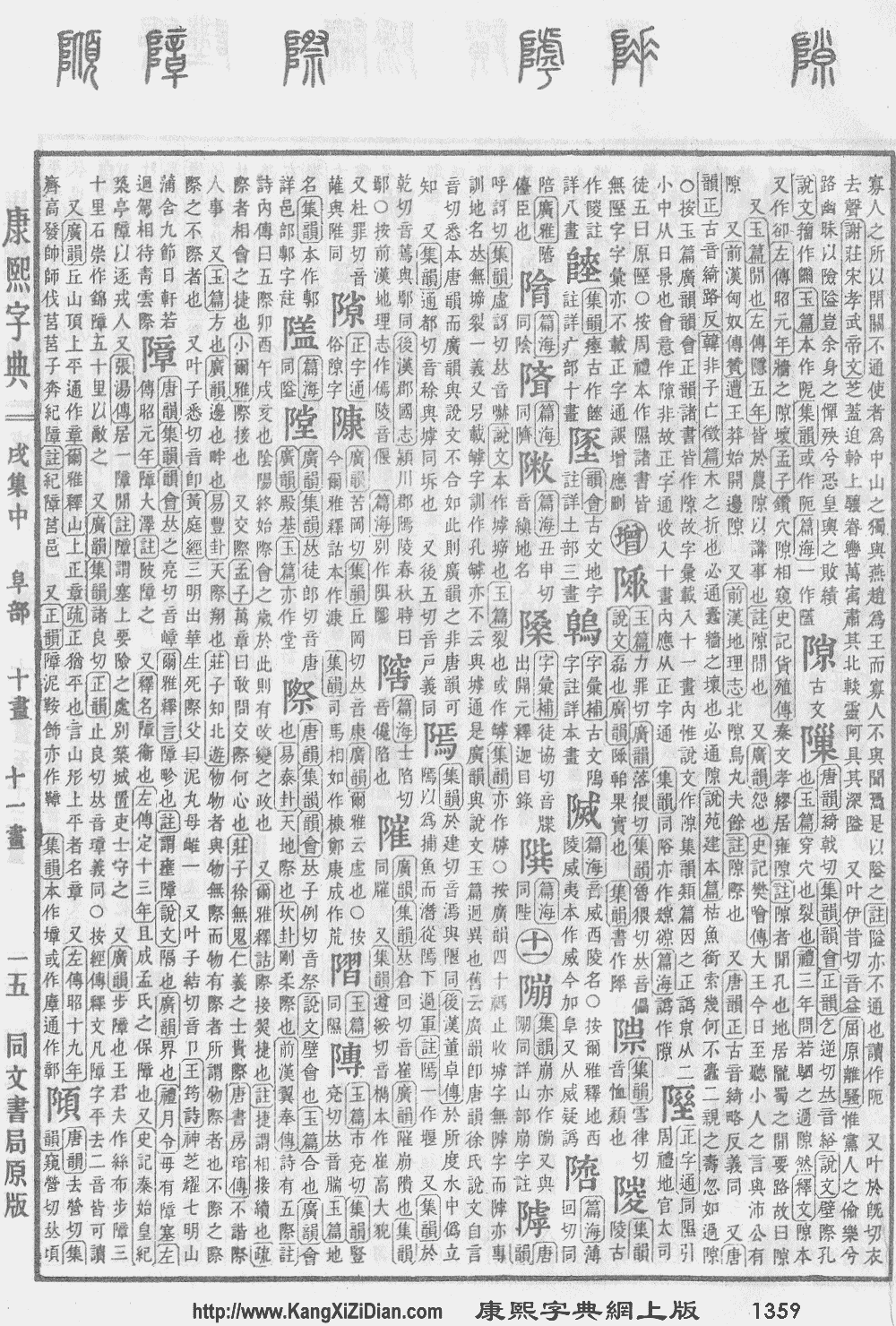
- Kangxi Dictionary: page 1359, character 1
- Dai Kanwa Jiten: character 41792
- Dae Jaweon: page 1862, character 26
- Hanyu Da Zidian (first edition): volume 6, page 4150, character 11
- Unihan data for U+9699
Chinese
| trad. | 隙 | |
|---|---|---|
| simp. # | 隙 | |
| 2nd round simp. | ⿰阝夕 | |
| alternative forms | ||
Glyph origin
Etymology
Possibly related to 間 (OC *kreːn, *kreːns, “space, gap”) (Wang, 1982).
Outside of Chinese, compare Proto-Kuki-Chin *kak (“to crack; to rend; to split”), Jingpho [script needed] (kaʔ³¹, “to crack”) (Sagart, 2017).
Pronunciation
Definitions
隙
Compounds
- 不虞之隙
- 乘間投隙/乘间投隙
- 乘隙 (chéngxì)
- 乘隙而入 (chéngxì'érrù)
- 仇隙
- 伺隙
- 凶終隙末
- 可乘之隙
- 嫌隙 (xiánxì)
- 孔隙
- 寸隙
- 小隙沉舟
- 抵瑕蹈隙
- 指瑕造隙
- 捫隙發罅/扪隙发罅
- 搆隙/构隙
- 有隙
- 有隙可乘 (yǒuxìkěchéng)
- 無隙可乘/无隙可乘 (wúxìkěchéng)
- 生隙
- 白駒過隙/白驹过隙 (báijūguòxì)
- 睚眥之隙/睚眦之隙
- 穴隙
- 空隙 (kòngxì)
- 縫隙/缝隙 (fèngxì)
- 罅隙 (xiàxì)
- 裂隙 (lièxì)
- 觀釁伺隙/观衅伺隙
- 讎隙/雠隙 (chóuxì)
- 讒隙/谗隙
- 踰牆鑽隙/逾墙钻隙
- 蹈隙
- 農隙/农隙
- 過隙/过隙
- 過隙白駒/过隙白驹
- 釁隙/衅隙
- 鑽隙踰牆/钻隙逾墙
- 門隙/门隙
- 閒隙/闲隙
- 間隙/间隙 (jiànxì)
- 隙地
- 隙大牆壞/隙大墙坏
- 隙宇
- 隙縫/隙缝
- 隙罅
- 隙駒/隙驹
- 駟之過隙/驷之过隙
- 駒兒隙/驹儿隙
Japanese
Kanji
隙
- This term needs a translation to English. Please help out and add a translation, then remove the text
{{rfdef}}.
Readings
Korean
Etymology
From Middle Chinese 隙 (MC khjaek). Recorded as Middle Korean 극〯 (kǔk) (Yale: kuk) in Hunmong Jahoe (訓蒙字會 / 훈몽자회), 1527.
Vietnamese
Han character
隙: Hán Việt readings: khích[1][2][3]
隙: Nôm readings: khích[1][2]
- This term needs a translation to English. Please help out and add a translation, then remove the text
{{rfdef}}.
References
- Nguyễn (2014).
- Nguyễn et al. (2009).
- Trần (2004).
This article is issued from Wiktionary. The text is licensed under Creative Commons - Attribution - Sharealike. Additional terms may apply for the media files.