감
| ||||||||||
| 가각갂갃간갅갆 갇갈갉갊갋갌갍 갎갏감갑값갓갔 강갖갗갘같갚갛 | |
| → 개 | |
|---|---|
Jeju
Etymology
From Middle Korean 감〯 (kǎm). Cognate to Korean 감 (gam)
Pronunciation
| Romanizations | |
|---|---|
| Revised Romanization? | gam |
| Revised Romanization (translit.)? | gam |
| Yale Romanization? | kam |
Derived terms
- 감낭 (gamnang)
References
- The template Template:R:Jeju's culture and language does not use the parameter(s):
3=4352_4449_4535
Please see Module:checkparams for help with this warning.“감” in Jeju's culture and language, Digital museum. - 제주 문화 예술 재단 [jeju munhwa yesul jaedan] (2009) 개정 증보 제주어 사전 [gaejeong jeungbo jejueo sajeon], 제주 특별 자치도 [jeju teukbyeol jachido], →ISBN, page 30
Korean
Etymology 1
Sino-Korean word from 感 (“to feel, to perceive; emotion”).
Pronunciation
- (SK Standard/Seoul) IPA(key): [ka̠(ː)m]
- Phonetic hangul: [감(ː)]
- Though still prescribed in Standard Korean, most speakers in both Koreas no longer distinguish vowel length.
| Romanizations | |
|---|---|
| Revised Romanization? | gam |
| Revised Romanization (translit.)? | gam |
| McCune–Reischauer? | kam |
| Yale Romanization? | kām |
Derived terms
- See the hanja entry at 感 for Sino-Korean compounds of 감 (感, gam).
Suffix
—감 • (-gam) (hanja 感)
See also
- Korean terms suffixed with -감 (感)
Etymology 2
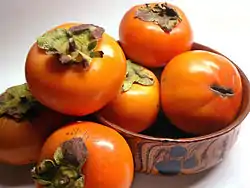
First attested in the Jīlín lèishì (鷄林類事 / 계림유사), 1103, as Late Old Korean 坎 (Yale: *kǎm). In the Hangul script, first attested in the Hunminjeong'eum haerye (訓民正音解例 / 훈민정음해례), 1446, as Middle Korean 감〯 (Yale: kǎm). The presence of a rising syllable suggests an ancient bisyllabic form.
Pronunciation
- (SK Standard/Seoul) IPA(key): [ka̠(ː)m]
- Phonetic hangul: [감(ː)]
- Though still prescribed in Standard Korean, most speakers in both Koreas no longer distinguish vowel length.
| Romanizations | |
|---|---|
| Revised Romanization? | gam |
| Revised Romanization (translit.)? | gam |
| McCune–Reischauer? | kam |
| Yale Romanization? | kām |
Derived terms
- 감나무 (gamnamu, “persimmon tree”)
Etymology 3
First attested in the Worin seokbo (月印釋譜 / 월인석보), 1459, as Middle Korean ᄀᆞᅀᆞᆷ (Yale: kòzòm).
Pronunciation
- (SK Standard/Seoul) IPA(key): [ka̠(ː)m]
- Phonetic hangul: [감(ː)]
- Though still prescribed in Standard Korean, most speakers in both Koreas no longer distinguish vowel length.
| Romanizations | |
|---|---|
| Revised Romanization? | gam |
| Revised Romanization (translit.)? | gam |
| McCune–Reischauer? | kam |
| Yale Romanization? | kām |
Noun
감 • (gam)
Derived terms
Etymology 4
Sino-Korean word from 甘.
Pronunciation
- (SK Standard/Seoul) IPA(key): [ka̠m]
- Phonetic hangul: [감]
| Romanizations | |
|---|---|
| Revised Romanization? | Gam |
| Revised Romanization (translit.)? | Gam |
| McCune–Reischauer? | Kam |
| Yale Romanization? | kam |
Etymology 5
Korean reading of various Chinese characters.
Syllable
감 (gam)
| Extended content |
|---|
|
Middle Korean
Etymology
From Late Old Korean 坎 (*kǎm), attested in the twelfth-century wordlist Jilin leishi.
Pronunciation
- IPA(key): /kam/, [kam]
This article is issued from Wiktionary. The text is licensed under Creative Commons - Attribution - Sharealike. Additional terms may apply for the media files.