敢
| ||||||||
Translingual
| Stroke order | |||
Mainland China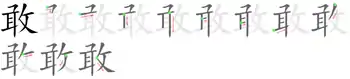 | |||
Alternative forms
- In mainland China (based on Xin Zixing 新字形), the upper left component is written 乛 (one stroke).
- In other regions, the upper left component is written 丅 (two strokes) which is the orthodox form found in the Kangxi dictionary.
Han character
敢 (Kangxi radical 66, 攴+8, 12 strokes in traditional Chinese, Japanese and Korean, 11 strokes in mainland China, cangjie input 弓十人大 (NJOK) or 一十人大 (MJOK), four-corner 18140 or 18440, composition ⿰⿱乛耳攵(G) or ⿰⿱丅耳攵(HTJKV))
Derived characters
References
- Kangxi Dictionary: page 472, character 26
- Dai Kanwa Jiten: character 13260
- Dae Jaweon: page 825, character 13
- Hanyu Da Zidian (first edition): volume 2, page 1463, character 9
- Unihan data for U+6562

Chinese
| trad. | 敢 | |
|---|---|---|
| simp. # | 敢 | |
| 2nd round simp. | 攼 | |
Glyph origin
| Historical forms of the character 敢 | ||
|---|---|---|
| Western Zhou | Warring States | |
| Bronze inscriptions | Bronze inscriptions | Chu slip and silk script |
 |
 |
 |
Characters in the same phonetic series (敢) (Zhengzhang, 2003)
Phono-semantic compound (形聲/形声, OC *klaːmʔ) : semantic 爭 (“to fight”) + phonetic 甘 (OC *kaːm).
Etymology
From Proto-Sino-Tibetan *s/m-wam (“to dare”) (Schuessler, 2007; STEDT).
Pronunciation
Definitions
敢
- bold; brave; daring
- to dare (to); to venture (to)
- to be sure; to be certain; to bet; to presume
- (polite) may I venture
- (literary or Hokkien, Teochew, Taiwanese Hakka, rhetorical question) can it be possible that; how
- alt. forms: 豈/岂 (qǐ)
- 敢通按呢? [Taiwanese Hokkien] ― Kám thang án-ne? [Pe̍h-ōe-jī] ― How could it be like this?
- (archaic or Xiamen, Quanzhou and Zhangzhou Hokkien) perhaps
- (Taiwanese Hokkien, Taiwanese Hakka) Interrogative adverb, placed before the verb to create a yes-no question.
- alt. forms: 咁 (hán), 甘 (gān), 干
- 你敢有閒?/你敢有闲? [Taiwanese Hokkien] ― Lí kám ū-êng? [Pe̍h-ōe-jī] ― Are you free?
Synonyms
- (can it be possible that):
Dialectal synonyms of 難道 (“could it be that; is it possible that”) [map]
| Variety | Location | Words |
|---|---|---|
| Classical Chinese | 莫非, 豈, 莫不是 | |
| Formal (Written Standard Chinese) | 莫非, 豈, 難道, 莫不是 | |
| Mandarin | Beijing | 難道, 難不成, 甭 |
| Taiwan | 難道, 難不成 | |
| Xuzhou | 難說 | |
| Cantonese | Guangzhou | 唔通 |
| Hong Kong | 唔通 | |
| Taishan | 唔成, 敢係, 唔得旨, 毋旨, 毋旨估 | |
| Hakka | Miaoli (N. Sixian) | 無成, 敢講, 敢係 |
| Pingtung (Neipu; S. Sixian) | 無成, 敢講, 敢係 | |
| Hsinchu County (Zhudong; Hailu) | 無成, 敢講, 敢係 | |
| Taichung (Dongshi; Dabu) | 無成, 敢講, 敢會, 敢係 | |
| Hsinchu County (Qionglin; Raoping) | 無成, 毋成, 敢講, 敢係 | |
| Yunlin (Lunbei; Zhao'an) | 無敢, 敢講, 敢會, 敢係 | |
| Southern Min | Xiamen | 敢, 總無 |
| Quanzhou | 敢, 總無, 攏無 | |
| Zhangzhou | 敢, 總無 | |
| Tainan | 敢 | |
| Manila (Hokkien) | 敢 | |
| Shantou | 未是 | |
| Jieyang | 未是, 敢, 敢是 | |
| Wu | Shanghai | 只勿 |
| Shanghai (Chongming) | 難算得 | |
| Xiang | Changsha | 冇過 |
See also
- 肯 (kěn)
Compounds
- 不敢 (bùgǎn)
- 不敢出氣/不敢出气
- 不敢則聲/不敢则声
- 不敢告勞/不敢告劳
- 不敢吭聲/不敢吭声
- 不敢妄言
- 不敢後人/不敢后人
- 不敢從命/不敢从命
- 不敢欺
- 不敢當/不敢当 (bùgǎndāng)
- 何敢 (hégǎn)
- 到敢
- 勇敢 (yǒnggǎn)
- 勇猛果敢
- 怕敢
- 愧不敢當/愧不敢当
- 敢且
- 敢作敢為/敢作敢为 (gǎnzuògǎnwéi)
- 敢作敢當/敢作敢当
- 敢保
- 敢做敢當/敢做敢当 (gǎnzuògǎndāng)
- 敢則/敢则
- 敢則是/敢则是
- 敢勇當先/敢勇当先
- 敢只是
- 敢問/敢问 (gǎnwèn)
- 敢待
- 敢怕
- 敢怒而不敢言
- 敢情
- 敢攀玉趾
- 敢於/敢于 (gǎnyú)
- 敢是
- 敢死 (gǎnsǐ)
- 敢死士
- 敢死軍/敢死军 (gǎnsǐjūn)
- 敢死隊/敢死队 (gǎnsǐduì)
- 敢當/敢当 (gǎndāng)
- 敢緊/敢紧
- 敢自 (gǎnzì)
- 敢若 (káⁿ-ná) (Min Nan)
- 敢莫是
- 敢言
- 敢請/敢请
- 未敢 (wèigǎn)
- 果敢 (guǒgǎn)
- 正色敢言
- 石敢當/石敢当 (shígǎndāng)
- 膽敢/胆敢 (dǎngǎn)
- 莫敢是
- 莫敢誰何/莫敢谁何 (mògǎn-shuíhé)
- 豈敢/岂敢 (qǐgǎn)
- 竟敢 (jìnggǎn)
- 鬼子敢爾/鬼子敢尔
Further reading
- “Entry #8439”, in 臺灣閩南語常用詞辭典 [Dictionary of Frequently-Used Taiwan Minnan] (overall work in Mandarin and Hokkien), Ministry of Education, R.O.C., 2023.
Japanese
Readings
Pronunciation
- IPA(key): [kã̠ɴ]
Vietnamese
This article is issued from Wiktionary. The text is licensed under Creative Commons - Attribution - Sharealike. Additional terms may apply for the media files.