gé
See also: Appendix:Variations of "ge"
Czech
Pronunciation
- IPA(key): [ˈɡɛː]
Hungarian
Pronunciation
- IPA(key): [ˈɡeː]
Audio (file) - Rhymes: -ɡeː
Declension
| Inflection (stem in long/high vowel, front unrounded harmony) | ||
|---|---|---|
| singular | plural | |
| nominative | gé | gék |
| accusative | gét | géket |
| dative | gének | géknek |
| instrumental | gével | gékkel |
| causal-final | géért | gékért |
| translative | gévé | gékké |
| terminative | géig | gékig |
| essive-formal | géként | gékként |
| essive-modal | — | — |
| inessive | gében | gékben |
| superessive | gén | géken |
| adessive | génél | géknél |
| illative | gébe | gékbe |
| sublative | gére | gékre |
| allative | géhez | gékhez |
| elative | géből | gékből |
| delative | géről | gékről |
| ablative | gétől | géktől |
| non-attributive possessive - singular |
géé | géké |
| non-attributive possessive - plural |
gééi | gékéi |
| Possessive forms of gé | ||
|---|---|---|
| possessor | single possession | multiple possessions |
| 1st person sing. | gém | géim |
| 2nd person sing. | géd | géid |
| 3rd person sing. | géje | géi |
| 1st person plural | génk | géink |
| 2nd person plural | gétek | géitek |
| 3rd person plural | géjük | géik |
Icelandic
Pronunciation
- IPA(key): /cɛː/
- Rhymes: -ɛː
Irish
Etymology 1
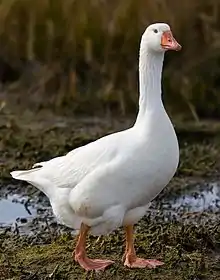
gé
From Middle Irish géd m (“goose”), from Proto-Celtic *gezdā. Cognate with Welsh gŵydd, Cornish goth and Breton gwaz.
Pronunciation
- (Cois Fharraige) IPA(key): /ɟeː/, (plural) IPA(key): /ˈɟeːwə/[1]
Noun
gé f or m (genitive singular gé or géidh, nominative plural géanna or géidhe or géacha)
- goose (grazing waterfowl of the family Anatidae)
Declension
As feminine noun:
Declension of gé
As masculine noun (now archaic):
Declension of gé
Alternative nominative plural forms géacha (feminine and masculine), géabha (Cois Fharraige)
Alternative forms
- géadh (archaic)
Hyponyms
- gandal m (“gander”)
Derived terms
- gé Cheanadach f (“Canada goose”)
- gé ghiúrainn f (“barnacle goose”)
- gé ghlas f (“greylag goose”)
References
- de Bhaldraithe, Tomás (1977) Gaeilge Chois Fhairrge: An Deilbhíocht (in Irish), 2nd edition, Dublin Institute for Advanced Studies, § 9 (p. 5) and p. 52
Further reading
- Ó Dónaill, Niall (1977) “gé”, in Foclóir Gaeilge–Béarla, Dublin: An Gúm, →ISBN
- G. Toner, M. Ní Mhaonaigh, S. Arbuthnot, D. Wodtko, M.-L. Theuerkauf, editors (2019), “géd”, in eDIL: Electronic Dictionary of the Irish Language
- Dinneen, Patrick S. (1904) “gé”, in Foclóir Gaeḋilge agus Béarla, 1st edition, Dublin: Irish Texts Society, page 354
- Entries containing “gé” in English-Irish Dictionary, An Gúm, 1959, by Tomás de Bhaldraithe.
- Entries containing “gé” in New English-Irish Dictionary by Foras na Gaeilge.
See also
Louisiana Creole
Pronunciation
- IPA(key): /ɡe/
- Rhymes: -e
Mandarin
Alternative forms
- ge — nonstandard
Romanization
- Hanyu Pinyin reading of 佮
- Hanyu Pinyin reading of 匌
- Hanyu Pinyin reading of 呄
- Hanyu Pinyin reading of 嗝
- Hanyu Pinyin reading of 噶
- Hanyu Pinyin reading of 塥
- Hanyu Pinyin reading of 嶮/崄
- Hanyu Pinyin reading of 愅
- Hanyu Pinyin reading of 挌
- Hanyu Pinyin reading of 揶
- Hanyu Pinyin reading of 搿
- Hanyu Pinyin reading of 擱/搁
- Hanyu Pinyin reading of 敋
- Hanyu Pinyin reading of 格
- Hanyu Pinyin reading of 槅
- Hanyu Pinyin reading of 浦
- Hanyu Pinyin reading of 滄/沧
- Hanyu Pinyin reading of 烖/灾
- Hanyu Pinyin reading of 獦
- Hanyu Pinyin reading of 砗
- Hanyu Pinyin reading of 胳
- Hanyu Pinyin reading of 膈
- Hanyu Pinyin reading of 臵
- Hanyu Pinyin reading of 茖
- Hanyu Pinyin reading of 葛
- Hanyu Pinyin reading of 蛒
- Hanyu Pinyin reading of 蛤
- Hanyu Pinyin reading of 裓
- Hanyu Pinyin reading of 觡
- Hanyu Pinyin reading of 諽
- Hanyu Pinyin reading of 輵/𬨍, 轕/𮝺
- Hanyu Pinyin reading of 郃
- Hanyu Pinyin reading of 鉀/钾
- Hanyu Pinyin reading of 鉻/铬
- Hanyu Pinyin reading of 鎘/镉
- Hanyu Pinyin reading of 铬
- Hanyu Pinyin reading of 镉
- Hanyu Pinyin reading of 閗/𫔯
- Hanyu Pinyin reading of 閣/阁
- Hanyu Pinyin reading of 閤/合
- Hanyu Pinyin reading of 闔/阖
- Hanyu Pinyin reading of 阁
- Hanyu Pinyin reading of 阖
- Hanyu Pinyin reading of 隔
- Hanyu Pinyin reading of 革
- Hanyu Pinyin reading of 鞇
- Hanyu Pinyin reading of 鞷
- Hanyu Pinyin reading of 韐/𱂆
- Hanyu Pinyin reading of 韚/𫠅
- Hanyu Pinyin reading of 領/领
- Hanyu Pinyin reading of 颌
- Hanyu Pinyin reading of 骼
- Hanyu Pinyin reading of 髂
- Hanyu Pinyin reading of 鬬
- Hanyu Pinyin reading of 鬲
- Hanyu Pinyin reading of 鮯/𫚗
- Hanyu Pinyin reading of 鰪
- Hanyu Pinyin reading of 齃
- Hanyu Pinyin reading of 騔/𩨀
Old Irish
Pronunciation
- IPA(key): /ɡʲeː/
This article is issued from Wiktionary. The text is licensed under Creative Commons - Attribution - Sharealike. Additional terms may apply for the media files.