卜
| ||||||||
| ||||||||
Translingual
| Stroke order | |||
|---|---|---|---|
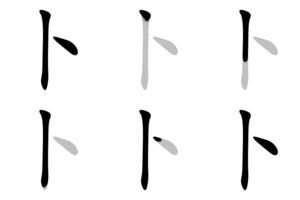 | |||
Han character
卜 (Kangxi radical 25, 卜+0, 2 strokes, cangjie input 卜 (Y), four-corner 23000, composition ⿰丨丶)
- Kangxi radical #25, ⼘.
Derived characters
References
- Kangxi Dictionary: page 157, character 25
- Dai Kanwa Jiten: character 2774
- Dae Jaweon: page 361, character 15
- Hanyu Da Zidian (first edition): volume 1, page 91, character 11
- Unihan data for U+535C

Chinese
Glyph origin
| Historical forms of the character 卜 | |||||
|---|---|---|---|---|---|
| Shang | Western Zhou | Warring States | Shuowen Jiezi (compiled in Han) | Liushutong (compiled in Ming) | |
| Oracle bone script | Bronze inscriptions | Chu slip and silk script | Qin slip script | Small seal script | Transcribed ancient scripts |
 |
 |
 |
 |
 |
 |
Characters in the same phonetic series (卜) (Zhengzhang, 2003)
Perhaps a pictogram (象形) of a crack in an oracle bone, used for divination in ancient China.
Officially adopted as the simplified form of 蔔 in the Chinese Character Simplification Scheme (《漢字簡化方案》) in 1956.
Etymology 1
| simp. and trad. |
卜 | |
|---|---|---|
| alternative forms | 𠁡 𠁢 | |
"Cracking" of a bone or tortoise shell in fire: "to divine by oracle bone" (Schuessler, 2007). Compare Galo -`buk (“to burst”), Galo -`puk (“to pop”), Mizo puak (“to explode; to burst”) (STEDT).
Pronunciation
Definitions
卜
- to divine
- 予惟乙卯,朝至于洛師。我卜河朔黎水。 [Classical Chinese, trad.]
- From: The Book of Documents, circa 4th – 3rd century BCE
- Yǔ wéi yǐmǎo, zhāo zhì yú Luòshī. Wǒ bǔ Héshuò Lí shuǐ. [Pinyin]
- On the day Yi-mao, I came in the morning to this capital of Luo. I (first) divined by the shell concerning (the ground about) the li-water on the north of the He.
予惟乙卯,朝至于洛师。我卜河朔黎水。 [Classical Chinese, simp.]
- (literary) to foretell; to predict
- 生死未卜 ― shēngsǐwèibǔ ― no one knows whether the person is dead of alive
- (literary) to choose
- 卜居 ― bǔjū ― to choose a place to live
- a surname
Compounds
- 不卜可知
- 前途未卜
- 十卜 (sap6 bok1) (Cantonese)
- 卜人
- 卜兒/卜儿
- 卜卜
- 卜卦 (bǔguà)
- 卜吉
- 卜夜卜晝/卜夜卜昼
- 卜婿
- 卜宅
- 卜居 (bǔjū)
- 卜年 (bǔnián)
- 卜度
- 卜征
- 卜日
- 卜易
- 卜晝卜夜/卜昼卜夜
- 卜珓 (bǔjiào)
- 卜祝
- 卜窀穸
- 卜筮 (bǔshì)
- 卜算
- 卜築/卜筑
- 卜老
- 卜者
- 卜課/卜课 (bǔkè)
- 卜辭/卜辞 (bǔcí)
- 卜鄰/卜邻 (bǔlín)
- 占卜 (zhānbǔ)
- 吉凶未卜
- 吉卜賽人/吉卜赛人 (jíbǔsàirén)
- 問卜/问卜 (wènbǔ)
- 太卜
- 存亡未卜
- 成都賣卜/成都卖卜
- 拉卜楞
- 未卜 (wèibǔ)
- 未卜先知 (wèibǔxiānzhī)
- 枚卜
- 死生未卜
- 殷墟卜辭
- 求神問卜/求神问卜 (qiúshénwènbǔ)
- 油花卜
- 狼卜食
- 玉枝卜壽/玉枝卜寿
- 羊卜
- 老醫少卜/老医少卜
- 耳卜
- 貞卜文字/贞卜文字
- 貨卜/货卜
- 賣卜/卖卜
- 賣卜測字/卖卜测字
- 醫卜星相/医卜星相
- 響卜/响卜
- 預卜/预卜 (yùbǔ)
- 鳥卜/鸟卜
- 龜卜/龟卜 (guībǔ)
Etymology 2
| For pronunciation and definitions of 卜 – see 蔔 (“carrot”). (This character is the simplified form of 蔔). |
Notes:
|
Etymology 3
| For pronunciation and definitions of 卜 – see 欲 (“(Min) to want (to do); about to”). (This character is a variant form of 欲). |
References
- “Entry #64”, in 臺灣閩南語常用詞辭典 (overall work in Mandarin and Hokkien), Ministry of Education, R.O.C., 2023.
Japanese
Readings
Etymology 1
| Kanji in this term |
|---|
| 卜 |
| うらない Jinmeiyō |
| kun’yomi |
| For pronunciation and definitions of 卜 – see the following entry. | ||
| ||
| (This term, 卜, is an alternative spelling of the above term.) |
Etymology 2
| Kanji in this term |
|---|
| 卜 |
| ぼく Jinmeiyō |
| kan’yōon |
Derived terms
- 卜する (bokusuru, “tell fortunes”)
Etymology 3
| Kanji in this term |
|---|
| 卜 |
| うら Jinmeiyō |
| kun’yomi |
| For pronunciation and definitions of 卜 – see the following entry. | ||
| ||
| (This term, 卜, is an alternative spelling of the above term.) |
Vietnamese
Han character
卜: Hán Việt readings: bốc, bặc
卜: Nôm readings: bói, bóc, vúc, bốc, vốc, vóc, bặc, cốc
References
- Nôm Foundation
- Lê Sơn Thanh, "Nom-Viet.dat", WinVNKey (details)
This article is issued from Wiktionary. The text is licensed under Creative Commons - Attribution - Sharealike. Additional terms may apply for the media files.