朴
See also: 樸
| ||||||||
Translingual
| Stroke order | |||
|---|---|---|---|
 | |||
Han character
朴 (Kangxi radical 75, 木+2, 6 strokes, cangjie input 木卜 (DY), four-corner 43900, composition ⿰木卜)
Derived characters
- 𠡙, 𠧭, 烞, 𬇑
References
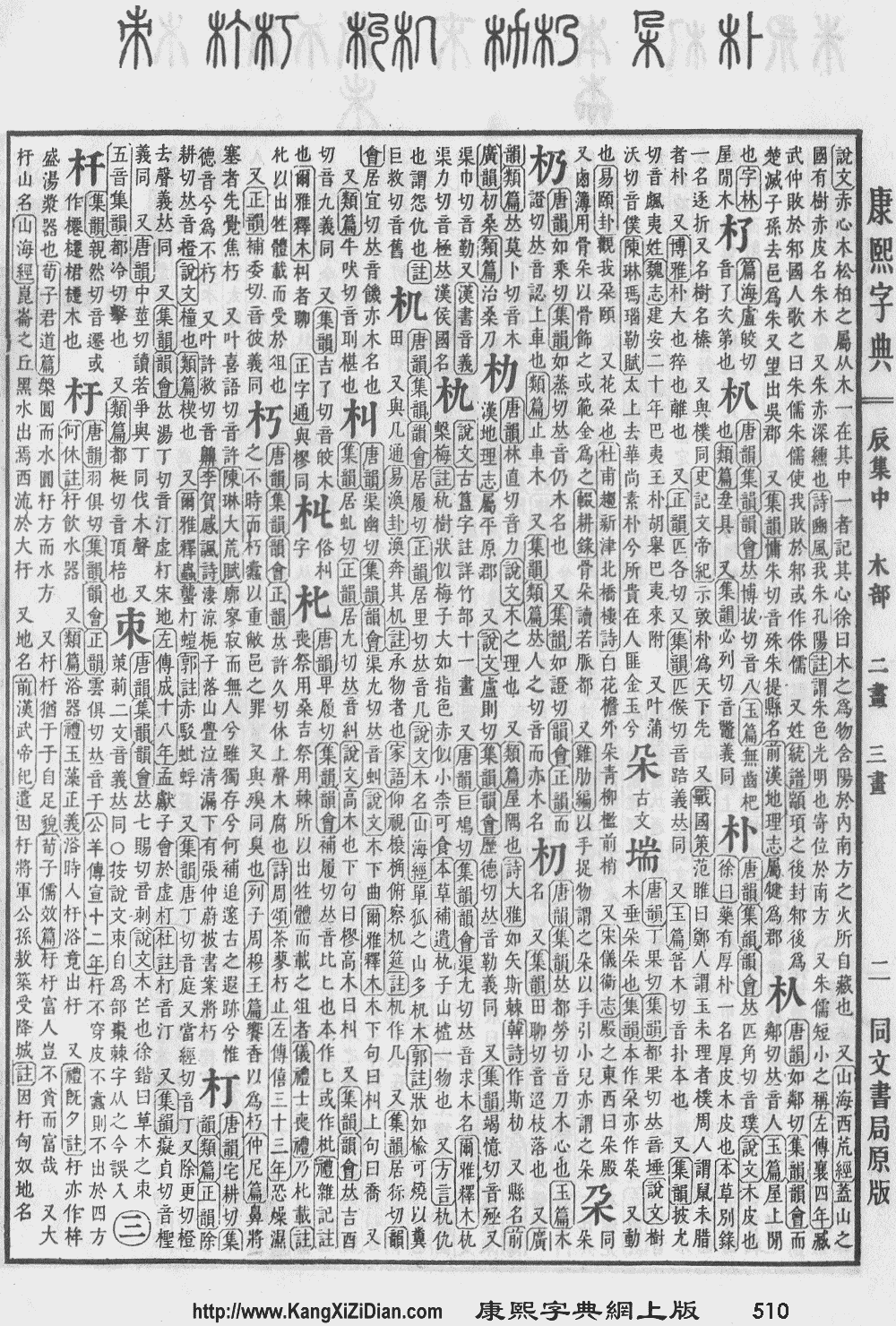
- Kangxi Dictionary: page 510, character 4
- Dai Kanwa Jiten: character 14428
- Dae Jaweon: page 894, character 3
- Hanyu Da Zidian (first edition): volume 2, page 1154, character 2
- Unihan data for U+6734
Chinese
Glyph origin
| Historical forms of the character 朴 | |
|---|---|
| Shuowen Jiezi (compiled in Han) | Liushutong (compiled in Ming) |
| Small seal script | Transcribed ancient scripts |
 |
 |
Characters in the same phonetic series (卜) (Zhengzhang, 2003)
Phono-semantic compound (形聲/形声, OC *pʰroːɡ) : semantic 木 + phonetic 卜 (OC *poːɡ).
Officially adopted as the simplified form of 樸 (etymology 6) in the Chinese Character Simplification Scheme (《漢字簡化方案》) in 1956.
Pronunciation
Pronunciation
Definitions
朴
- † big
- † big timber
- † rat meat which has not been air-dried
- 鄭人謂玉未理者璞,周人謂鼠未腊者朴。周人懷朴,過鄭賈曰:「欲買朴乎?」鄭賈曰:「欲之。」出其朴,視之,乃鼠也。因謝不取。今平原君自以賢,顯名於天下,然降其主父沙丘而臣之。天下之王尚猶尊之,是天下之王不如鄭賈之智也,眩於名,不知其實也。」 [Classical Chinese, trad.]
- From: Zhanguo Ce, circa 5th – 3rd centuries BCE
- Zhèng rén wèi yù wèi lǐ zhě pú, zhōu rén wèi shǔ wèi là zhě pǔ. Zhōu rén huái pǔ, guò zhèng gǔ yuē: “Yù mǎi pǔ hū?” Zhèng gǔ yuē: “Yù zhī.” Chū qí pǔ, shì zhī, nǎi shǔ yě. Yīn xiè bù qǔ. Jīn Píngyuán jūn zì yǐ xián, xiǎnmíng yú tiānxià, rán jiàng qí zhǔ fù Shāqiū ér chén zhī. Tiānxià zhī wáng shàng yóu zūn zhī, shì tiānxià zhī wáng bùrú zhèng gǔ zhī zhì yě, xuàn yú míng, bùzhī qí shí yě.” [Pinyin]
- The people from the state of Zheng gave the name 璞 (pú) for unrefined jade that is not yet carved or polished while the people from the state of Zhou gave the name 朴 (pǔ) for rat meat which has not been air-dried.
A man from Zhou holding 朴 (pǔ) went to see a businessman in Zheng and asked, "Do you want to buy some 朴 (pǔ)?". The businessman replied, "Yes, I would like to". The man from Zhou held out his 朴 (pǔ). The businessman saw that it was a rat. And so he declined to take it.
Now the Prince of Pingyuan has a distinguished reputation throughout the world as a man of worth and ability. But he degraded his ruler's father at Shaqiu and treated him as a subject. And yet and kings throughout the world have less understanding than the merchant of Zheng. They are dazzled by a name and do not know what he really is.
郑人谓玉未理者璞,周人谓鼠未腊者朴。周人怀朴,过郑贾曰:「欲买朴乎?」郑贾曰:「欲之。」出其朴,视之,乃鼠也。因谢不取。今平原君自以贤,显名于天下,然降其主父沙丘而臣之。天下之王尚犹尊之,是天下之王不如郑贾之智也,眩于名,不知其实也。」 [Classical Chinese, simp.]
Pronunciation
Definitions
朴
- a historical surname used by the Yi (夷 (yí)) people.
- 九月,巴七姓夷王朴胡、賨邑侯杜濩舉巴夷、賨民來附,於是分巴郡,以胡爲巴東太守,濩為巴西太守, [Literary Chinese, trad.]
- From: Chen Shou, Records of the Three Kingdoms, circa 3rd century CE
- jiǔyuè, bā qī xìng yí wáng Púhú, cóng yìhóu Dùhuò jǔ bā yí, cóng mín láifù, yúshì fēn bā jùn, yǐ Hú wèi bā dōng tàishǒu, Huò wèi bā xī tàishǒu, [Pinyin]
- (please add an English translation of this usage example)
九月,巴七姓夷王朴胡、𰷥邑侯杜濩举巴夷、𰷥民来附,于是分巴郡,以胡为巴东太守,濩为巴西太守, [Literary Chinese, simp.]
Pronunciation
Pronunciation
Definitions
朴
Etymology 6
| For pronunciation and definitions of 朴 – see 樸 (“simple; plain; rough; unpolished; sincere; honest; etc.”). (This character is the simplified form of 樸). |
Notes:
|
Pronunciation
Japanese
Readings
Alternative forms
Pronunciation
- IPA(key): [pa̠kɯ̟ᵝ]
References
- Matsumura, Akira, editor (2006), 大辞林 [Daijirin] (in Japanese), Third edition, Tōkyō: Sanseidō, →ISBN
- NHK Broadcasting Culture Research Institute, editor (1998), NHK日本語発音アクセント辞典 [NHK Japanese Pronunciation Accent Dictionary] (in Japanese), Tōkyō: NHK Publishing, →ISBN
Korean
Etymology
From Middle Chinese 朴 (MC phaewk).
Tày
Vietnamese
This article is issued from Wiktionary. The text is licensed under Creative Commons - Attribution - Sharealike. Additional terms may apply for the media files.