占
| ||||||||
Translingual
| Stroke order | |||
|---|---|---|---|
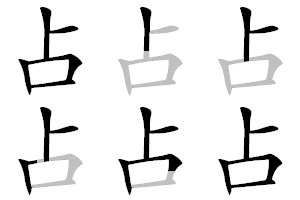 | |||
Han character
占 (Kangxi radical 25, 卜+3, 5 strokes, cangjie input 卜口 (YR), four-corner 21600, composition ⿱⺊口)
Derived characters
- 點(点, 奌), 店, 佔, 𢓕, 沾, 笘, 苫, 坫, 战, 粘, 砧, 拈, 毡, 鉆(钻), 玷, 貼(贴), 黏, 阽, 帖, 扂, 颭(飐), 鮎(鲇), 𡱇, 痁, 𨱬, 㚲, 趈, 迠, 炶, 煔, 枮
- left:
乩, 战, 敁, 覘, 觇, 頕, 㓠, 㣌, 𡖡, 𢧗, 𤿝
- right:
佔, 呫, 坫, 嚸, 岾, 帖, 怗, 拈, 枮, 沾, 炶, 煔, 玷, 砧, 秥, 站, 粘, 胋, 蛅, 袩, 詀, 貼, 贴, 跕, 酟, 鉆, 钻, 阽, 鮎, 鲇, 鹵, 黇, 黏, 點, 㚲, 䀡, 䍄, 䩇, 䩞, 䪓, 䬯, 䴴, 𠕟, 𠸞, 𡖞, 𡖵, 𢓕, 𣩚, 𤘇, 𤝓, 𥿕, 𦕒, 𧮪, 𧲸, 𨱬, 𪉜, 𪎋, 𪕐, 𪖚
- above:
- below:
- outside:
- inside:
- other:
梷, 檆, 蒧, 㸃, 㼭, 𠖣, 𠚝, 𠧱, 𠧴, 𠧵, 𠧷, 𠧺, 𠧾, 𠵑, 𠶧, 𡅴, 𡅾, 𡌐, 𡌽, 𡙏, 𢒦, 𢜋, 𢨟, 𢮸, 𢰷, 𣈔, 𣈘, 𣎀, 𣗴, 𣷀, 𣸾, 𣿤, 𤉽, 𤋒, 𤋧, 𤑰, 𤭥, 𥇞, 𥭔, 𥮒, 𥮠, 𥯎, 𥱱, 𥷠, 𥺦, 𦁦, 𦝿, 𦷙, 𧆗, 𧍈, 𧨼, 𨃊, 𩃅, 𩄷, 𩌓, 𩲦, 𩳨, 𪐇
References
- Kangxi Dictionary: page 157, character 30
- Dai Kanwa Jiten: character 2780
- Dae Jaweon: page 361, character 19
- Hanyu Da Zidian (first edition): volume 1, page 92, character 5
- Unihan data for U+5360

Chinese
| simp. and trad. |
占 | |
|---|---|---|
Glyph origin
| Historical forms of the character 占 | ||
|---|---|---|
| Shang | Warring States | Shuowen Jiezi (compiled in Han) |
| Oracle bone script | Chu slip and silk script | Small seal script |
 |
 |
 |
| Old Chinese | |
|---|---|
| 頕 | *taːm |
| 煔 | *ɦlaːm, *hljems, *hl'eːms |
| 炶 | *ɦlaːm |
| 詀 | *rteːm, *rdeːms, *teːm, *tʰjeb |
| 站 | *rteːms |
| 檆 | *sreːm |
| 黏 | *nem |
| 粘 | *nem |
| 枮 | *slem, *ʔl'ɯm |
| 霑 | *tem |
| 沾 | *tem, *teːms, *tʰeːm |
| 覘 | *tems, *tʰem |
| 鉆 | *tʰem, *ɡrem, *tʰeːb |
| 占 | *ʔljem, *tjems |
| 颭 | *tjemʔ |
| 佔 | *tjems, *teːm |
| 苫 | *hljem, *hljems |
| 痁 | *hljem, *teːms |
| 蛅 | *njem |
| 阽 | *lem |
| 敁 | *teːm |
| 掂 | *tiːm |
| 點 | *teːmʔ |
| 玷 | *teːmʔ, *teːms |
| 店 | *tiːms |
| 坫 | *tiːms, *tim |
| 黇 | *tʰeːm |
| 扂 | *deːmʔ |
| 拈 | *neːm |
| 鮎 | *neːm |
| 砧 | *ʔl'ɯm |
| 笘 | *teːb |
| 跕 | *teːb, *tʰeːb |
| 貼 | *tʰeːb |
| 帖 | *tʰeːb |
| 怗 | *tʰeːb |
| 呫 | *tʰeːb |
Ideogrammic compound (會意/会意) : 卜 (“divination”) + 口 (“mouth”).
Pronunciation
Definitions
占
Synonyms
| Variety | Location | Words |
|---|---|---|
| Formal (Written Standard Chinese) | 分 | |
| Mandarin | Beijing | 分 |
| Taiwan | 分 | |
| Jinan | 分 | |
| Xi'an | 分 | |
| Wuhan | 分 | |
| Chengdu | 分 | |
| Yangzhou | 分 | |
| Hefei | 分 | |
| Malaysia | 仙 | |
| Singapore | 分 | |
| Cantonese | Guangzhou | 分 |
| Hong Kong | 仙, 仙士 dated | |
| Taishan | 分, 仙 | |
| Gan | Nanchang | 分 |
| Hakka | Meixian | 分 |
| Jin | Taiyuan | 分 |
| Northern Min | Jian'ou | 分 |
| Eastern Min | Fuzhou | 分 |
| Southern Min | Xiamen | 占, 分 |
| Quanzhou | 占 | |
| Zhangzhou | 占 | |
| Tainan | 仙 | |
| Penang (Hokkien) | 鐳, sen | |
| Singapore (Hokkien) | 占 | |
| Manila (Hokkien) | 仙 | |
| Chaozhou | 分 | |
| Singapore (Teochew) | 占 | |
| Wu | Suzhou | 分 |
| Wenzhou | 分 | |
| Xiang | Changsha | 分 |
| Shuangfeng | 分 | |
Compounds
References
- “占”, in 漢語多功能字庫 (Multi-function Chinese Character Database), 香港中文大學 (the Chinese University of Hong Kong), 2014–
Pronunciation
Usage notes
Sources vary in the pronunciation of sense "to recount orally". Zhengzitong recorded a level tone, yet Zihui recorded a departing tone.
The standard Mandarin pronunciation is zhàn in Mainland China and Taiwan.
Pronunciation
Compounds
Etymology 4
| For pronunciation and definitions of 占 – see 佔 (“to occupy; to possess; etc.”). (This character is the simplified and variant traditional form of 佔). |
Notes:
|
Compounds
- 侵占 (qīnzhàn)
- 侵占罪
- 包占
- 占上
- 占上游
- 占上風 (zhàn shàngfēng)
- 占地 (zhàndì)
- 占地步
- 占地盤
- 占場兒/占场儿
- 占強
- 占房
- 占據 (zhànjù)
- 占斷
- 占有 (zhànyǒu)
- 占有權
- 占為己有
- 占用 (zhànyòng)
- 占花魁
- 占課
- 占領 (zhànlǐng)
- 占頭籌/占头筹
- 占鰲頭/占鳌头
- 口占
- 寡占 (guǎzhàn)
- 強占 (qiángzhàn)
- 影占
- 拜占庭 (Bàizhàntíng)
- 搶占 (qiǎngzhàn)
- 攻占 (gōngzhàn)
- 標占
- 獨占 (dúzhàn)
- 獨占花魁
- 獨占資本/独占资本
- 獨占鰲頭/独占鳌头 (dúzhàn'áotóu)
- 獨占鼇頭/独占鳌头
- 稍占上風
- 竊占
- 竊占罪
- 聯合獨占/联合独占
- 進占 (jìnzhàn)
- 陰占
- 霸占 (bàzhàn)
- 鰲頭獨占/鳌头独占
- 鳩占鵲巢/鸠占鹊巢 (jiūzhànquècháo)
- 鵲巢鳩占/鹊巢鸠占 (quècháojiūzhàn)
- 鼇頭獨占/鳌头独占
Japanese
Readings
Compounds
- 占卜 (senboku): augury, divination, fortune-telling
- 卜占 (bokusen): augury, divination, fortune-telling
- 複占 (fukusen): duopoly
Noun
| Kanji in this term |
|---|
| 占 |
| うら Grade: S |
| kun’yomi |
| Alternative spelling |
|---|
| 卜 |
占 • (ura)
- (archaic) fortune-telling
Korean
Etymology 1
From Middle Chinese 占 (MC tsyemH).
| Historical readings |
|---|
|
Pronunciation
- (SK Standard/Seoul) IPA(key): [t͡ɕʌ̹m]
- Phonetic hangul: [점]
Compounds
Etymology 2
From Middle Chinese 占 (MC tsyem).
| Historical readings |
|---|
|
Pronunciation
- (SK Standard/Seoul) IPA(key): [t͡ɕʌ̹m]
- Phonetic hangul: [점]