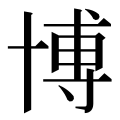
博
See also: 愽
| ||||||||
 | ||||||||
Translingual
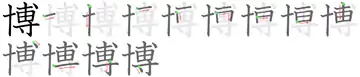
| Stroke order | |||
|---|---|---|---|
 | |||
Han character
博 (Kangxi radical 24, 十+10, 12 strokes, cangjie input 十戈月戈 (JIBI), four-corner 43046, composition ⿰十尃)
Derived characters
- 𠽢, 𣽡, 𭧧, 𫓆, 𮑀, 簙
References
- Kangxi Dictionary: page 157, character 13
- Dai Kanwa Jiten: character 2761
- Dae Jaweon: page 360, character 10
- Hanyu Da Zidian (first edition): volume 1, page 66, character 2
- Unihan data for U+535A
- Unihan data for U+2F82E

Bala
Chinese
| trad. | 博 | |
|---|---|---|
| simp. # | 博 | |
| 2nd round simp. | ⿰十⿺专丶 | |
| alternative forms | 卜 (poh) Hokkien | |
Glyph origin
Characters in the same phonetic series (甫) (Zhengzhang, 2003)
| Old Chinese | |
|---|---|
| 豧 | *pʰoːs, *pʰa, *pʰas |
| 縛 | *baːɡs, *baɡ |
| 逋 | *paː |
| 餔 | *paː, *baːs |
| 晡 | *paː |
| 庯 | *paː |
| 陠 | *paː, *pʰaː |
| 鵏 | *paː, *baːs |
| 峬 | *paː |
| 誧 | *paː, *pʰaː, *pʰaːʔ, *pʰaːs |
| 秿 | *paː, *pʰa, *baʔ |
| 鯆 | *paː, *pʰaː, *paʔ |
| 補 | *paːʔ |
| 圃 | *paːʔ, *paːs |
| 鋪 | *pʰaː, *pʰaːs, *pʰa |
| 痡 | *pʰaː, *pʰa |
| 浦 | *pʰaːʔ |
| 烳 | *pʰaːʔ |
| 溥 | *pʰaːʔ, *paːɡ |
| 悑 | *pʰaːs |
| 酺 | *baː |
| 匍 | *baː |
| 蜅 | *baː, *paʔ |
| 脯 | *baː, *paʔ |
| 葡 | *baː |
| 蒱 | *baː |
| 蒲 | *baː |
| 簿 | *baːʔ, *baːɡ |
| 捕 | *baːs |
| 哺 | *baːs |
| 簠 | *pa, *paʔ, *pʰas |
| 甫 | *paʔ |
| 黼 | *paʔ |
| 莆 | *paʔ |
| 俌 | *paʔ, *pʰaʔ |
| 郙 | *paʔ, *pʰa |
| 傅 | *paɡs |
| 搏 | *paɡs, *paːɡ, *pʰaːɡ |
| 麱 | *pʰa |
| 尃 | *pʰa |
| 榑 | *ba |
| 輔 | *baʔ |
| 鬴 | *baʔ |
| 賻 | *baɡs |
| 博 | *paːɡ |
| 髆 | *paːɡ |
| 鎛 | *paːɡ |
| 猼 | *paːɡ |
| 餺 | *paːɡ |
| 簙 | *paːɡ |
| 鑮 | *paːɡ, *baːɡ |
| 欂 | *paːɡ, *baɡ, *breːɡ |
| 蒪 | *pʰaːɡ |
| 膊 | *pʰaːɡ |
| 薄 | *baːɡ |
| 礡 | *baːɡ |
Phono-semantic compound (形聲/形声, OC *paːɡ) : semantic 十 + phonetic 尃 (OC *pʰa).
Pronunciation
Definitions
博
- abundant; plentiful; rich
- wide; broad
- to thoroughly understand; to be well versed in
- to win; to court
- (historical) Liubo (an ancient Chinese board game)
- alt. forms: 簙 (bó)
- to gamble; to play games
- (Hokkien) to try without certainty (hoping to get some benefit by chance)
- (Xiamen and Zhangzhou Hokkien) maybe; perhaps; probably
- Short for 博覽/博览 (bólǎn, “expo”).
- Short for 博客 (bókè, “blog”).
- Short for 博士 (bóshì, “doctoral degree”).
- a surname
Synonyms
- (maybe):
- 也許/也许 (yěxǔ)
- 保不住 (bǎobuzhù) (colloquial)
- 保不定 (bǎobudìng) (colloquial)
- 保不齊/保不齐 (bǎobuqí) (colloquial)
- 備不住/备不住 (bèibuzhù) (regional)
- 凡勢/凡势 (hoān-sè) (Taiwanese Hokkien)
- 博定 (Zhangzhou Hokkien)
- 可能 (kěnéng)
- 容許/容许 (róngxǔ) (literary)
- 怕係/怕系 (Hakka)
- 怕是 (pàshì)
- 或者 (huòzhě)
- 或許/或许 (huòxǔ)
- 指不定 (zhǐbùdìng)
- 搞不好 (gǎobùhǎo)
- 歉采 (Hokkien)
- 殼張/壳张 (7khoq-tsan) (Wu, dated)
- 沒準兒/没准儿 (méizhǔnr) (colloquial)
- 興許/兴许 (xīngxǔ) (colloquial)
- 話勿出/话勿出 (6gho-veq-tsheq) (Wu)
- 話唔埋/话唔埋 (waa6 m4 maai4) (Cantonese)
- 話唔定/话唔定 (waa6 m4 ding6) (Cantonese)
- 說不定/说不定 (shuōbùdìng)
- 講勿定/讲勿定 (5kaon-veq-din) (Wu)
- 講唔定/讲唔定 (gong2 m4 ding6) (Cantonese)
- 難免/难免 (nánmiǎn)
Compounds
- 五經博士/五经博士
- 仁言利博
- 六博 (liùbó)
- 博克達山/博克达山
- 博取 (bóqǔ)
- 博古 (bógǔ)
- 博古兒/博古儿
- 博古圖錄/博古图录
- 博古知今
- 博古通今 (bógǔtōngjīn)
- 博士 (bóshì)
- 博士學位/博士学位 (bóshì xuéwèi)
- 博士弟子
- 博士買驢/博士买驴 (bóshìmǎilǘ)
- 博大 (bódà)
- 博大精深 (bódàjīngshēn)
- 博奕
- 博奧/博奥
- 博學/博学 (bóxué)
- 博學多才/博学多才 (bóxuéduōcái)
- 博學多聞/博学多闻 (bóxuéduōwén)
- 博學宏詞/博学宏词
- 博學洽聞/博学洽闻
- 博學篇/博学篇
- 博學鴻儒/博学鸿儒
- 博客 (bókè)
- 博局
- 博山香爐/博山香炉 (bóshān xiānglú)
- 博巴
- 博弈 (bóyì)
- 博弈論/博弈论 (bóyìlùn)
- 博徒
- 博得 (bódé)
- 博愛/博爱 (bó'ài)
- 博愛座/博爱座 (bó'àizuò)
- 博愛濟群/博爱济群
- 博戲/博戏
- 博換/博换
- 博文約禮/博文约礼 (bówényuēlǐ)
- 博斯坦 (Bósītǎn)
- 博斯騰湖/博斯腾湖
- 博施濟眾/博施济众
- 博易
- 博望侯
- 博望坡
- 博洽 (bóqià)
- 博浪
- 博浪沙
- 博浪飛椎/博浪飞椎
- 博浪鼓
- 博淄煤礦/博淄煤矿
- 博濟醫院/博济医院
- 博父國/博父国
- 博爾赤/博尔赤
- 博物 (bówù)
- 博物多聞/博物多闻
- 博物學/博物学 (bówùxué)
- 博物志
- 博物洽聞/博物洽闻
- 博物院 (bówùyuàn)
- 博物館/博物馆 (bówùguǎn)
- 博磨
- 博社 (Bóshè)
- 博而不精 (bó'érbùjīng)
- 博聞/博闻 (bówén)
- 博聞多見/博闻多见
- 博聞多識/博闻多识
- 博聞強記/博闻强记 (bówénqiángjì)
- 博聞強識/博闻强识 (bówénqiángzhì)
- 博聞彊志/博闻强志
- 博聞彊記/博闻强记
- 博聞閎覽/博闻闳览
- 博興/博兴 (Bóxīng)
- 博覽/博览 (bólǎn)
- 博覽五車/博览五车
- 博覽古今/博览古今
- 博覽會/博览会 (bólǎnhuì)
- 博覽群書/博览群书 (bólǎnqúnshū)
- 博識/博识 (bóshí)
- 博貫/博贯
- 博達/博达
- 博郎鼓
- 博雅 (bóyǎ)
- 國家博士/国家博士
- 土博士
- 地大物博 (dìdàwùbó)
- 太常博士
- 奧博/奥博 (àobó)
- 女博士
- 學問淵博/学问渊博
- 守約施博/守约施博
- 寬博/宽博
- 峨冠博帶/峨冠博带
- 廣博/广博 (guǎngbó)
- 彊記博聞/强记博闻
- 打博
- 旁徵博引/旁征博引 (pángzhēngbóyǐn)
- 氾博
- 沉博絕麗/沉博绝丽
- 汪洋浩博
- 洽聞博見/洽闻博见
- 浩博 (hàobó)
- 淄博 (Zībó)
- 淵博/渊博 (yuānbó)
- 淹博
- 淄博煤礦/淄博煤矿
- 深稽博考
- 溥博
- 由博返約/由博返约
- 知今博古
- 磨博士
- 算博士
- 米鹽博辯/米盐博辩
- 繁博
- 花博士
- 茶博士
- 袂博假博 (bē-phok-ké-phok) (Min Nan)
- 褒衣博帶/褒衣博带
- 見聞廣博/见闻广博
- 該博/该博
- 賅博/赅博
- 賭博/赌博 (dǔbó)
- 賭博場/赌博场
- 賭博罪/赌博罪
- 超博士
- 通今博古
- 通古博今
- 鄂博 (èbó)
- 酒博士
- 閎覽博物/闳览博物
- 零和博弈 (línghé bóyì)
- 風流博浪/风流博浪
- 高冠博帶/高冠博带
- 高才博學/高才博学
- 鴻博/鸿博
Japanese
| Shinjitai | 博 | |
| Kyūjitai [1] |
博󠄁 博+ 󠄁?(Adobe-Japan1) |
 |
| 博󠄄 博+ 󠄄?(Hanyo-Denshi) (Moji_Joho) | ||
| The displayed kanji may be different from the image due to your environment. See here for details. | ||
Readings
Compounds
Compounds
- 医博 (ihaku, “doctor of medicine”)
- 該博 (gaihaku, “profundity; profound”)
- 賭博 (tobaku, “gambling”)
- 博士 (hakase, “doctor; expert”)
- 博多 (hakata, “Hakata”)
- 博愛 (hakuai, “fraternity”)
- 博奕 (bakueki, “gambling”)
- 博雅 (hakuga, “erudition; erudite”)
- 博学 (hakugaku, “erudition; erudite”)
- 博戯 (hakugi, “gambling game”)
- 博士 (hakushi, “doctor”)
- 博識 (hakushiki, “erudition; erudite”)
- 博捜 (hakusō, “wide search”)
- 博大 (hakudai, “large and wide”)
- 博打 (bakuchi, “gambling”)
- 博徒 (bakuto, “gambler”)
- 博物 (hakubutsu, “natural history; wide learning”)
- 博聞 (hakubun, “well-informed, erudite”)
- 博覧 (hakuran, “public exhibition; extensive knowledge”)
- 万博 (banpaku, “international exposition, expo”)
- 文博 (bunhaku, “doctor of literature”)
- 理博 (rihaku, “doctor of science”)
Etymology 2
| Kanji in this term |
|---|
| 博 |
| ひろし Grade: 4 |
| nanori |
Korean
Vietnamese
This article is issued from Wiktionary. The text is licensed under Creative Commons - Attribution - Sharealike. Additional terms may apply for the media files.