弋
See also: 戈
| ||||||||
| ||||||||
Translingual
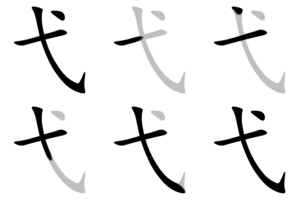
| Stroke order | |||
|---|---|---|---|
 | |||
Han character
弋 (Kangxi radical 56, 弋+0, 3 strokes, cangjie input 戈心 (IP), four-corner 43000, composition ⿺𫠠丶)
- Kangxi radical #56, ⼷.
Derived characters
References
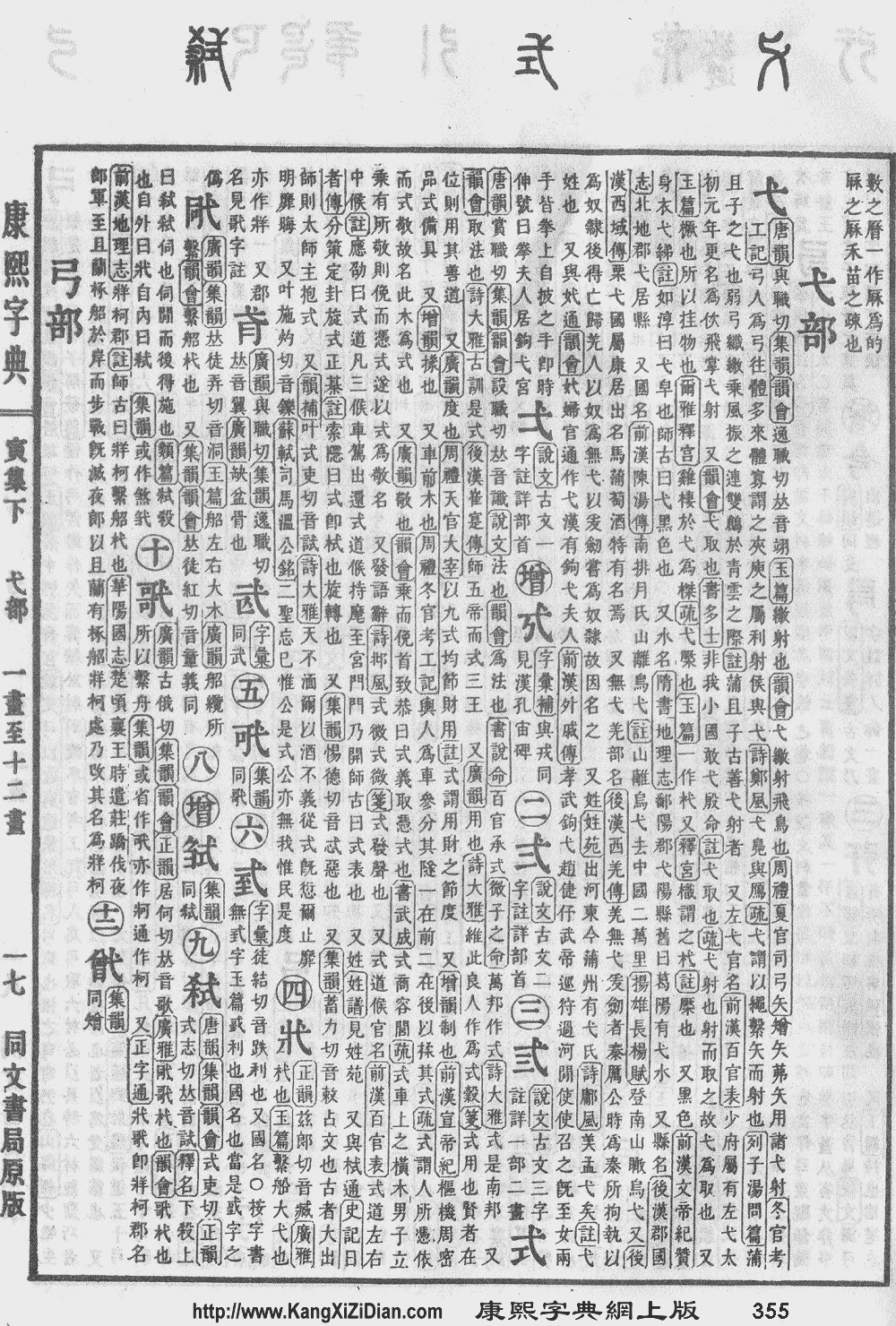
- Kangxi Dictionary: page 355, character 1
- Dai Kanwa Jiten: character 9656
- Dae Jaweon: page 670, character 16
- Hanyu Da Zidian (first edition): volume 1, page 557, character 23
- Unihan data for U+5F0B
Chinese
| simp. and trad. |
弋 | |
|---|---|---|
| alternative forms | 𢍺 隿 | |
Glyph origin
| Historical forms of the character 弋 | ||||
|---|---|---|---|---|
| Shang | Western Zhou | Warring States | Shuowen Jiezi (compiled in Han) | Liushutong (compiled in Ming) |
| Oracle bone script | Bronze inscriptions | Chu slip and silk script | Small seal script | Transcribed ancient scripts |
 |
 |
 |
 |
 |
Characters in the same phonetic series (弋) (Zhengzhang, 2003)
| Old Chinese | |
|---|---|
| 戴 | *ʔl'ɯːɡs |
| 襶 | *tɯːɡs |
| 貸 | *l̥ʰɯːɡs |
| 代 | *l'ɯːɡs |
| 袋 | *l'ɯːɡs |
| 岱 | *l'ɯːɡs |
| 黛 | *l'ɯːɡs |
| 玳 | *l'ɯːɡs |
| 帒 | *l'ɯːɡs |
| 甙 | *l'ɯːɡs |
| 酨 | *l'ɯːs, *zlɯːs |
| 試 | *hljɯɡs |
| 弒 | *hljɯɡs |
| 忒 | *l̥ʰɯːɡ |
| 貣 | *l̥ʰɯːɡ, *l'ɯːɡ |
| 鴏 | *l'ɯːɡ |
| 栻 | *l̥ʰɯɡ, *hljɯɡ |
| 侙 | *l̥ʰɯɡ |
| 恜 | *l̥ʰɯɡ |
| 式 | *hljɯɡ |
| 軾 | *hljɯɡ |
| 拭 | *hljɯɡ |
| 鉽 | *hljɯɡ |
| 烒 | *hljɯɡ |
| 弋 | *lɯɡ |
| 芅 | *lɯɡ |
| 黓 | *lɯɡ |
| 隿 | *lɯɡ |
| 杙 | *lɯɡ |
| 釴 | *lɯɡ |
Pronunciation
Definitions
弋
Compounds
References
- “弋”, in 漢語多功能字庫 (Multi-function Chinese Character Database), 香港中文大學 (the Chinese University of Hong Kong), 2014–
Japanese
Korean
Hanja
弋 (eum 익 (ik))
- This term needs a translation to English. Please help out and add a translation, then remove the text
{{rfdef}}.
Vietnamese
This article is issued from Wiktionary. The text is licensed under Creative Commons - Attribution - Sharealike. Additional terms may apply for the media files.