戈
| ||||||||
| ||||||||
Translingual
| Stroke order | |||
|---|---|---|---|
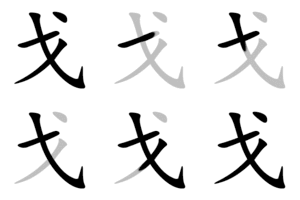 | |||
| Stroke order (Taiwan) | |||
|---|---|---|---|
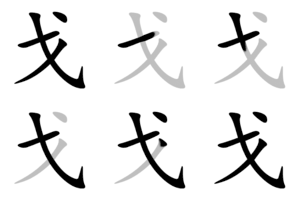 | |||
Han character
戈 (Kangxi radical 62, 戈+0, 4 strokes, cangjie input 戈 (I), four-corner 53000, composition ⿻弋丿)
- Kangxi radical #62, ⼽.
Derived characters
References
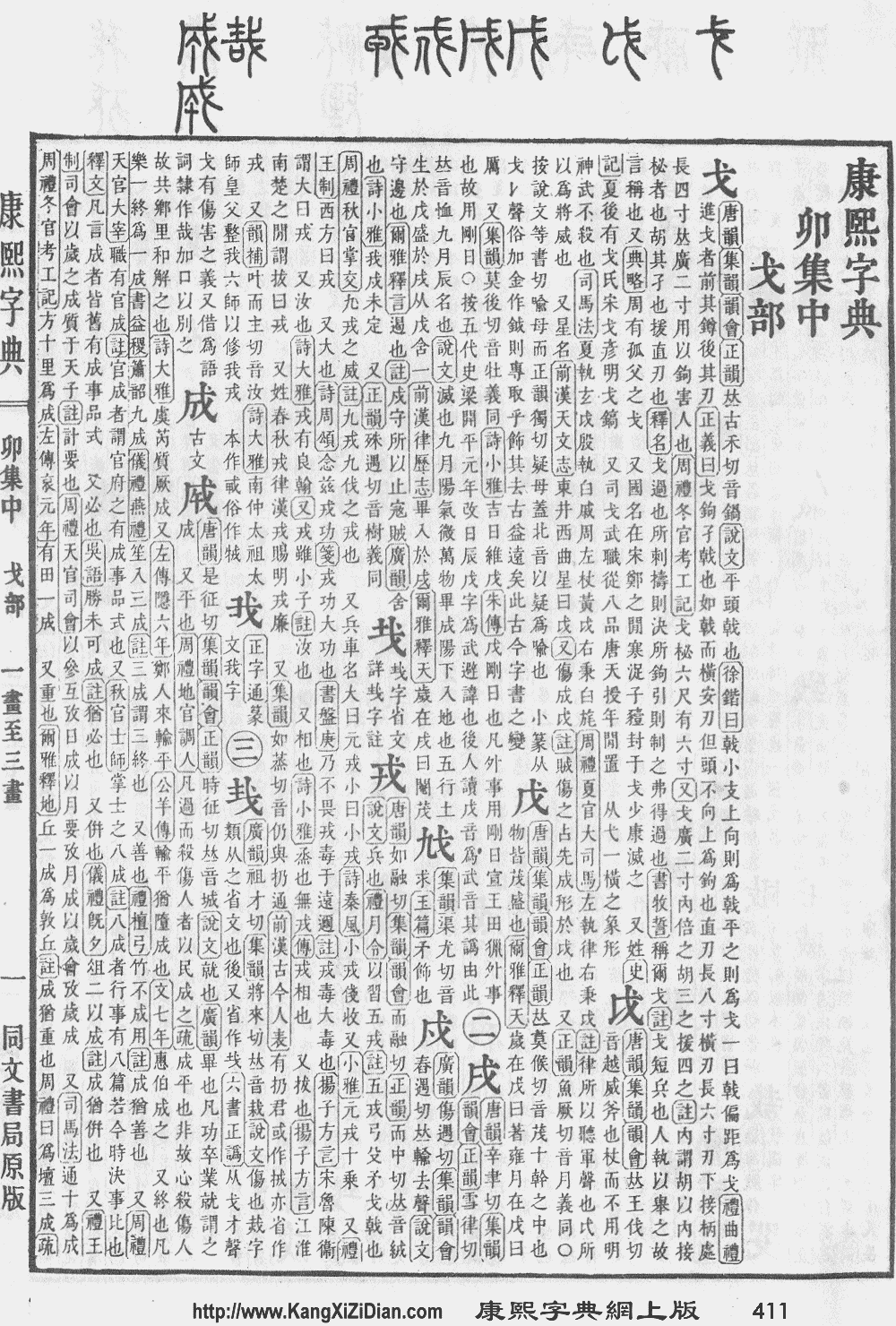
- Kangxi Dictionary: page 411, character 1
- Dai Kanwa Jiten: character 11530
- Dae Jaweon: page 752, character 5
- Hanyu Da Zidian (first edition): volume 2, page 1397, character 1
- Unihan data for U+6208
Chinese
| simp. and trad. |
戈 | |
|---|---|---|

A bronze dagger-axe.
Glyph origin
| Historical forms of the character 戈 | |||
|---|---|---|---|
| Shang | Western Zhou | Warring States | Shuowen Jiezi (compiled in Han) |
| Oracle bone script | Bronze inscriptions | Chu slip and silk script | Small seal script |
 |
 |
 |
 |
Characters in the same phonetic series (戈) (Zhengzhang, 2003)
Pictogram (象形) ― a tool or weapon on a pole, the pole having developed into the long upper-left to lower-right diagonal stroke.
Pronunciation
Compounds
- 上戈 (Shànggē)
- 不念荷戈
- 倒戈
- 倒戈卸甲
- 倒持干戈 (dàochí gāngē)
- 倒置干戈
- 倒載干戈
- 入室操戈
- 兵戈 (bīnggē)
- 兵戈擾攘/兵戈扰攘
- 動干戈
- 反戈
- 反戈一擊/反戈一击 (fǎngēyījī)
- 同室操戈 (tóngshìcāogē)
- 大動干戈
- 大戈壁
- 天戈
- 干戈 (gāngē)
- 干戈載戢
- 戈什
- 戈什哈
- 戈壁 (Gēbì)
- 戈比 (gēbǐ)
- 投戈
- 投戈講藝/投戈讲艺
- 投袂援戈
- 投袂荷戈
- 拋戈卸甲/抛戈卸甲
- 拋戈棄甲/抛戈弃甲
- 探戈 (tàngē)
- 探戈舞 (tàngēwǔ)
- 揮戈/挥戈
- 揮戈反日/挥戈反日
- 揮戈回日/挥戈回日
- 撝戈反日/㧑戈反日
- 操戈
- 操戈入室
- 擐甲持戈 (huànjiǎ chí gē)
- 擐甲揮戈/擐甲挥戈
- 擐甲操戈
- 枕戈嘗膽/枕戈尝胆
- 枕戈坐甲
- 枕戈寢甲/枕戈寝甲
- 枕戈待敵/枕戈待敌
- 枕戈待旦
- 枕戈汗馬/枕戈汗马
- 枕戈泣血
- 枕戈飲膽/枕戈饮胆
- 杯酒戈矛
- 棄甲拋戈/弃甲抛戈
- 止戈
- 止戈散馬/止戈散马
- 止戈為武/止戈为武 (zhǐgēwéiwǔ)
- 止戈興仁/止戈兴仁
- 泣血枕戈
- 礪戈秣馬/砺戈秣马
- 蒙戈 (měnggē)
- 解甲倒戈
- 解甲投戈
- 負戈/负戈
- 金戈鐵馬/金戈铁马 (jīngētiěmǎ)
- 鐵馬金戈/铁马金戈
- 雕戈
- 韜戈偃武/韬戈偃武
- 韜戈卷甲/韬戈卷甲
- 魯陽揮戈/鲁阳挥戈
Japanese
Korean
Vietnamese
Han character
戈: Hán Nôm readings: qua, quơ, quờ
- This term needs a translation to English. Please help out and add a translation, then remove the text
{{rfdef}}.
Compounds
- 𣦆戈 (trải qua)
This article is issued from Wiktionary. The text is licensed under Creative Commons - Attribution - Sharealike. Additional terms may apply for the media files.