找

找 U+627E, 找
CJK UNIFIED IDEOGRAPH-627E
← 扽
[U+627D]
CJK Unified Ideographs 承 →
[U+627F]

Translingual

Stroke order
7 strokes

Han character

找 (Kangxi radical 64, 手+4, 7 strokes, cangjie input 手戈 (QI), four-corner 53050, composition ⿰扌戈)

References

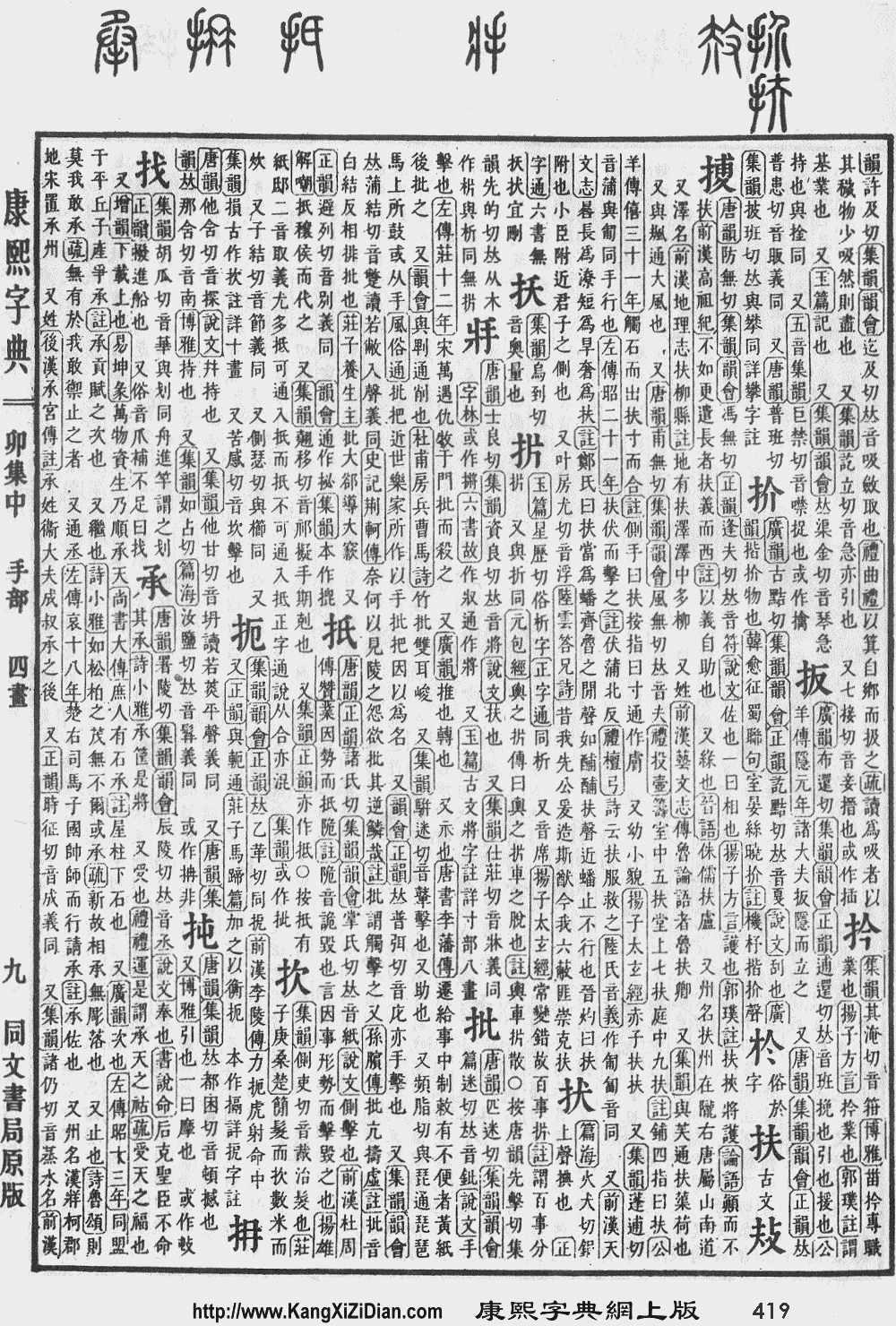
  • Kangxi Dictionary: page 419, character 18
  • Dai Kanwa Jiten: character 11851
  • Dae Jaweon: page 766, character 10
  • Hanyu Da Zidian (first edition): volume 3, page 1835, character 4
  • Unihan data for U+627E

Chinese

Glyph origin

Phono-semantic compound (形聲/形声, OC *ʔsruːʔ) : semantic 扌 (“hand”) + phonetic 戈 (OC *koːl).

Originally a variant form of 划. Borrowed to mean a similar action.(Can this(+) etymology be sourced?)

The popular interpretation as a hand (扌) looking for a halberd (戈) is a mnemonic and not the origin of the character.

Etymology 1

simp. and trad.
找
alternative forms 爪 “to seek”

Both “to seek” and “to give change” senses are attested since the Ming dynasty. The etymology is uncertain and it is unclear whether both senses are of the same origin. Compare 爪 (zhuǎ) and 抓 (zhuā).

Pronunciation


Note:
  • chāu/chǎu - vernacular;
  • cháu - literary.
    • Wu
      • (Shanghai):
        • Wugniu: 5tsau
        • MiniDict: tsau去
        • Wiktionary Romanisation (Shanghai): 2tsau
        • Sinological IPA (Shanghai): /t͡sɔ³⁴/
    • Xiang
      • (Changsha)
        • Wiktionary: zhau3
        • Sinological IPA (key) (old-style): /ʈ͡ʂɒu̯⁴¹/
        • Sinological IPA (key) (new-style): /t͡sɒu̯⁴¹/

Zhengzhang system (2003)
Character 找
Reading # 1/1
No. 17661
Phonetic
component
爪
Rime
group
幽
Rime
subdivision
1
Corresponding
MC rime
爪
Old
Chinese
/*ʔsruːʔ/
Notes 抓分化字

Definitions

找

  1. to look for; to seek
    他決定出去找食物。 [MSC, trad.]
    他决定出去找食物。 [MSC, simp.]
    Tā juédìng chūqù zhǎo shíwù. [Pinyin]
    He decided to go out to search for food.
    你找過沙發後面了嗎? [MSC, trad.]
    你找过沙发后面了吗? [MSC, simp.]
    Nǐ zhǎo guò shāfā hòumiàn le ma? [Pinyin]
    Have you looked behind the sofa?
    我找到鑰匙了。/我找到钥匙了。  ―  Wǒ zhǎo dào yàoshi le.  ―  I found my keys.
    找到事情的根源  ―  zhǎo dào shìqíng de gēnyuán  ―  to get to the root of the matter
    我想我能給你找到合適的尺碼。 [MSC, trad.]
    我想我能给你找到合适的尺码。 [MSC, simp.]
    Wǒ xiǎng wǒ néng gěi nǐ zhǎo dào héshì de chǐmǎ. [Pinyin]
    I think I can find the right size for you.
    我在一輛旅行車旁邊找到了一個車位。 [MSC, trad.]
    我在一辆旅行车旁边找到了一个车位。 [MSC, simp.]
    Wǒ zài yī liàng lǚxíngchē pángbiān zhǎo dào le yī ge chēwèi. [Pinyin]
    I found a place to park beside a station wagon.
    找不到工作  ―  zhǎobudào gōngzuò  ―  to be unable to find work
    找不到回去的路  ―  zhǎobudào huíqù de lù  ―  to be unable to find the way back
  2. to ask for somebody; to call on somebody
    有人來找我嗎?/有人来找我吗?  ―  Yǒu rén lái zhǎo wǒ ma?  ―  Did anybody ask for me?
    為什麼要找我幫忙? [MSC, trad.]
    为什么要找我帮忙? [MSC, simp.]
    Wèishénme yào zhǎo wǒ bāngmáng? [Pinyin]
    Why do you(/they) want me specifically to help?
  3. to give change
    不用找了。  ―  Bùyòng zhǎo le.  ―  Keep the change.
    這是找你的錢。/这是找你的钱。  ―  Zhè shì zhǎo nǐ de qián.  ―  Here is your change.
    找返你三個六。 [Cantonese, trad.]
    找返你三个六。 [Cantonese, simp.]
    zaau2 faan1 nei5 saam1 go3 luk6. [Jyutping]
    $3.60 is your change.
  4. to make up (a deficiency)
Synonyms
  • (to give change): (Hokkien, Teochew) 拄 (zhǔ)

Compounds

  • 倒找
  • 兩不找/两不找
  • 外找
  • 外找兒/外找儿
  • 尋找/寻找 (xúnzhǎo)
  • 打著燈籠沒處找/打着灯笼没处找
  • 找上門/找上门
  • 找不自在
  • 找不著北/找不着北 (zhǎobùzháoběi)
  • 找主
  • 找事 (zhǎoshì)
  • 找便宜
  • 找倒霉
  • 找價/找价
  • 找出路
  • 找刺
  • 找墊背的/找垫背的
  • 找婆家
  • 找尋/找寻 (zhǎoxún)
  • 找對象/找对象
  • 找對頭/找对头
  • 找岔兒/找岔儿
  • 找岔子 (zhǎo chàzi)
  • 找帳/找帐
  • 找平
  • 找彆扭/找别扭
  • 找換/找换
  • 找換店/找换店 (zhǎohuàndiàn)
  • 找數/找数
  • 找晦氣/找晦气
  • 找梯子下臺/找梯子下台
  • 找樂子/找乐子 (zhǎo lèzi)
  • 找機會/找机会
  • 找死 (zhǎosǐ)
  • 找沒味兒/找没味儿
  • 找沒趣/找没趣
  • 找病
  • 找碴 (zhǎochá)
  • 找碴兒/找碴儿
  • 找竅門/找窍门
  • 找籬/找篱
  • 找絕/找绝
  • 找縫子/找缝子
  • 找續/找续 (zhǎoshú)
  • 找臺階/找台階/找台阶
  • 找臺階下/找台階下/找台阶下
  • 找茬 (zhǎochá)
  • 找藉口/找借口
  • 找補/找补
  • 找贖/找赎 (zhǎoshú)
  • 找踏級/找踏级
  • 找轍/找辙
  • 找野食
  • 找錢/找钱 (zhǎoqián)
  • 找門路/找门路
  • 找面子
  • 找頭/找头
  • 找飯碗/找饭碗
  • 找麻煩/找麻烦
  • 找齊/找齐
  • 探找
  • 有找
  • 查找 (cházhǎo)
  • 自找 (zìzhǎo)
  • 自找罪受
  • 自找苦吃
  • 自找麻煩/自找麻烦
  • 騎馬找馬/骑马找马
  • 騎驢找驢/骑驴找驴

See also

Etymology 2

For pronunciation and definitions of 找 – see 划 (“to row; to paddle”).
(This character is a variant form of 划).

Japanese

Kanji

找

(uncommon “Hyōgai” kanji)

  1. to look for
  2. to seek
  3. to make change

Readings

  • Go-on: げ (ge)
  • Kan-on: か (ka)
  • On: そう (sō)
  • Kun: さおさす (saosasu, 找す); たずねる (tazuneru, 找ねる)

Korean

Hanja

找 (eumhun 채울 조 (chae'ul jo))

  1. This term needs a translation to English. Please help out and add a translation, then remove the text {{rfdef}}.

找 (eumhun 삿대질할 화 (satdaejilhal hwa))

  1. This term needs a translation to English. Please help out and add a translation, then remove the text {{rfdef}}.

Vietnamese

Han character

找: Hán Nôm readings: trảo, hoa, quơ, chết, triễu

  1. This term needs a translation to English. Please help out and add a translation, then remove the text {{rfdef}}.
This article is issued from Wiktionary. The text is licensed under Creative Commons - Attribution - Sharealike. Additional terms may apply for the media files.