倷
| ||||||||
Translingual
Han character
倷 (Kangxi radical 9, 人+8, 10 strokes, cangjie input 人大一火 (OKMF), four-corner 24291, composition ⿰亻奈)
References
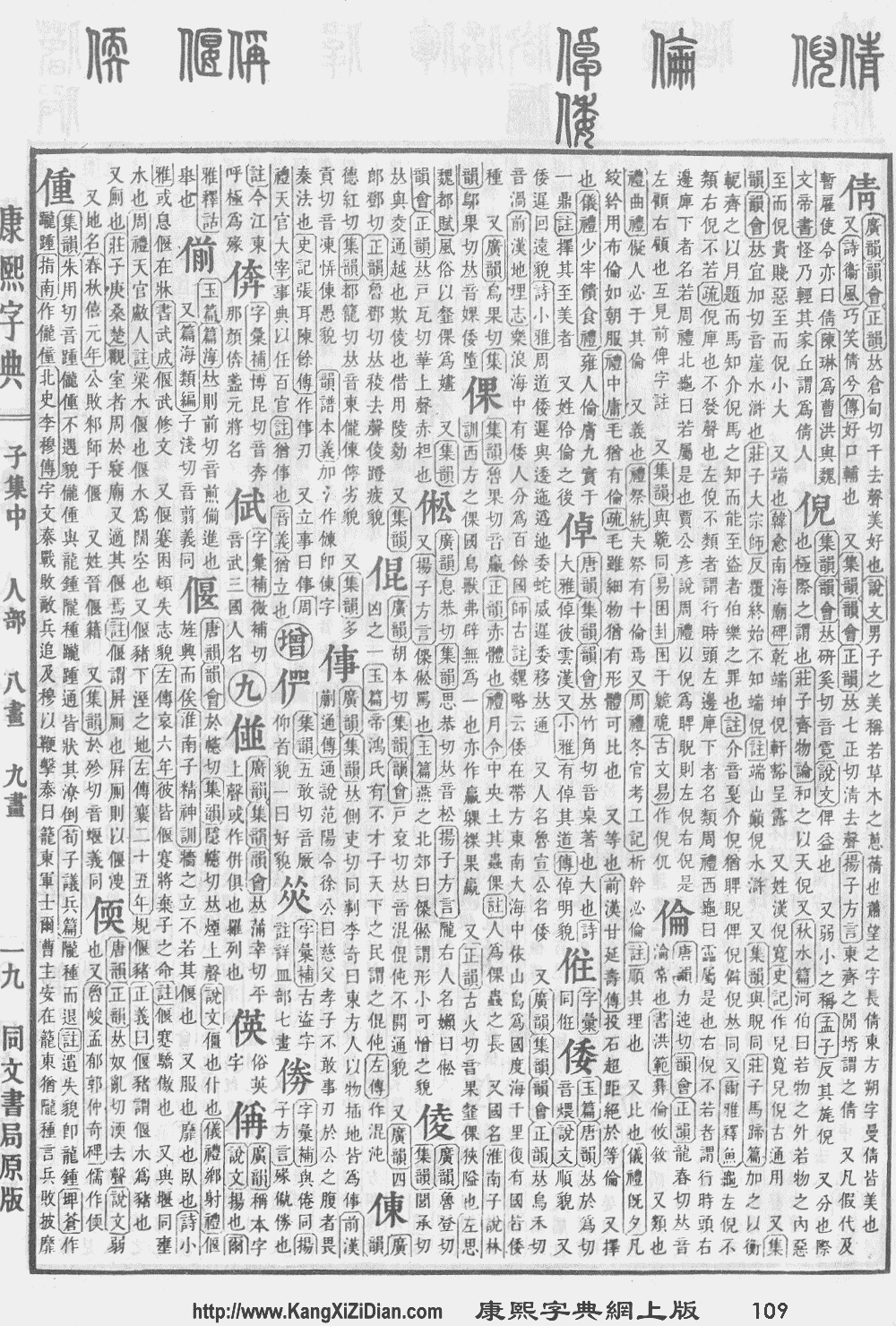
- Kangxi Dictionary: not present, would follow page 109, character 17
- Dai Kanwa Jiten: character 818
- Dae Jaweon: page 232, character 20
- Hanyu Da Zidian (first edition): volume 1, page 172, character 9
- Unihan data for U+5037
Chinese
| trad. | 倷 | |
|---|---|---|
| simp. # | 倷 | |
| alternative forms | 奈 Suzhounese 耐 Suzhounese | |
Etymology 1
- Suzhounese Wu “you”
- Some scholars suggest that it is from 汝 (MC nyoX) (Mei, 1993) or 爾 (MC nyeX) (You, 1995), both of which have been related to /n̩/ or /ŋ̍/, the second-person singular pronoun in other Wu dialects (You, 1995; Chen and Pan, 1999).
- However, Chen and Pan (1999) argue that it is a contraction of 汝儂. They suggest that 儂 may have undergone a change: /*neŋ/ > /*nẽ/ > /ne/. Thus, 汝 /n̩/ + 儂 /ne/ > /ne/. Compare Shanghainese 儂 /nʊŋ/, which also derives from 汝儂 /n̩ nʊŋ/.
Pronunciation
Synonyms
Dialectal synonyms of 你 (“you (singular)”) [map]
Dialectal synonyms of 你們 (“you (plural)”) [map]
Japanese
Kanji
倷
- This term needs a translation to English. Please help out and add a translation, then remove the text
{{rfdef}}.
This article is issued from Wiktionary. The text is licensed under Creative Commons - Attribution - Sharealike. Additional terms may apply for the media files.