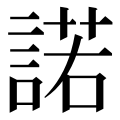
諾
See also: 诺
| ||||||||
| ||||||||
 | ||||||||
Translingual
Han character
諾 (Kangxi radical 149, 言+9, 15 strokes, cangjie input 卜口廿大口 (YRTKR), four-corner 04664, composition ⿰訁若)
References
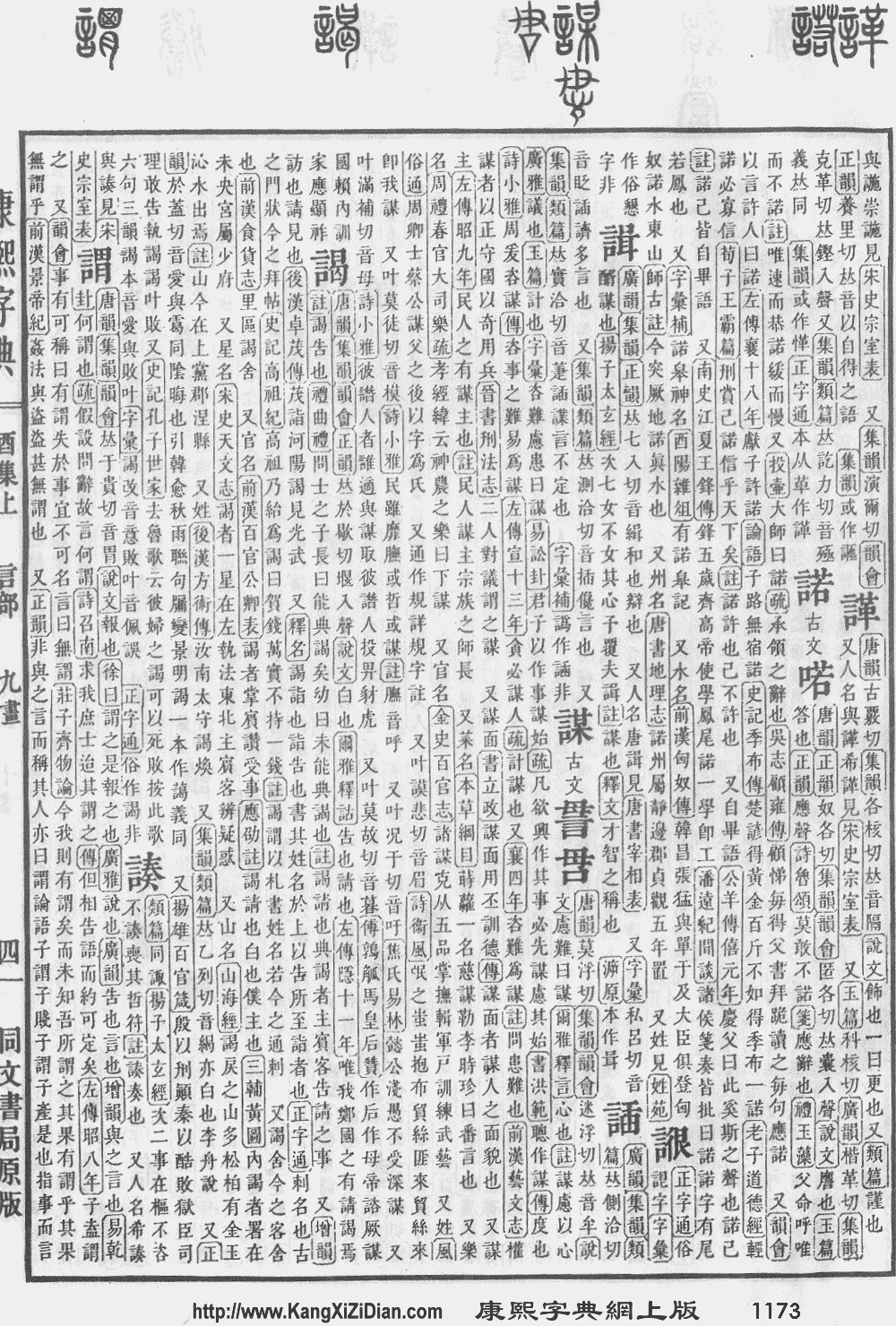
- Kangxi Dictionary: page 1173, character 2
- Dai Kanwa Jiten: character 35687
- Dae Jaweon: page 1638, character 1
- Hanyu Da Zidian (first edition): volume 6, page 3984, character 1
- Unihan data for U+8AFE
- Unihan data for U+F95D
- Unihan data for U+FABD
Bailang
Chinese
| trad. | 諾 | |
|---|---|---|
| simp. | 诺 | |
| alternative forms | 喏 “yes” | |
Glyph origin
| Historical forms of the character 諾 | |||
|---|---|---|---|
| Shang | Western Zhou | Shuowen Jiezi (compiled in Han) | Liushutong (compiled in Ming) |
| Oracle bone script | Bronze inscriptions | Small seal script | Transcribed ancient scripts |
 |
 |
 |
 |
Characters in the same phonetic series (若) (Zhengzhang, 2003)
Phono-semantic compound (形聲/形声, OC *naːɡ) : semantic 言 (“word, speak”) + phonetic 若 (OC *nja, *njaʔ, *njaɡ, “like this; such”) — to answer affirmatively.
Etymology 1
Cognate with 若 (OC *njaɡ, “like this; such; if”) (Schuessler, 2007).
Pronunciation
Definitions
諾
Synonyms
Dialectal synonyms of 你 (“you (singular)”) [map]
Compounds
- 一呼再諾/一呼再诺
- 一呼百諾/一呼百诺
- 一諾千金/一诺千金 (yīnuòqiānjīn)
- 二諾/二诺
- 伊凡諾夫/伊凡诺夫
- 伊利諾州/伊利诺州
- 允諾/允诺 (yǔnnuò)
- 千金一諾/千金一诺
- 唯唯諾諾/唯唯诺诺 (wéiwéinuònuò)
- 唯諾/唯诺
- 基諾族/基诺族 (Jīnuòzú)
- 季布一諾/季布一诺
- 宿諾/宿诺
- 布宜諾/布宜诺
- 布爾諾/布尔诺
- 布魯諾/布鲁诺 (Bùlǔnuò)
- 慨然允諾/慨然允诺
- 慨然領諾/慨然领诺
- 應諾/应诺 (yìngnuò)
- 承諾/承诺 (chéngnuò)
- 承諾值/承诺值
- 披亞諾/披亚诺
- 敬諾/敬诺
- 札賚諾爾/札赉诺尔
- 朱諾/朱诺 (Zhūnuò)
- 畫諾/画诺
- 皮諾丘/皮诺丘
- 聖馬利諾/圣马利诺 (Shèngmǎlìnuò)
- 許諾/许诺 (xǔnuò)
- 諾亞/诺亚 (Nuòyà)
- 諾們罕/诺们罕
- 諾已/诺已
- 諾普蘭/诺普兰
- 諾曼人/诺曼人 (nuòmànrén)
- 諾曼第/诺曼第 (Nuòmàndì)
- 諾言/诺言 (nuòyán)
- 諾諾/诺诺 (nuònuò)
- 諾貝爾獎/诺贝尔奖 (Nuòbèi'ěr-jiǎng)
- 諾魯/诺鲁 (Nuòlǔ)
- 踐諾/践诺
- 輕諾寡信/轻诺寡信
- 鄂諾河/鄂诺河
- 重然諾/重然诺 (zhòngránnuò)
- 金諾/金诺
- 阿諾德/阿诺德 (Ānuòdé)
- 領諾/领诺
- 馬利諾會/马利诺会
- 齊諾/齐诺
Japanese
Compounds
Compounds
Korean
Vietnamese
This article is issued from Wiktionary. The text is licensed under Creative Commons - Attribution - Sharealike. Additional terms may apply for the media files.