吹
See also: 欥
| ||||||||
Translingual
| Stroke order | |||
|---|---|---|---|
 | |||
Han character
吹 (Kangxi radical 30, 口+4, 7 strokes, cangjie input 口弓人 (RNO), four-corner 67082, composition ⿰口欠)
References
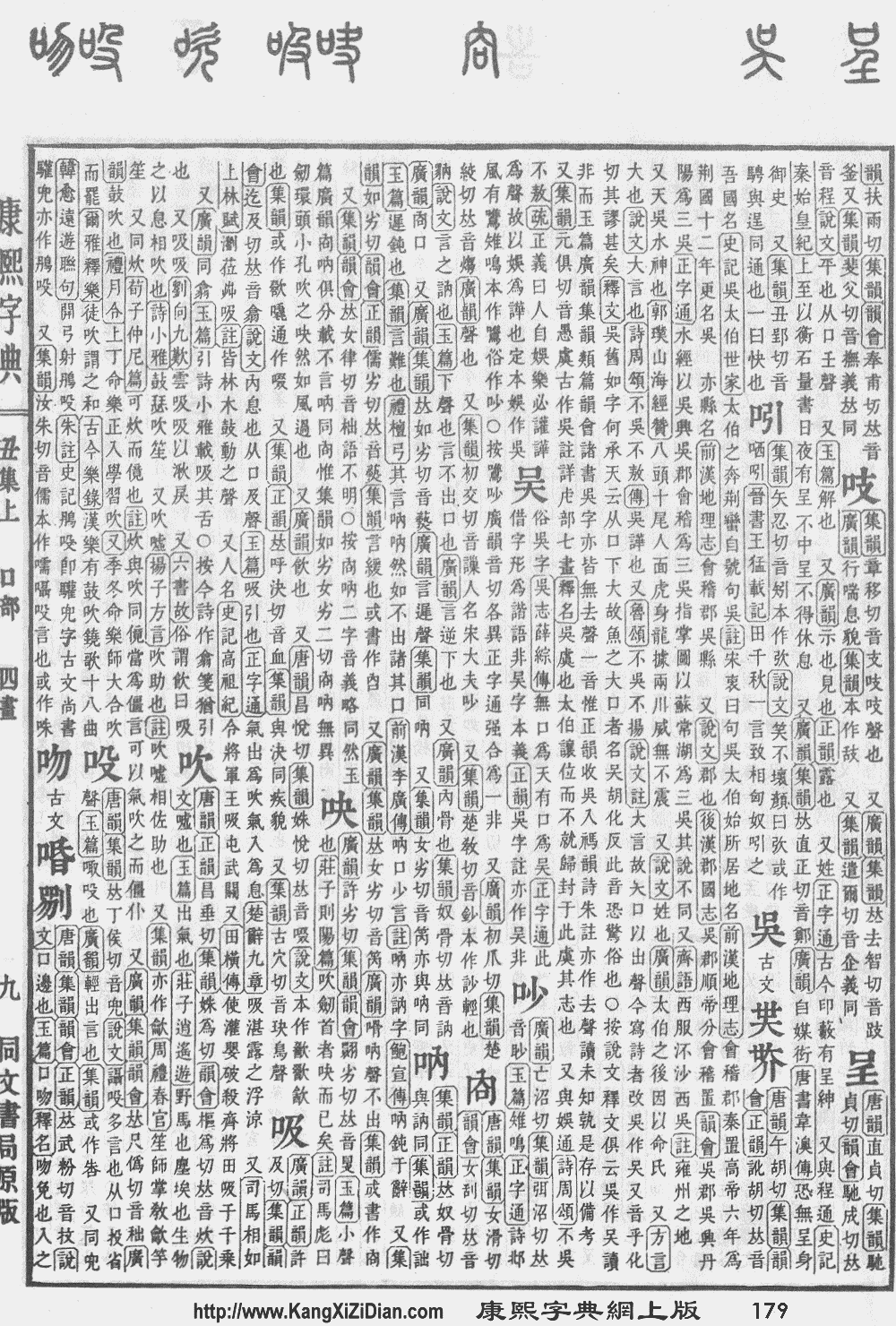
- Kangxi Dictionary: page 179, character 13
- Dai Kanwa Jiten: character 3373
- Dae Jaweon: page 397, character 7
- Hanyu Da Zidian (first edition): volume 1, page 593, character 3
- Unihan data for U+5439
Chinese
Glyph origin
| Historical forms of the character 吹 | |||
|---|---|---|---|
| Shang | Western Zhou | Shuowen Jiezi (compiled in Han) | Liushutong (compiled in Ming) |
| Oracle bone script | Bronze inscriptions | Small seal script | Transcribed ancient scripts |
 |
 |
 |
 |
Characters in the same phonetic series (吹) (Zhengzhang, 2003)
Definitions
吹
- to blow; to puff
- (of wind) to blow
- to blow; to play a wind instrument
- 吹口琴 ― chuī kǒuqín ― to play the harmonica
- (colloquial) to brag; to boast
- (colloquial) to drink alcoholic beverages directly from a bottle
- (colloquial, of a plan) to fall through; (of relationship) to break down
- (Cantonese) Short for 吹水.
- (Cantonese) Short for 吹脹/吹胀 (ceoi1 zoeng3).
- (ACG) to like
- Misspelling of 催 (cuī, “to urge”).
Synonyms
- (to play a wind instrument): 吹奏 (chuīzòu)
- (to brag):
- 吹噓/吹嘘 (chuīxū)
- 吹水 (chuīshuǐ) (chiefly Cantonese)
- 吹牛 (chuīniú) (colloquial)
- 吹牛三 (1tshy 6gnieu-se) (Wu)
- 吹牛屄 (chuīniúbī)
- 吹牛皮 (chuī niúpí) (colloquial)
- 呾卵話/呾卵话 (Teochew)
- 喝仙 (Min Nan)
- 嗙虎膦 (Southern Sixian Hakka)
- 嗙雞胲/嗙鸡胲 (Hakka)
- 好臉/好脸 (Hokkien, Teochew)
- 拉空 (Teochew)
- 拉誧/拉𰵩 (Teochew)
- 放空 (Min Nan)
- 放臭屁 (Min Nan)
- 放風球/放风球 (Min Nan)
- 放風龜/放风龟 (Min Nan)
- 歕雞胲/𬅫鸡胲 (Zhao'an Hakka)
- 歕雞胿/𬅫鸡胿 (pûn-ke-kui) (Min Nan)
- 白話/白话 (báihua) (regional)
- 相空 (Min Nan)
- 矜人 (jīnrén) (literary)
- 練扇空/练扇空 (Min Nan)
- 膨風/膨风 (Min Nan)
- 自矜 (zìjīn)
- 自詡/自诩 (zìxǔ)
- 自誇/自夸 (zìkuā)
- 表功 (biǎogōng) (to brag about one's contributions)
- 誇/夸 (kuā)
- 誇口/夸口 (kuākǒu)
- 誇喙/夸喙 (kuă-*chói) (Eastern Min)
- 誇耀/夸耀 (kuāyào)
- 說大話/说大话 (shuō dàhuà)
- 講嘐潲話/讲嘐潲话 (Hokkien)
- 講空/讲空 (Min Nan)
- 車大炮/车大炮 (Cantonese, Hakka, Teochew)
- 風龜/风龟 (Min Nan)
- 鼓吹
Dialectal synonyms of 說大話 (“to brag; to boast; to talk big”) [map]
Compounds
- 一吹一唱
- 一風吹/一风吹 (yīfēngchuī)
- 吹冷風/吹冷风 (chuī lěngfēng)
- 吹功 (chuīgōng)
- 吹口哨 (chuī kǒushào)
- 吹呼
- 吹啦
- 吹喇叭 (chuī lǎba)
- 吹噓/吹嘘 (chuīxū)
- 吹大氣/吹大气
- 吹大炮 (chuī dàpào)
- 吹奏 (chuīzòu)
- 吹奏樂器/吹奏乐器 (chuīzòu yuèqì)
- 吳市吹簫/吴市吹箫
- 吹彈/吹弹
- 吹影鏤塵/吹影镂尘
- 吹手
- 吹打 (chuīdǎ)
- 吹打樂/吹打乐 (chuīdǎyuè)
- 吹拂 (chuīfú)
- 吹指
- 吹捧 (chuīpěng)
- 吹擂
- 吹樂器/吹乐器
- 吹毛
- 吹毛取瑕
- 吹毛毛
- 吹毛求瑕
- 吹毛求疵 (chuīmáoqiúcī)
- 吹毛索疵
- 吹氣勝蘭/吹气胜兰
- 吹氣球/吹气球
- 吹法螺
- 吹火
- 吹灰
- 吹灰之力 (chuīhuīzhīlì)
- 吹燈/吹灯
- 吹燈兒/吹灯儿
- 吹牛 (chuīniú)
- 吹牛大王 (chuīniú dàwáng)
- 吹牛皮 (chuī niúpí)
- 吹玻璃
- 吹皺一池春水/吹皱一池春水 (chuī zhòu yīchí chūn shuǐ)
- 吹竹
- 吹筒
- 吹管 (chuīguǎn)
- 吹箭
- 吹簫/吹箫 (chuīxiāo)
- 吹簫吳市/吹箫吴市
- 吹糖
- 吹糖人兒/吹糖人儿
- 吹糠見米/吹糠见米
- 吹網/吹网
- 吹脣/吹唇
- 吹腔 (chuīqiāng)
- 吹臺/吹台 (chuītái)
- 吹葭
- 吹蝕/吹蚀 (chuīshí)
- 吹蝕作用/吹蚀作用
- 吹蝕穴/吹蚀穴 (chuīshíxué)
- 吹襲/吹袭 (chuīxí)
- 吹起捏塌
- 吹送流
- 吹釉
- 吹銃/吹铳
- 吹雲/吹云
- 吹風/吹风 (chuīfēng)
- 吹風機/吹风机 (chuīfēngjī)
- 吹風胡哨/吹风胡哨
- 吹鬍子/吹胡子
- 吹鼓手 (chuīgǔshǒu)
- 噓枯吹生/嘘枯吹生
- 因風吹火/因风吹火
- 大力鼓吹
- 大吹
- 大吹大擂 (dàchuīdàléi)
- 大吹法螺 (dàchuīfǎluó)
- 大吹牛皮
- 大肆吹噓/大肆吹嘘
- 引風吹火/引风吹火
- 弦吹
- 懲羹吹齏/惩羹吹齑 (chénggēngchuījī)
- 斬草不除根,春風吹又生/斩草不除根,春风吹又生 (zhǎn cǎo bù chúgēn, chūnfēng chuī yòu shēng)
- 日炙風吹/日炙风吹
- 橫吹/横吹 (héngchuī)
- 清吹
- 胡吹亂滂/胡吹乱滂
- 胡吹亂謅/胡吹乱诌
- 胡吹大氣/胡吹大气
- 自吹自擂 (zìchuīzìléi)
- 自我吹噓/自我吹嘘
- 超吹 (chāochuī)
- 鏤塵吹影/镂尘吹影
- 雨打風吹/雨打风吹
- 電吹風/电吹风 (diànchuīfēng)
- 順風吹火/顺风吹火
- 風吹浪打/风吹浪打
- 風吹砂/风吹砂
- 風吹草低/风吹草低
- 風吹草動/风吹草动 (fēngchuīcǎodòng)
- 風吹雨打/风吹雨打 (fēngchuīyǔdǎ)
- 馬上吹/马上吹
- 鬼吹燈/鬼吹灯
- 麵杖吹火/面杖吹火
- 鼓吹
Compounds
References
- “Entry #2981”, in 臺灣閩南語常用詞辭典 [Dictionary of Frequently-Used Taiwan Minnan] (overall work in Mandarin and Hokkien), Ministry of Education, R.O.C., 2023.
Japanese
Korean
Etymology
Historical spelling: ᄎᆔ (Yale: chywi), see Gale (1897, p. 1094).
References
Gale, James S.: A Korean-English Dictionary. Yokohama: Kelly & Walsh, 1897.
Vietnamese
This article is issued from Wiktionary. The text is licensed under Creative Commons - Attribution - Sharealike. Additional terms may apply for the media files.