垂
| ||||||||
Translingual
| Stroke order | |||
|---|---|---|---|
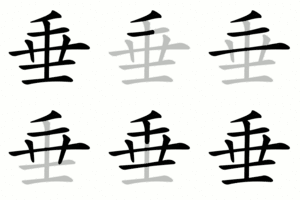 | |||
| Stroke order (Japan) | |||
|---|---|---|---|
 | |||
| Stroke order | |||
|---|---|---|---|
 | |||
Han character
垂 (Kangxi radical 32, 土+5, 8 strokes, cangjie input 竹十廿一 (HJTM), four-corner 20104, composition ⿻⿱千工艹 or ⿻⿱千工卄)
Derived characters
References
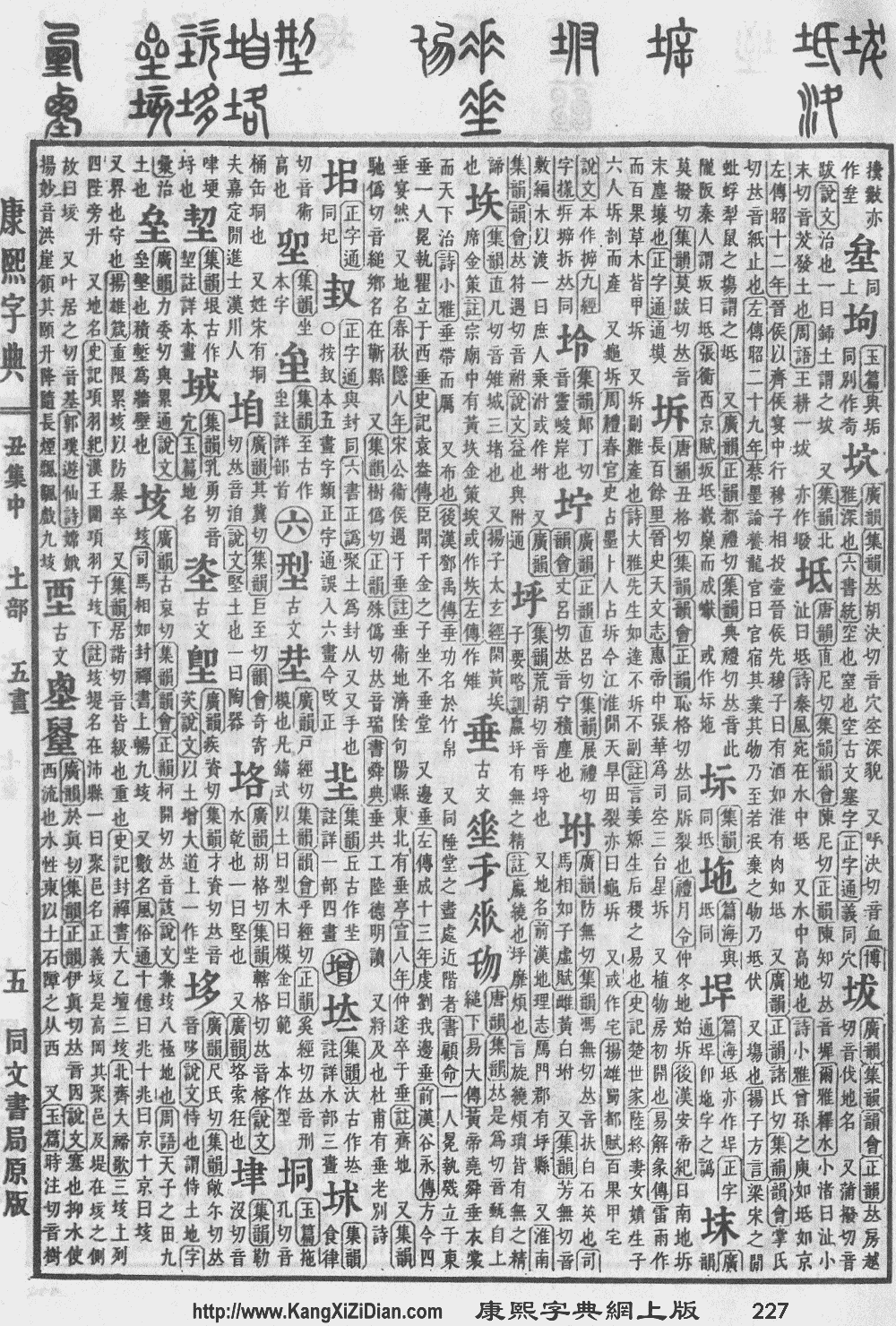
- Kangxi Dictionary: page 227, character 16
- Dai Kanwa Jiten: character 5012
- Dae Jaweon: page 463, character 2
- Hanyu Da Zidian (first edition): volume 1, page 432, character 5
- Unihan data for U+5782
Chinese
| trad. | 垂 | |
|---|---|---|
| simp. # | 垂 | |
| alternative forms | ||
Glyph origin
| Historical forms of the character 垂 | ||
|---|---|---|
| Spring and Autumn | Shuowen Jiezi (compiled in Han) | Liushutong (compiled in Ming) |
| Bronze inscriptions | Small seal script | Transcribed ancient scripts |
 |
 |
 |
Characters in the same phonetic series (垂) (Zhengzhang, 2003)
Originally 𡍮. Pictogram (象形) : 𠂹 + 土, flowers hanging from a plant.
Etymology
May be from Proto-Sino-Tibetan *(d/n)waj (“to hang from; to cling to; creeper”) (STEDT), whence Burmese တွယ် (twai, “to cling”). May be related to 睡 (OC *djols, “to sleep”), 朵 (OC *toːlʔ, “to hang from a tree; classifier for blossoms”), 橢 (OC *l̥ʰoːlʔ, “oblong; oval”), 惰 (OC *l'oːlʔ, *l'oːls, “lazy”) and 蕊 (OC *ŋljolʔ, *ŋljulʔ, “reproductive organ of flower”).
Pronunciation
Definitions
垂
- to suspend; to hang (down); bend (down)
- to drip, to shed (tears)
- to hand down, to bequeath, to transmit (something abstract, such as a message or tradition) to one’s successors or aftercomers
- nearly; almost
- to approach
- (Teochew) listless
- (Teochew) wilted
- (obsolete) difficult; hard
- (obsolete) hardly; harshly
Compounds
- 下垂 (xiàchuí)
- 並垂不朽/并垂不朽
- 事敗垂成/事败垂成
- 低垂 (dīchuí)
- 公垂線/公垂线
- 創業垂統/创业垂统
- 功垂竹帛
- 功墮垂成/功堕垂成
- 功敗垂成/功败垂成 (gōngbàichuíchéng)
- 北垂 (běichuí)
- 南垂
- 厄利垂亞/厄利垂亚 (Èlìchuíyà)
- 名垂不朽
- 名垂後世/名垂后世
- 名垂竹帛
- 名垂罔極/名垂罔极
- 名垂青史 (míngchuíqīngshǐ)
- 四垂
- 坐不垂堂
- 垂下
- 垂亡
- 垂危 (chuíwēi)
- 垂名
- 垂名竹帛
- 垂命
- 垂問/垂问
- 垂垂
- 垂堂
- 垂察
- 垂心 (chuíxīn)
- 垂念
- 垂愛/垂爱
- 垂憐/垂怜 (chuílián)
- 垂憫/垂悯
- 垂懸/垂悬
- 垂成
- 垂手
- 垂手可得 (chuíshǒukědé)
- 垂手而得
- 垂手過膝/垂手过膝
- 垂披
- 垂拱
- 垂拱而治
- 垂掛/垂挂 (chuíguà)
- 垂教
- 垂於將來/垂于将来
- 垂暮 (chuímù)
- 垂柳 (chuíliǔ)
- 垂棘
- 垂楊/垂杨
- 垂楊柳/垂杨柳
- 垂橐
- 垂櫜
- 垂死 (chuísǐ)
- 垂死掙扎
- 垂泣 (chuíqì)
- 垂涎 (chuíxián)
- 垂涕
- 垂涎三尺 (chuíxiánsānchǐ)
- 垂涎欲滴 (chuíxiányùdī)
- 垂淚/垂泪 (chuílèi)
- 垂照
- 垂璧
- 垂白
- 垂白上僂/垂白上偻
- 垂白之親/垂白之亲
- 垂直 (chuízhí)
- 垂直尾翼
- 垂直帶/垂直带
- 垂直線/垂直线
- 垂直貿易/垂直贸易
- 垂直起落飛機/垂直起落飞机
- 垂直起飛/垂直起飞
- 垂直距離/垂直距离
- 垂直關係/垂直关系
- 垂直面
- 垂盼
- 垂示
- 垂範/垂范 (chuífàn)
- 垂簾/垂帘 (chuílián)
- 垂簾聽政/垂帘听政 (chuíliántīngzhèng)
- 垂統/垂统
- 垂絲/垂丝
- 垂絕/垂绝
- 垂綸/垂纶
- 垂線/垂线 (chuíxiàn)
- 垂線足/垂线足
- 垂翅
- 垂老 (chuílǎo)
- 垂聽/垂听 (chuítīng)
- 垂花門/垂花门
- 垂落
- 垂衣拱手
- 垂裕後昆/垂裕后昆
- 垂詢/垂询 (chuíxún)
- 垂足 (chuízú)
- 垂釣/垂钓 (chuídiào)
- 垂鑒/垂鉴
- 垂陰/垂阴
- 垂露
- 垂青 (chuíqīng)
- 垂面
- 垂頭/垂头 (chuítóu)
- 垂頭喪氣/垂头丧气 (chuítóusàngqì)
- 垂頭拱手/垂头拱手
- 垂頭搨翼/垂头拓翼
- 垂首
- 垂首喪氣/垂首丧气
- 垂馨千祀
- 垂體/垂体 (chuítǐ)
- 垂髫 (chuítiáo)
- 垂髮/垂发
- 夜幕低垂
- 奄奄垂絕/奄奄垂绝
- 德垂後裔/德垂后裔
- 愴然垂首/怆然垂首
- 懸壅垂/悬壅垂 (xuányōngchuí)
- 懷金垂紫/怀金垂紫
- 懸針垂露/悬针垂露
- 披垂
- 拖紫垂青
- 拱手垂裳
- 敗於垂成/败于垂成
- 染指垂涎
- 永垂不朽 (yǒngchuíbùxiǔ)
- 涕淚交垂/涕泪交垂
- 海立雲垂/海立云垂
- 獨垂青盼/独垂青盼
- 眉垂目合
- 綈袍垂愛/绨袍垂爱
- 綠楊垂柳/绿杨垂柳
- 羊裘垂釣/羊裘垂钓
- 耳垂 (ěrchuí)
- 聯垂/联垂
- 胃下垂 (wèixiàchuí)
- 腦下垂體/脑下垂体 (nǎoxiàchuítǐ)
- 舯垂
- 艉垂標/艉垂标
- 艏垂標/艏垂标
- 西垂 (Xīchuí)
- 邥垂
- 鉛垂線/铅垂线 (qiānchuíxiàn)
- 飛蠅垂珠/飞蝇垂珠
- 饞涎欲垂/馋涎欲垂
- 鳴琴垂拱/鸣琴垂拱
References
- “Query for 垂”, in 臺灣閩南語常用詞辭典 [Dictionary of Frequently-Used Taiwan Minnan] (overall work in Hokkien and Mandarin), Ministry of Education, R.O.C., 2023.
- “Entry #8621”, in 重編國語辭典修訂本 [Revised Mandarin Chinese Dictionary] (in Chinese), National Academy for Educational Research (Taiwan), 2021.
Japanese
Readings
Noun
垂 • (shide)
- zigzag-shaped paper streamer often used to adorn Shinto-related objects
- hornbeam plant
Alternative forms
- 四手 (shide)
Compounds
- 垂直 (suichoku): vertical, perpendicular
- 垂線 (suisen): perpendicular line
- 懸垂 (kensui): suspension, pendency
- 垂れ下がる (taresagaru): hang, dangle
- 雨垂れ (amadare): raindrops
- 垂らす (tarasu): hang down
- 髪を垂らす (kamiotarasu): let one's hair hang down
- 垂れ (tare): sauce, gravy
- 胡麻垂れ (gomadare): sesame sauce
- 糞っ垂れ (kusottare): vulgar epithet
- しみっ垂れ (shimittare): stinginess, miser
Korean
Hanja
垂 (eum 수 (su))
- This term needs a translation to English. Please help out and add a translation, then remove the text
{{rfdef}}.
This article is issued from Wiktionary. The text is licensed under Creative Commons - Attribution - Sharealike. Additional terms may apply for the media files.