燒
| ||||||||
Translingual
| Traditional | 燒 |
|---|---|
| Shinjitai | 焼 |
| Simplified | 烧 |
Han character
燒 (Kangxi radical 86, 火+12, 16 strokes, cangjie input 火土土山 (FGGU), four-corner 94811, composition ⿰火堯)
Derived characters
- 𬘏
References
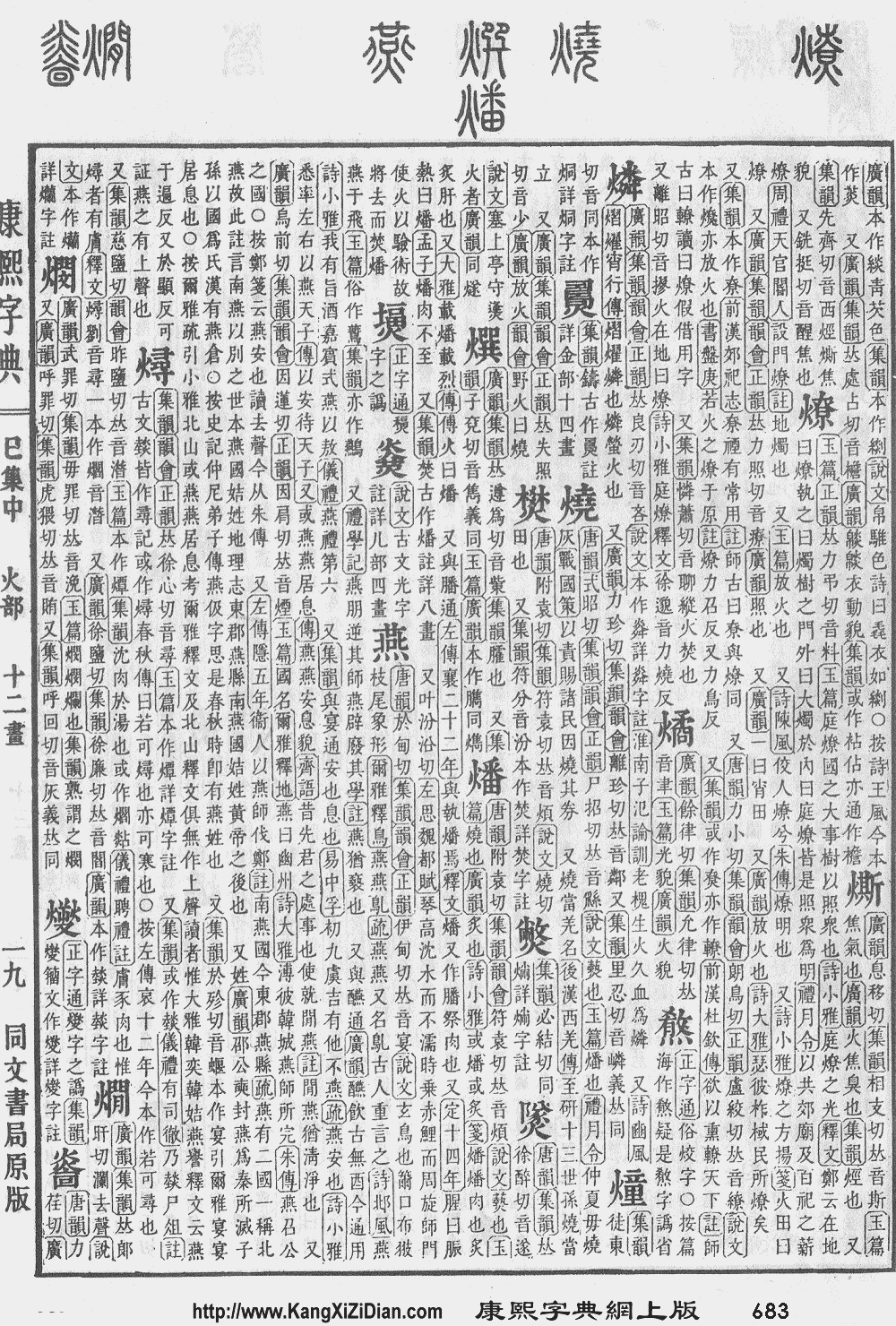
- Kangxi Dictionary: page 683, character 8
- Dai Kanwa Jiten: character 19420
- Dae Jaweon: page 1095, character 8
- Hanyu Da Zidian (first edition): volume 3, page 2231, character 7
- Unihan data for U+71D2
Chinese
| trad. | 燒 | |
|---|---|---|
| simp. | 烧 | |
| alternative forms | 焼 | |
Glyph origin
| Historical forms of the character 燒 | |
|---|---|
| Warring States | Shuowen Jiezi (compiled in Han) |
| Chu slip and silk script | Small seal script |
 |
 |
Characters in the same phonetic series (垚) (Zhengzhang, 2003)
| Old Chinese | |
|---|---|
| 撓 | *hŋaːw, *rŋaːw, *rnaːwʔ |
| 鐃 | *rŋaːw |
| 譊 | *rŋaːw |
| 橈 | *rŋaːws, *ŋjew |
| 磽 | *ŋ̊ʰreːw, *ŋreːws, *ŋ̊ʰeːwʔ |
| 墝 | *ŋ̊ʰreːw |
| 穘 | *hŋreːw |
| 顤 | *hŋreːw, *ŋeːws |
| 燒 | *hŋjew, *hŋjaws |
| 饒 | *ŋjew, *ŋjaws |
| 蟯 | *ŋjew, *ʔŋew |
| 蕘 | *ŋjew |
| 襓 | *ŋjew |
| 繞 | *ŋjewʔ, *ŋjaws |
| 遶 | *ŋjewʔ |
| 嬈 | *njewʔ, *neːwʔ, *hŋeːws |
| 趬 | *ŋ̊ʰew, *ŋ̊ʰews |
| 蹺 | *ŋ̊ʰew |
| 翹 | *ɡew, *ɡews |
| 澆 | *ŋkeːw, *ŋeːws |
| 驍 | *ŋkeːw |
| 僥 | *kŋeːwʔ, *ŋeːw |
| 堯 | *ŋeːw |
| 垚 | *ŋeːw |
| 嶢 | *ŋeːw |
| 獟 | *ŋeːws |
| 膮 | *hŋeːw, *hŋeːwʔ |
| 嘵 | *hŋeːw |
| 憢 | *hŋeːw |
| 曉 | *hŋeːwʔ |
| 皢 | *hŋeːwʔ |
Phono-semantic compound (形聲/形声, OC *hŋjew, *hŋjaws) : semantic 火 (“fire”) + phonetic 堯 (OC *ŋeːw).
Etymology
From 蕘 (OC *ŋjew, “firewood; fuel”) with causative devoicing (Schuessler, 2007).
Pronunciation
Definitions
燒
- to burn
- to heat up; to make warm
- to burn; to corrode
- to roast; to grill; to braise
- to stew after frying, or to fry after stewing
- to cook (food)
- (of a fuse) to blow
- (medicine) to have a fever; to run a temperature
- (medicine) fever; temperature
- (colloquial) bigheaded; conceited and forgetting oneself due to having too many resources (money etc.)
- 哎呦,你看看。隔壁那誰,燒得都不知道姓什麼了,把那點兒錢到處亂花。 [dialectal Mandarin, trad.]
- Āiyou, nǐ kànkan. Gébì nèi shéi, shāo de dōu bùzhīdào xìng shenme le, bǎ nèi diǎnr qián dàochu luàn huā. [Pinyin]
- Oh, look. The neighbor you-know-who, has lost clearheadedness to keep the money, spends that a little money on everywhere.
哎呦,你看看。隔壁那谁,烧得都不知道姓什么了,把那点儿钱到处乱花。 [dialectal Mandarin, simp.]
- (dialectal Mandarin, Gan, Hakka, Jin) boiling hot; scalding hot
- (Hakka, Northern Min, Southern Min, Malaysian and Singapore Mandarin) hot; having a high temperature (distinguished from 熱/热, which describes weather)
- (Cantonese) to set off (firecrackers, fireworks, etc.)
- (Cantonese, electronics) to burn out
- (Sichuanese) to smoke
- (Sichuanese) to trick; to deceive
- (Sichuanese) to ridicule; to roast
- (Internet slang) to cause flaming; to cause controversy
- (Mainland China, Internet slang) Alternative form of 騷/骚 (sāo, “flirty; provocative”)
Synonyms
Dialectal synonyms of 燙 (“boiling hot”) [map]
| Variety | Location | Words |
|---|---|---|
| Formal (Written Standard Chinese) | 燙 | |
| Mandarin | Beijing | 燙 |
| Taiwan | 燙 | |
| Jinan | 燙 | |
| Xi'an | 燙, 燒 | |
| Wuhan | 炟 | |
| Chengdu | 燙 | |
| Guilin | 燙 | |
| Yangzhou | 燙 | |
| Hefei | 燙 | |
| Singapore | 燒 | |
| Cantonese | Guangzhou | 焫, 滾 |
| Hong Kong | 焫, 滾 | |
| Hong Kong (San Tin Weitou) | 焫 | |
| Hong Kong (Ting Kok) | 淥 | |
| Hong Kong (Tung Ping Chau) | 淥 | |
| Taishan | 焫 | |
| Dongguan | 焫 | |
| Yangjiang | 燙 | |
| Kuala Lumpur (Guangfu) | 淥 | |
| Singapore (Guangfu) | 滾 | |
| Gan | Nanchang | 燒, 滾 |
| Pingxiang | 滾 | |
| Hakka | Meixian | 滾, 淥, 焫 |
| Miaoli (N. Sixian) | 燒 | |
| Pingtung (Neipu; S. Sixian) | 燒 | |
| Hsinchu County (Zhudong; Hailu) | 燒 | |
| Taichung (Dongshi; Dabu) | 燒 | |
| Hsinchu County (Qionglin; Raoping) | 燒 | |
| Yunlin (Lunbei; Zhao'an) | 燒 | |
| Hong Kong | 燒 | |
| Senai (Huiyang) | 燒, 淥 | |
| Jin | Taiyuan | 燙, 燙人, 燒, 燒人 |
| Northern Min | Jian'ou | 燙 |
| Eastern Min | Fuzhou | 灴 |
| Southern Min | Xiamen | 燙 |
| Kaohsiung | 燒 | |
| Yilan | 燒 | |
| Changhua (Lukang) | 燒 | |
| Taichung | 燒 | |
| Taichung (Wuqi) | 燒 | |
| Tainan | 燒 | |
| Taitung | 燒 | |
| Hsinchu | 燒 | |
| Penghu (Magong) | 燒 | |
| Singapore (Hokkien) | 燒 | |
| Manila (Hokkien) | 燒 | |
| Chaozhou | 燙 | |
| Bangkok (Teochew) | 燙 | |
| Johor Bahru (Teochew) | 燒 | |
| Wu | Suzhou | 燙 |
| Ningbo | 燙 | |
| Wenzhou | 燙 | |
| Xiang | Changsha | 燒𤐰, 𤐰 |
| Shuangfeng | 辣 | |
Dialectal synonyms of 熱 (“hot”) [map]
Dialectal synonyms of 發燒 (“to have a fever”) [map]
Compounds
- 不伏燒埋/不伏烧埋
- 不服燒埋/不服烧埋
- 串燒/串烧 (chuànshāo)
- 二度燒傷/二度烧伤
- 交趾燒/交趾烧
- 割燒/割烧
- 叉燒/叉烧 (chāshāo)
- 叉燒包/叉烧包 (chāshāobāo)
- 吃燒餅/吃烧饼
- 堆花燒酒/堆花烧酒
- 完全燃燒/完全燃烧
- 屠燒/屠烧
- 山田燒墾/山田烧垦
- 延燒/延烧 (yánshāo)
- 引火燒身/引火烧身 (yǐnhuǒshāoshēn)
- 怒火中燒/怒火中烧 (nùhuǒzhōngshāo)
- 惹火燒身/惹火烧身 (rěhuǒshāoshēn)
- 扛子火燒/扛子火烧
- 揀佛燒香/拣佛烧香
- 摧燒/摧烧
- 槓子火燒/杠子火烧
- 湯燒火熱/汤烧火热
- 火燒/火烧
- 火燒兒/火烧儿 (huǒshāor)
- 火燒坪/火烧坪 (Huǒshāopíng)
- 火燒屁股/火烧屁股
- 火燒心/火烧心
- 火燒火燎/火烧火燎
- 火燒眉毛/火烧眉毛 (huǒshāoméimáo)
- 火燒祆廟/火烧祆庙
- 火燒車/火烧车
- 火燒雲/火烧云 (huǒshāoyún)
- 灼燒/灼烧
- 灼背燒頂/灼背烧顶
- 烙燒餅/烙烧饼
- 焚燒/焚烧 (fénshāo)
- 煮鶴燒琴/煮鹤烧琴
- 燒丹鍊汞/烧丹炼汞
- 燒傷/烧伤 (shāoshāng)
- 燒冷灶/烧冷灶
- 燒刀子/烧刀子 (shāodāozi)
- 燒利市/烧利市
- 燒包/烧包 (shāobāo)
- 燒化/烧化 (shāohuà)
- 燒味/烧味 (shāowèi)
- 燒喇嘛/烧喇嘛
- 燒埋/烧埋
- 燒埋錢/烧埋钱
- 燒墾/烧垦
- 燒夷彈/烧夷弹
- 燒尾/烧尾
- 燒心/烧心 (shāoxīn)
- 燒料/烧料
- 燒春/烧春
- 燒杯/烧杯 (shāobēi)
- 燒果/烧果
- 燒殺搶掠/烧杀抢掠
- 燒毀/烧毁 (shāohuǐ)
- 燒水/烧水 (shāoshuǐ)
- 燒活/烧活
- 燒火/烧火 (shāohuǒ)
- 燒火焜/烧火焜
- 燒灼/烧灼 (shāozhuó)
- 燒炕/烧炕
- 燒烤/烧烤 (shāokǎo)
- 燒焊/烧焊 (shāohàn)
- 燒焦/烧焦 (shāojiāo)
- 燒煉/烧炼
- 燃燒/燃烧 (ránshāo)
- 燜燒鍋/焖烧锅
- 燒王船/烧王船
- 燒瓶/烧瓶 (shāopíng)
- 燒眉之急/烧眉之急
- 燒石膏/烧石膏
- 燒窯/烧窑
- 燒箱庫/烧箱库
- 燒紙/烧纸 (shāozhǐ)
- 燒紙引鬼/烧纸引鬼
- 燒結/烧结
- 燒肉/烧肉 (shāoròu)
- 燒腦/烧脑 (shāonǎo)
- 燒臘/烧腊 (shāolà)
- 燒荒/烧荒
- 燒菜/烧菜
- 燒葬/烧葬
- 燒藍/烧蓝
- 燒豬/烧猪
- 燒賣/烧卖 (shāomài)
- 燒酒/烧酒 (shāojiǔ)
- 燒銲/烧焊
- 燒錢/烧钱 (shāoqián)
- 燒錄/烧录 (shāolù)
- 燒錄器/烧录器
- 燒錄機/烧录机
- 燒鍋/烧锅
- 燒頭香/烧头香
- 燒飯/烧饭 (shāofàn)
- 燒餅/烧饼 (shāobǐng)
- 燒餅歌/烧饼歌
- 燒香/烧香 (shāoxiāng)
- 燒香磕頭/烧香磕头
- 燒高香/烧高香
- 燒鴨子/烧鸭子
- 燒鹼/烧碱 (shāojiǎn)
- 留得青山在,不怕沒柴燒/留得青山在,不怕没柴烧 (liú dé qīngshān zài, bùpà méi chái shāo)
- 發燒/发烧 (fāshāo)
- 發燒友/发烧友 (fāshāoyǒu)
- 發燒客/发烧客
- 發燒度/发烧度
- 發高燒/发高烧
- 白燒/白烧
- 磕頭燒香/磕头烧香
- 紅燒/红烧 (hóngshāo)
- 紅燒肉/红烧肉 (hóngshāoròu)
- 裡外發燒/里外发烧
- 赤舌燒城/赤舌烧城
- 退燒/退烧 (tuìshāo)
- 酥燒/酥烧
- 釉燒/釉烧
- 野燒/野烧
- 銅鑼燒/铜锣烧 (tóngluóshāo)
- 鍛燒/锻烧
- 鐵板燒/铁板烧 (tiěbǎnshāo)
- 飢火燒腸/饥火烧肠
- 馮諼燒券/冯谖烧券
- 高燒/高烧 (gāoshāo)
- 麥燒/麦烧
References
- “燒”, in 漢語多功能字庫 (Multi-function Chinese Character Database), 香港中文大學 (the Chinese University of Hong Kong), 2014–
Korean
Etymology
From Middle Chinese 燒 (MC syew|syewH). Recorded as Middle Korean 쇼 (syo) (Yale: syo) in Hunmong Jahoe (訓蒙字會 / 훈몽자회), 1527.
Compounds
Vietnamese
This article is issued from Wiktionary. The text is licensed under Creative Commons - Attribution - Sharealike. Additional terms may apply for the media files.