戒
See also: 戎
| ||||||||
Translingual
Han character
戒 (Kangxi radical 62, 戈+3, 7 strokes, cangjie input 戈廿 (IT), four-corner 53400, composition ⿹戈廾)
See also
References
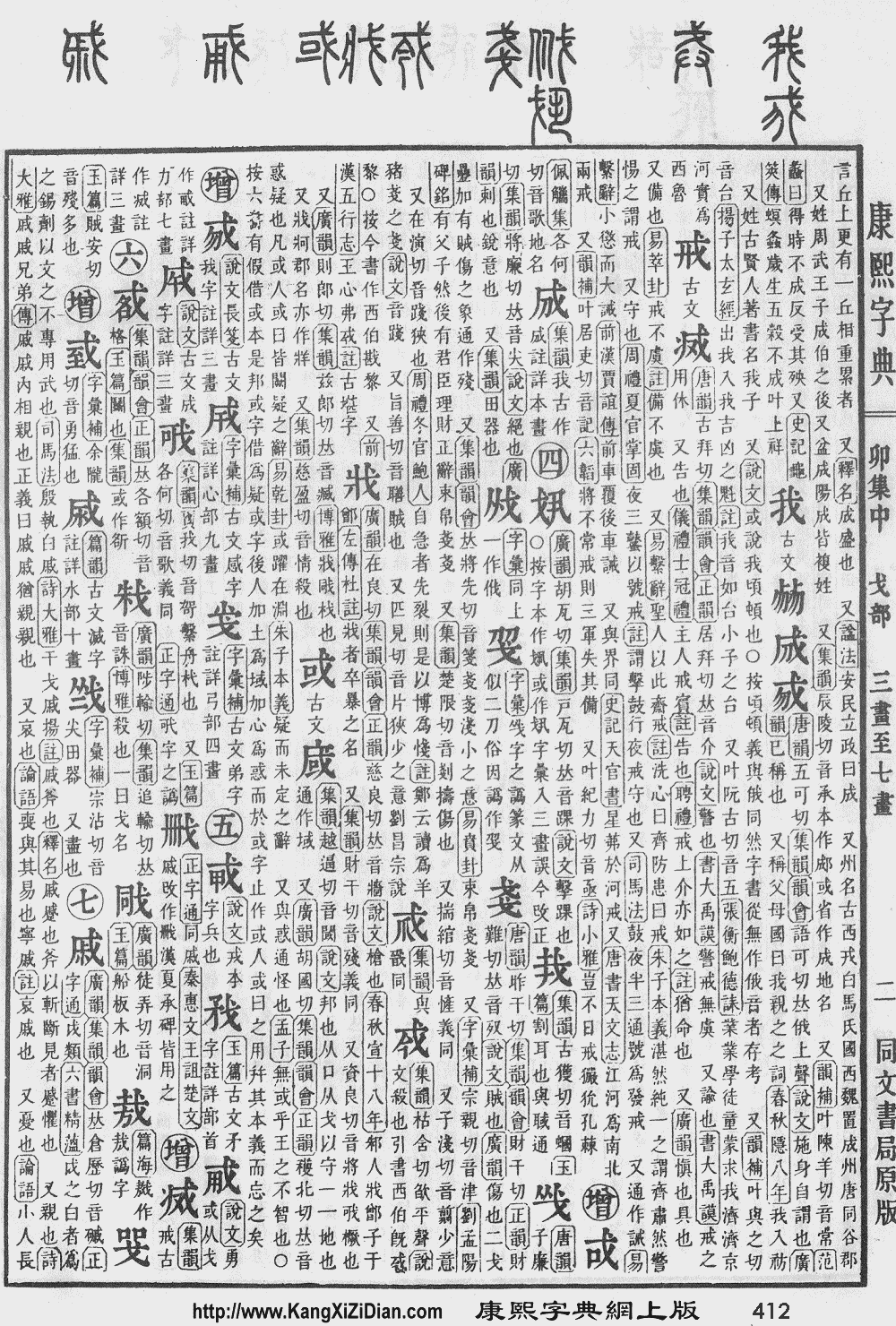
- Kangxi Dictionary: page 412, character 5
- Dai Kanwa Jiten: character 11548
- Dae Jaweon: page 754, character 4
- Hanyu Da Zidian (first edition): volume 2, page 1400, character 5
- Unihan data for U+6212
Chinese
| simp. and trad. |
戒 | |
|---|---|---|
| alternative forms | 𢌵 | |
Glyph origin
| Historical forms of the character 戒 | ||
|---|---|---|
| Western Zhou | Shuowen Jiezi (compiled in Han) | Liushutong (compiled in Ming) |
| Bronze inscriptions | Small seal script | Transcribed ancient scripts |
 |
 |
 |
Characters in the same phonetic series (戒) (Zhengzhang, 2003)
Ideogrammic compound (會意/会意) : 戈 (“halberd”) + 廾 (“hands”) – to hold up a weapon as warning.
Pronunciation
Definitions
戒
- to warn; to caution; to admonish
- to guard against; to forbid
- to give up; to quit (a bad habit)
- 2021, “反對無效 [Overruled]”, 陳詠謙 [Chan Wing Him] (lyrics), 馮允謙 [Jay Fung] and Cameron Browne (music)performed by 張天賦 [MC]:
- 神如何做出這種吸引 我愛你已開始變成癮 我戒不到這種興奮 [Literary Cantonese, trad.]
- san4 jyu4 ho4 zou6 ceot1 ze2 zung2 kap1 jan5, ngo5 oi3 nei5 ji5 hoi1 ci2 bin3 sing4 jan5, ngo5 gaai3 bat1 dou3-2 ze2 zung2 hing1 fan5 [Jyutping]
- How did God create this kind of attraction? My love for you has started to become an addiction. I cannot give this excitement up.
神如何做出这种吸引 我爱你已开始变成瘾 我戒不到这种兴奋 [Literary Cantonese, simp.]
- (archaic) to fast; to purify oneself
- (Buddhism) rules governing behavior; precepts
- Synonym: 尸羅 (shīluō)
- (archaic) to command; to order
- (literary) careful; cautious
- Short for 戒指 (jièzhi, “ring”).
Synonyms
Dialectal synonyms of 戒 (“to give up; to quit”) [map]
| Variety | Location | Words |
|---|---|---|
| Formal (Written Standard Chinese) | 戒 | |
| Mandarin | Taiwan | 戒 |
| Xi'an | 戒 | |
| Yangzhou | 戒 | |
| Cantonese | Guangzhou | 戒 |
| Hong Kong | 戒 | |
| Gan | Nanchang | 戒 |
| Hakka | Meixian | 戒 |
| Miaoli (N. Sixian) | 戒 | |
| Pingtung (Neipu; S. Sixian) | 戒 | |
| Hsinchu County (Zhudong; Hailu) | 戒 | |
| Taichung (Dongshi; Dabu) | 戒 | |
| Hsinchu County (Qionglin; Raoping) | 戒 | |
| Yunlin (Lunbei; Zhao'an) | 改 | |
| Huizhou | Jixi | 戒 |
| Southern Min | Xiamen | 改 |
| Quanzhou | 改 | |
| Zhangzhou | 改 | |
| Tainan | 改 | |
Compounds
- 三戒
- 不戒
- 五戒 (wǔjiè)
- 作持戒
- 傳戒/传戒
- 儆戒
- 八戒 (bājiè)
- 具戒
- 具足戒
- 力戒 (lìjiè)
- 勒戒 (lèjiè)
- 勸善戒惡/劝善戒恶
- 勸戒/劝戒 (quànjiè)
- 十戒 (shíjiè)
- 受戒 (shòujiè)
- 告戒 (gàojiè)
- 天戒 (tiānjiè)
- 小乘戒
- 履霜之戒
- 幽冥戒 (Yōumíng jiè)
- 引以為戒/引以为戒 (yǐnyǐwéijiè)
- 後車之戒/后车之戒
- 懲一戒百/惩一戒百
- 懲戒/惩戒 (chéngjiè)
- 懲戒處分/惩戒处分
- 懿戒
- 戒備/戒备 (jièbèi)
- 戒具
- 戒刀
- 戒勉
- 戒口 (jièkǒu)
- 戒嚴/戒严 (jièyán)
- 戒嚴令/戒严令 (jièyánlìng)
- 戒嚴法/戒严法
- 戒塗/戒涂 (jiètú)
- 戒壇/戒坛
- 戒尺 (jièchǐ)
- 戒律 (jièlǜ)
- 戒心 (jièxīn)
- 戒忌
- 戒惕
- 戒慎
- 戒懼/戒惧 (jièjù)
- 戒指
- 戒掉
- 戒敕
- 戒方 (jièfāng)
- 戒旦
- 戒書/戒书
- 戒條/戒条
- 戒毒 (jièdú)
- 戒法
- 戒牒 (jièdié)
- 戒相
- 戒石
- 戒絕/戒绝
- 戒臘/戒腊
- 戒菸/戒烟 (jièyān)
- 戒葷/戒荤
- 戒行 (jièxíng)
- 戒誨/戒诲
- 戒護/戒护
- 戒賭/戒赌 (jièdǔ)
- 戒酒 (jièjiǔ)
- 戒除 (jièchú)
- 戒飭/戒饬 (jièchì)
- 戒驕戒躁/戒骄戒躁
- 戒體/戒体
- 持戒
- 持滿戒盈/持满戒盈
- 持齋受戒/持斋受戒
- 摩頂受戒/摩顶受戒
- 敕戒
- 止持戒
- 殺戒/杀戒 (shājiè)
- 法戒
- 清規戒律/清规戒律
- 犯戒 (fànjiè)
- 省戒
- 破戒 (pòjiè)
- 禁戒
- 結婚戒指/结婚戒指
- 色戒
- 菩薩戒/菩萨戒 (Púsà jiè)
- 覆車之戒/覆车之戒
- 覆車當戒/覆车当戒
- 規戒/规戒 (guījiè)
- 說戒/说戒
- 諄諄告戒/谆谆告戒 (zhūnzhūngàojiè)
- 警戒 (jǐngjiè)
- 警戒線/警戒线 (jǐngjièxiàn)
- 警戒色
- 豬八戒/猪八戒 (Zhū Bājiè)
- 酒戒 (jiǔjiè)
- 鏡戒/镜戒
- 鑒戒/鉴戒 (jiànjiè)
- 鑑戒/鉴戒 (jiànjiè)
- 鑽戒/钻戒 (zuànjiè)
- 開戒/开戒
- 齋戒/斋戒 (zhāijiè)
- 齋戒沐浴/斋戒沐浴 (zhāijièmùyù)
Etymology 2
| For pronunciation and definitions of 戒 – see 誡 (“to warn; to admonish; to caution; to take precautions; to guard against; etc.”). (This character is the second-round simplified form of 誡). |
Notes:
|
Japanese
References
- Matsumura, Akira, editor (2006), 大辞林 [Daijirin] (in Japanese), Third edition, Tōkyō: Sanseidō, →ISBN
Vietnamese
This article is issued from Wiktionary. The text is licensed under Creative Commons - Attribution - Sharealike. Additional terms may apply for the media files.