已
| ||||||||
Translingual
| Stroke order | |||
|---|---|---|---|
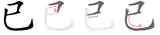 | |||
| Stroke order | |||
|---|---|---|---|
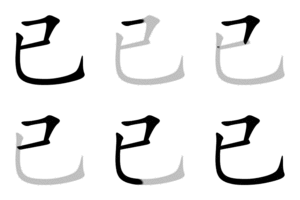 | |||
Han character
已 (Kangxi radical 49, 己+0, 3 strokes, cangjie input 尸山 (SU) or 難尸山 (XSU), four-corner 17717, composition ⿻コ乚)
Derived characters
- 𠖰, 𡉏, 𡴾, 𢩽, 𨑓, 𤣱, 𥝗, 𫧟, 𬜒, 𧿆, 𩨕, 𩝮, 𬀺, 𥮄
- 𤏁 (Exception: Only for Taiwan character form as Hong Kong character contains 己 instead)
References
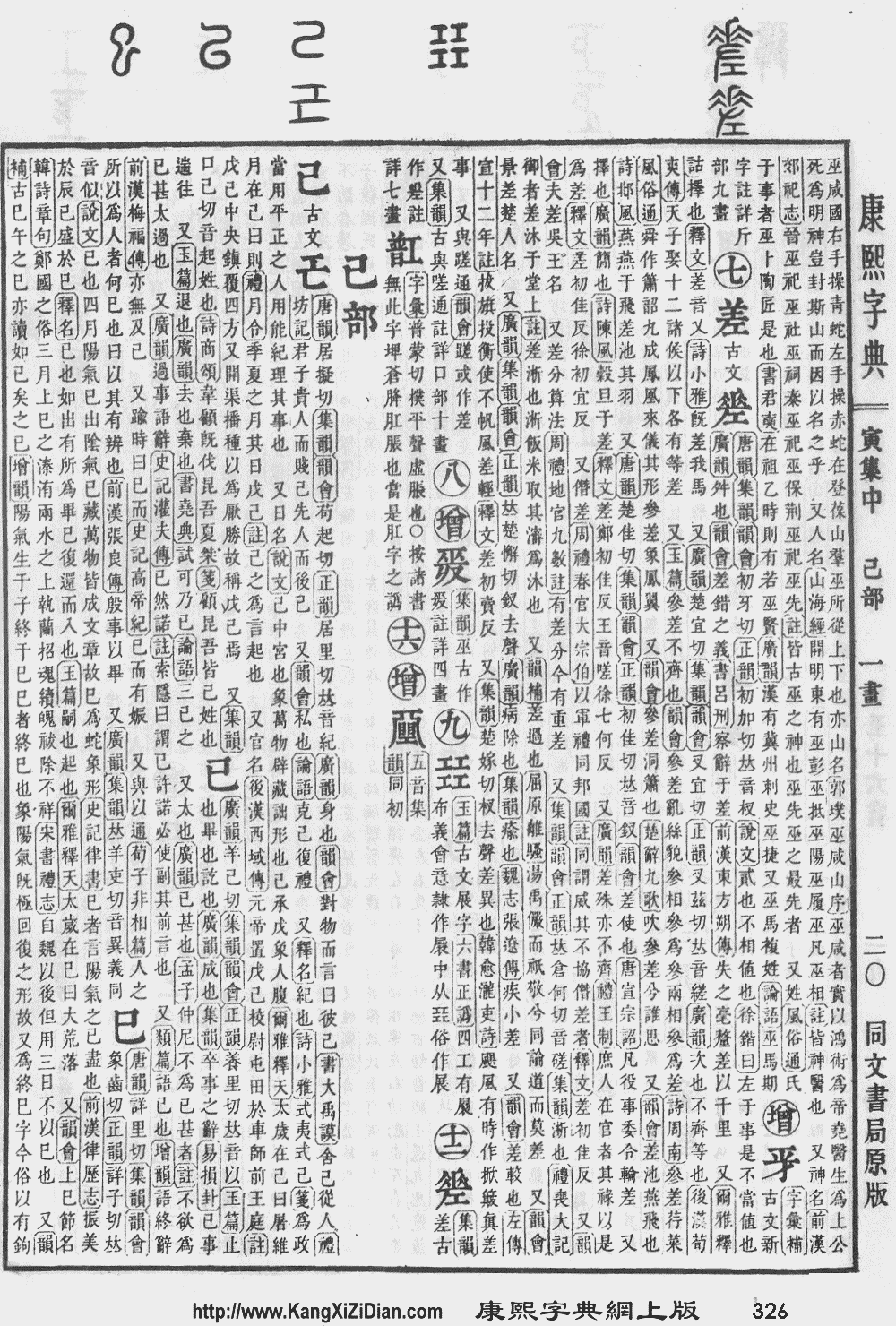
- Kangxi Dictionary: page 326, character 11
- Dai Kanwa Jiten: character 8743
- Dae Jaweon: page 630, character 11
- Hanyu Da Zidian (first edition): volume 2, page 984, character 1
- Unihan data for U+5DF2
Chinese
| simp. and trad. |
已 | |
|---|---|---|
Glyph origin
May have originally been the same character as 巳, a pictogram (象形) of either a snake or a fetus. This character cannot be found in the Shuowen Jiezi.
Pronunciation
Etymology 1
Etymology not clear (Schuessler, 2007). The “already” sense is lexicalized from the verb “to finish; to complete”, and gradually became more common than 既 (OC *kɯds), the older word for “already”, in the mid- to late first millennium BCE (Pulleyblank, 1995).
Definitions
已
- to stop; to finish
- 任重而道遠。仁以為己任,不亦重乎?死而後已,不亦遠乎? [Classical Chinese, trad.]
- From: The Analects of Confucius, c. 475 – 221 BCE
- Rèn zhòng ér dào yuǎn. Rén yǐwèi jǐ rèn, bù yì zhòng hū? Sǐ érhòu yǐ, bù yì yuǎn hū? [Pinyin]
- [His] duty is heavy and [his] way is far. He takes benevolence to be his duty; is that not heavy indeed? [His duty] is completed [only] when he dies; is that not far indeed?
任重而道远。仁以为己任,不亦重乎?死而后已,不亦远乎? [Classical Chinese, simp.]
- already; have done something
- 若已食則退,若未食則佐長者視具。 [Classical Chinese, trad.]
- From: The Book of Rites, c. 4th – 2nd century BCE
- Ruò yǐ shí zé tuì, ruò wèi shí zé zuǒ chángzhě shì jù. [Pinyin]
- If they have eaten already, they should retire; if they have not eaten, they will [remain to] assist their elder [brothers and sisters] and see what has been prepared.
若已食则退,若未食则佐长者视具。 [Classical Chinese, simp.]
Synonyms
Dialectal synonyms of 已經 (“already”) [map]
| Variety | Location | Words |
|---|---|---|
| Classical Chinese | 已, 業, 業已, 既 | |
| Formal (Written Standard Chinese) | 已經, 已, 業經, 業已, 已然 | |
| Mandarin | Beijing | 已經, 已竟, 已就 |
| Taiwan | 已經 | |
| Jinan | 已經 | |
| Xi'an | 已經 | |
| Wuhan | 已經 | |
| Chengdu | 已經 | |
| Guilin | 已經 | |
| Yangzhou | 已經 | |
| Hefei | 已經 | |
| Singapore | 已經 | |
| Sokuluk (Gansu Dungan) | 可價 | |
| Cantonese | Guangzhou | 已經, 經已 |
| Hong Kong | 已經, 經已 | |
| Taishan | 經已 | |
| Yangjiang | 應 | |
| Singapore (Guangfu) | 已經 | |
| Gan | Nanchang | 已經 |
| Hakka | Meixian | 既經 |
| Miaoli (N. Sixian) | 既經 | |
| Pingtung (Neipu; S. Sixian) | 既經, 已經 | |
| Hsinchu County (Zhudong; Hailu) | 既經 | |
| Taichung (Dongshi; Dabu) | 既經 | |
| Hsinchu County (Qionglin; Raoping) | 既經 | |
| Yunlin (Lunbei; Zhao'an) | 已經 | |
| Huizhou | Jixi | 已經 |
| Jin | Taiyuan | 已經 |
| Northern Min | Jian'ou | 已經 |
| Eastern Min | Fuzhou | 已經 |
| Matsu | 已經 | |
| Southern Min | Xiamen | 已經 |
| Quanzhou | 已經 | |
| Zhangzhou | 已經 | |
| Taipei | 已經 | |
| Kaohsiung | 已經 | |
| Singapore (Hokkien) | 已經 | |
| Manila (Hokkien) | 已經 | |
| Chaozhou | 已經 | |
| Shantou | 已經 | |
| Jieyang | 已經 | |
| Pontianak (Teochew) | 已經 | |
| Wu | Shanghai | 已經 |
| Suzhou | 已經 | |
| Wenzhou | 已經 | |
| Xiang | Changsha | 現是, 已經 |
| Shuangfeng | 已經, 既已經 | |
Etymology 2
Possibly a fusion of 也 (OC *laːlʔ) and 矣 (OC *ɢlɯʔ), explaining why the latter is never found after the former (Pulleyblank, 1995).
Definitions
已
- (Classical) Used after predicates, especially noun predicates, to express a new realization by the speaker. Compare 矣 (yǐ), which is used similarly but only after verbs. Sometimes expanded to 也已 or 也已矣, which are synonymous.
- 入其境,其田疇穢,都邑露,是貪主已。 [Classical Chinese, trad.]
- From: Xunzi, c. 3rd century BCE
- Rù qí jìng, qí tiánchóu huì, dōuyì lù, shì tān zhǔ yǐ. [Pinyin]
- If, upon entering the borders, the fields are in poor condition and the towns are exposed, one can tell that this is the [realm of] a covetous ruler.
入其境,其田畴秽,都邑露,是贪主已。 [Classical Chinese, simp.]
Compounds
- 一夔已足 (yīkuíyǐzú)
- 不已 (bùyǐ)
- 不得已 (bùdéyǐ)
- 不為已甚/不为已甚 (bùwéiyǐshèn)
- 不能自已 (bùnéngzìyǐ)
- 低徊不已
- 勢不得已/势不得已
- 喋喋不已
- 墓木已拱 (mùmùyǐgǒng)
- 壯心不已/壮心不已
- 大勢已去/大势已去 (dàshìyǐqù)
- 大勢已定/大势已定
- 大局已定
- 已去
- 已婚 (yǐhūn)
- 已定 (yǐdìng)
- 已往 (yǐwǎng)
- 已故 (yǐgù)
- 已決/已决 (yǐjué)
- 已然 (yǐrán)
- 已甚 (yǐshèn)
- 已矣
- 已知數/已知数
- 已經/已经 (yǐjīng)
- 已而 (yǐ'ér)
- 已而不登
- 已還/已还
- 必不得已
- 悶悶不已/闷闷不已
- 情非得已 (qíngfēidéyǐ)
- 斃而後已/毙而后已
- 方寸已亂/方寸已乱
- 日已銜山/日已衔山
- 早已 (zǎoyǐ)
- 有加無已/有加无已
- 木已成舟 (mùyǐchéngzhōu)
- 業已/业已 (yèyǐ)
- 死而後已/死而后已 (sǐ'érhòuyǐ)
- 為時已晚/为时已晚 (wéishíyǐwǎn)
- 無已/无已 (wúyǐ)
- 生生不已
- 病已成勢/病已成势
- 萬不得已/万不得已 (wànbùdéyǐ)
- 米已成炊 (mǐyǐchéngchuī)
- 紛爭不已/纷争不已
- 羽翮已就
- 羽翼已成
- 而已 (éryǐ)
- 芳魂已杳
- 誅求無已/诛求无已
- 諾已/诺已
- 貪求無已/贪求无已
- 迫不得已 (pòbùdéyǐ)
- 逼不得已
References
- “已”, in 漢語多功能字庫 (Multi-function Chinese Character Database), 香港中文大學 (the Chinese University of Hong Kong), 2014–
Japanese
Readings
Korean
Hanja
已 • (i) (hangeul 이, revised i, McCune–Reischauer i)
- This term needs a translation to English. Please help out and add a translation, then remove the text
{{rfdef}}.
Vietnamese
This article is issued from Wiktionary. The text is licensed under Creative Commons - Attribution - Sharealike. Additional terms may apply for the media files.