改
| ||||||||
Translingual
| Stroke order | |||
|---|---|---|---|
 | |||
Han character
改 (Kangxi radical 66, 攴+3, 7 strokes, cangjie input 尸山人大 (SUOK), four-corner 18740, composition ⿰己攵)
Derived characters
- 𠳚 𢚲 𢭮 𣒵 𦀻 𦰦
References
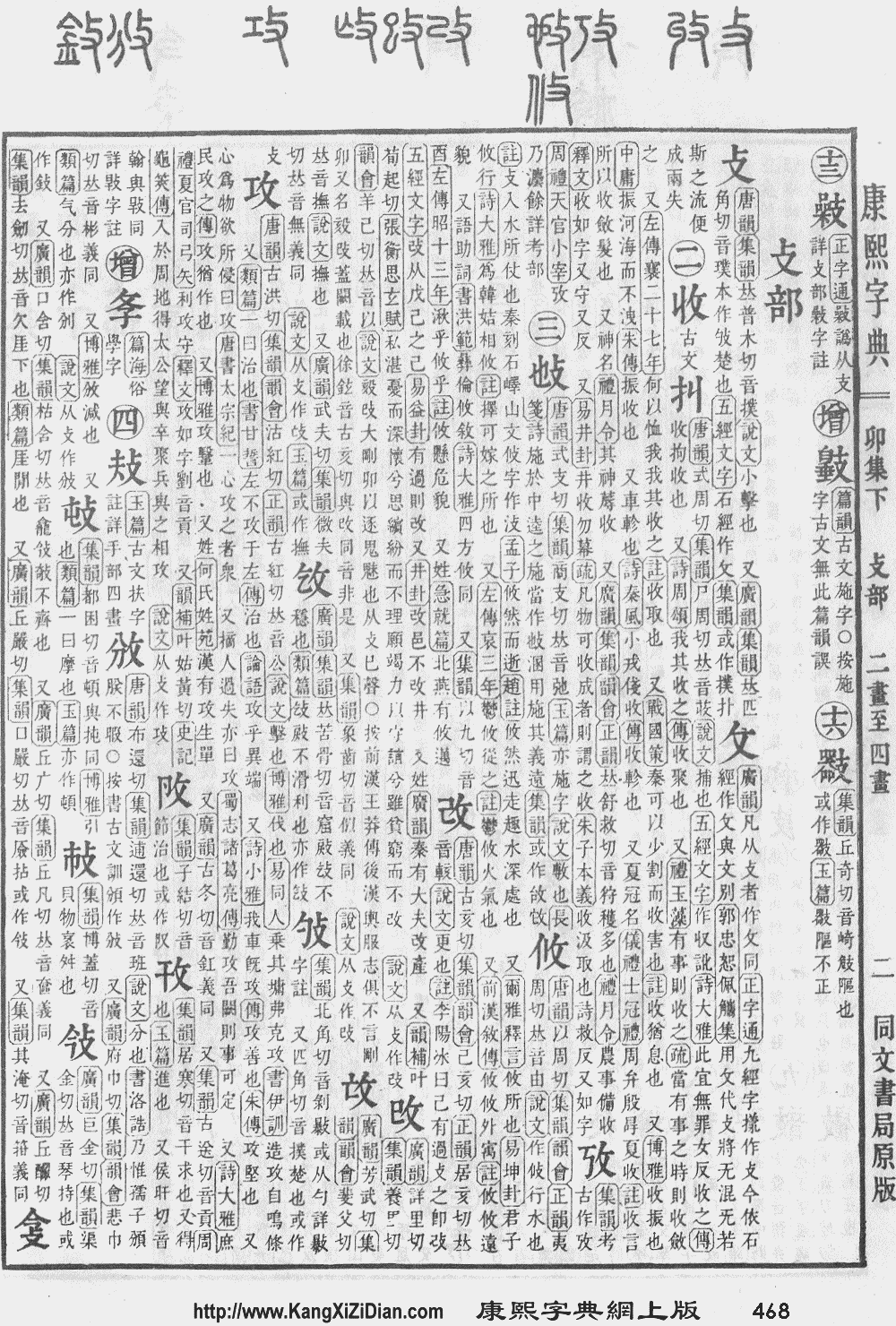
- Kangxi Dictionary: page 468, character 11
- Dai Kanwa Jiten: character 13114
- Dae Jaweon: page 816, character 4
- Hanyu Da Zidian (first edition): volume 2, page 1450, character 1
- Unihan data for U+6539
Chinese
Glyph origin
| Historical forms of the character 改 | |
|---|---|
| Shuowen Jiezi (compiled in Han) | Liushutong (compiled in Ming) |
| Small seal script | Transcribed ancient scripts |
 |
 |
Characters in the same phonetic series (己) (Zhengzhang, 2003)

In the oracle bone script, a phono-semantic compound (形聲/形声, OC *klɯːʔ) : phonetic 巳 (OC *ljɯʔ, *lɯs) + semantic 攴.
Since the small seal script, the phonetic component has been changed to 己 (OC *kɯʔ).
Etymology 1
| simp. and trad. |
改 | |
|---|---|---|
| alternative forms | 攺 | |
Related to 革 (OC *krɯːɡ, “to change”), 更 (OC *kraːŋ, “to change”) (Wang, 1982).
Pronunciation
Definitions
改
Synonyms
Dialectal synonyms of 戒 (“to give up; to quit”) [map]
| Variety | Location | Words |
|---|---|---|
| Formal (Written Standard Chinese) | 戒 | |
| Mandarin | Taiwan | 戒 |
| Xi'an | 戒 | |
| Yangzhou | 戒 | |
| Cantonese | Guangzhou | 戒 |
| Hong Kong | 戒 | |
| Gan | Nanchang | 戒 |
| Hakka | Meixian | 戒 |
| Miaoli (N. Sixian) | 戒 | |
| Pingtung (Neipu; S. Sixian) | 戒 | |
| Hsinchu County (Zhudong; Hailu) | 戒 | |
| Taichung (Dongshi; Dabu) | 戒 | |
| Hsinchu County (Qionglin; Raoping) | 戒 | |
| Yunlin (Lunbei; Zhao'an) | 改 | |
| Huizhou | Jixi | 戒 |
| Southern Min | Xiamen | 改 |
| Quanzhou | 改 | |
| Zhangzhou | 改 | |
| Tainan | 改 | |
Compounds
- 不改
- 個性難改/个性难改
- 修改 (xiūgǎi)
- 刪改/删改 (shāngǎi)
- 勞改/劳改 (láogǎi)
- 勞改場/劳改场
- 勞改營/劳改营 (láogǎiyíng)
- 和平改革
- 品種改良/品种改良
- 土地改革 (tǔdì gǎigé)
- 土改 (tǔgǎi)
- 塗改/涂改 (túgǎi)
- 宗教改革 (Zōngjiào Gǎigé)
- 屢教不改/屡教不改 (lǚjiàobùgǎi)
- 年深歲改/年深岁改
- 怙惡不改/怙恶不改
- 悔改 (huǐgǎi)
- 悛改
- 批改 (pīgǎi)
- 撥改貸/拨改贷
- 擅改
- 改俗遷風/改俗迁风
- 改元 (gǎiyuán)
- 改判 (gǎipàn)
- 改制 (gǎizhì)
- 改削
- 改則/改则 (Gǎizé)
- 改動/改动 (gǎidòng)
- 改口 (gǎikǒu)
- 改名 (gǎimíng)
- 改名換姓/改名换姓 (gǎimínghuànxìng)
- 改名易姓
- 改善 (gǎishàn)
- 改嘴
- 改圖/改图 (gǎitú)
- 改土歸流/改土归流 (gǎitǔguīliú)
- 改天 (gǎitiān)
- 改天換地/改天换地
- 改妝/改妆
- 改姓更名
- 改嫁 (gǎijià)
- 改定 (gǎidìng)
- 改容
- 改容加飾/改容加饰
- 改寫/改写 (gǎixiě)
- 改常
- 改建 (gǎijiàn)
- 改弦易張/改弦易张
- 改弦易調/改弦易调
- 改弦易轍/改弦易辙 (gǎixiányìzhé)
- 改弦更張/改弦更张 (gǎixiángēngzhāng)
- 改張易調/改张易调
- 改悔 (gǎihuǐ)
- 改惡向善/改恶向善
- 改惡從善/改恶从善 (gǎi'ècóngshàn)
- 改惡行善/改恶行善
- 改扮 (gǎibàn)
- 改抹
- 改授
- 改掉 (gǎidiào)
- 改換/改换 (gǎihuàn)
- 改換家門/改换家门
- 改換門庭/改换门庭
- 改換門閭/改换门闾
- 改操
- 改新
- 改日 (gǎirì)
- 改易 (gǎiyì)
- 改服
- 改期 (gǎiqī)
- 改朝換代/改朝换代 (gǎicháohuàndài)
- 改業/改业
- 改次
- 改正 (gǎizhèng)
- 改步改玉
- 改歲/改岁
- 改版 (gǎibǎn)
- 改玉改行
- 改用 (gǎiyòng)
- 改稱/改称 (gǎichēng)
- 改稿
- 改竄/改窜 (gǎicuàn)
- 改節/改节
- 改組/改组 (gǎizǔ)
- 改編/改编 (gǎibiān)
- 改編劇本/改编剧本
- 改腔兒/改腔儿
- 改良 (gǎiliáng)
- 改葬 (gǎizàng)
- 改行
- 改行遷善/改行迁善
- 改裝/改装 (gǎizhuāng)
- 改觀/改观 (gǎiguān)
- 改訂/改订 (gǎidìng)
- 改變/改变 (gǎibiàn)
- 改貌
- 改轅易轍/改辕易辙
- 改轍/改辙
- 改造 (gǎizào)
- 改進/改进 (gǎijìn)
- 改運/改运 (gǎiyùn)
- 改過/改过 (gǎiguò)
- 改道 (gǎidào)
- 改過不吝/改过不吝
- 改過向善/改过向善
- 改過從善/改过从善
- 改過從新/改过从新
- 改過自新/改过自新 (gǎiguòzìxīn)
- 改過遷善/改过迁善
- 改適/改适
- 改選/改选 (gǎixuǎn)
- 改邪歸正/改邪归正 (gǎixiéguīzhèng)
- 改醮
- 改錯/改错 (gǎicuò)
- 改錯題/改错题
- 改面革心
- 改革 (gǎigé)
- 改頭換面/改头换面
- 改顏/改颜
- 改點/改点
- 時移事改/时移事改
- 更名改姓
- 更改 (gēnggǎi)
- 朝令夕改 (zhāolìngxīgǎi)
- 朝令暮改
- 朝出夕改
- 朝更夕改
- 朝更暮改
- 朝聞夕改/朝闻夕改
- 朝行夕改
- 朝過夕改/朝过夕改
- 未改
- 校改 (jiàogǎi)
- 民主改革 (mínzhǔ gǎigé)
- 漢字改革/汉字改革
- 痛改前非 (tònggǎiqiánfēi)
- 知過必改/知过必改
- 知錯能改/知错能改 (zhīcuònénggǎi)
- 社會改革/社会改革 (shèhuì gǎigé)
- 積習難改/积习难改 (jīxínángǎi)
- 竄改/窜改 (cuàngǎi)
- 篡改 (cuàngǎi)
- 經濟改革/经济改革
- 翻然改圖/翻然改图
- 變風改俗/变风改俗
- 農地改革/农地改革
- 農業改革/农业改革
- 過勿憚改/过勿惮改
- 過而能改/过而能改
- 遷善改過/迁善改过
- 醫林改錯/医林改错
- 釐改
- 面不改容 (miànbùgǎiróng)
- 面不改色 (miànbùgǎisè)
- 風移俗改/风移俗改
- 風雨不改/风雨不改
- 體改/体改
Pronunciation
Japanese
Readings
Compounds
- 改悪 (kaiaku)
- 改案 (kaian)
- 改印 (kaīn)
- 改易 (kaieki)
- 改悔 (kaige)
- 改革 (kaikaku)
- 改行 (kaigyō)
- 改憲 (kaiken)
- 改元 (kaigen)
- 改稿 (kaikō)
- 改悟 (kaigo)
- 改号 (kaigō)
- 改刪 (kaisan)
- 改作 (kaisaku)
- 改札 (kaisatsu)
- 改竄 (kaizan)
- 改宗 (kaishū)
- 改修 (kaishū)
- 改春 (kaishun)
- 改悛 (kaishun)
- 改称 (kaishō)
- 改新 (kaishin)
- 改心 (kaishin)
- 改進 (kaishin)
- 改正 (kaisei)
- 改姓 (kaisei)
- 改製 (kaisei)
- 改選 (kaisen)
- 改善 (kaizen)
- 改組 (kaiso)
- 改装 (kaisō)
- 改葬 (kaisō)
- 改造 (kaizō)
- 改題 (kaidai)
- 改築 (kaichiku)
- 改鋳 (kaichū)
- 改定 (kaitei)
- 改訂 (kaitei)
- 改廃 (kaihai)
- 改変 (kaihen)
- 改編 (kaihen)
- 改名 (kaimei)
- 改訳 (kaiyaku)
- 改暦 (kaireki)
- 改良 (kairyō)
- 変改 (henkai)
Pronunciation
- IPA(key): [ka̠i]
Korean
Vietnamese
This article is issued from Wiktionary. The text is licensed under Creative Commons - Attribution - Sharealike. Additional terms may apply for the media files.