拂

See also: 払
拂 U+62C2, 拂
CJK UNIFIED IDEOGRAPH-62C2
← 拁
[U+62C1]
CJK Unified Ideographs 拃 →
[U+62C3]

Translingual

Han character

拂 (Kangxi radical 64, 手+5, 8 strokes, cangjie input 手中中弓 (QLLN), four-corner 55027, composition ⿰扌弗)

Derived characters

  • 𦲫, 𫂅

References

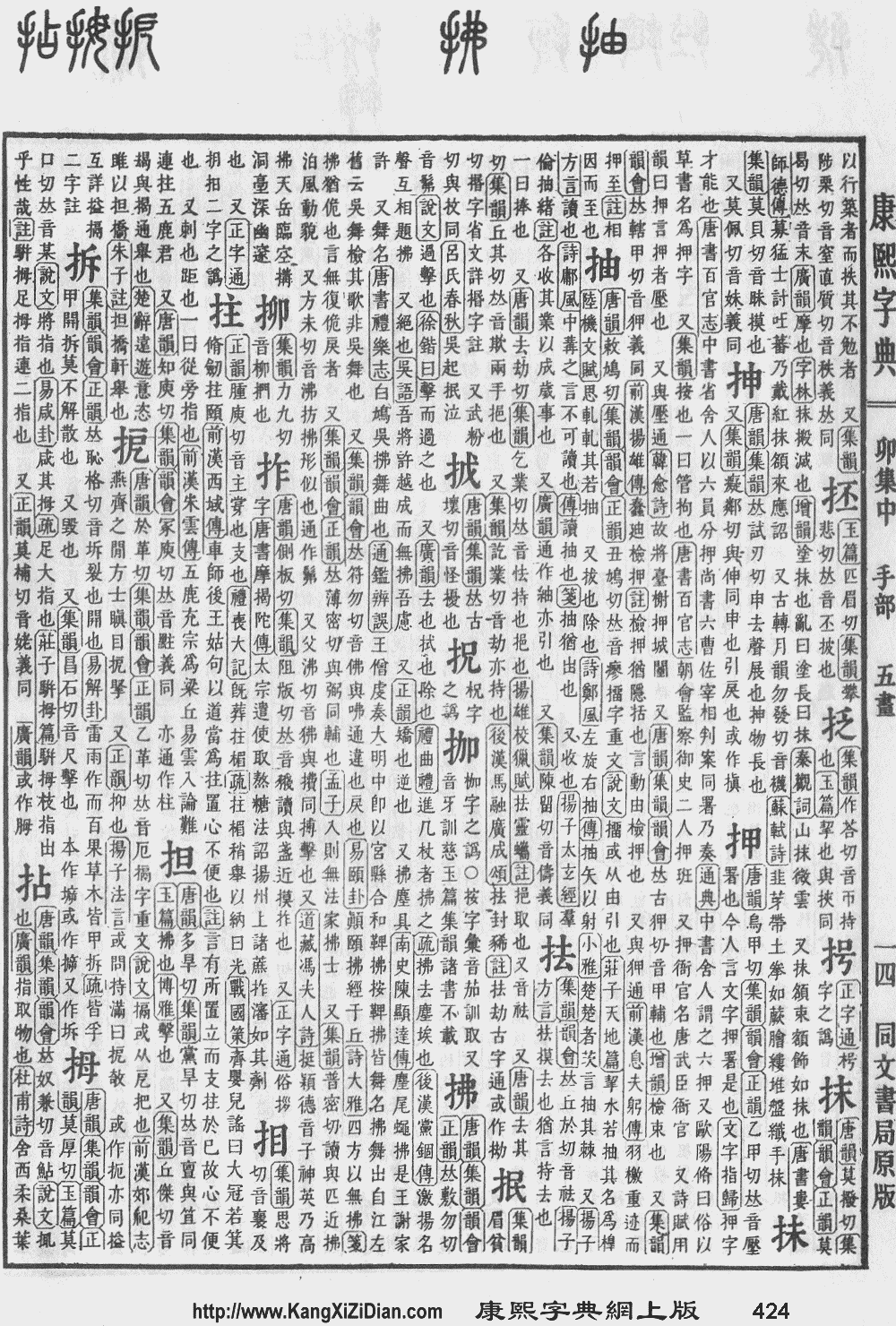
  • Kangxi Dictionary: page 424, character 14
  • Dai Kanwa Jiten: character 11936
  • Dae Jaweon: page 772, character 11
  • Hanyu Da Zidian (first edition): volume 3, page 1859, character 4
  • Unihan data for U+62C2

Chinese

simp. and trad.
拂

Glyph origin

Phono-semantic compound (形聲/形声, OC *pʰɯd) : semantic 扌 (“hand”) + phonetic 弗 (OC *pɯd).

Pronunciation


Rime
Character 拂
Reading # 1/1
Initial (聲) 滂 (2)
Final (韻) 物 (60)
Tone (調) Checked (Ø)
Openness (開合) Closed
Division (等) III
Fanqie 敷勿切
Baxter phjut
Reconstructions
Zhengzhang
Shangfang
/pʰɨut̚/
Pan
Wuyun
/pʰiut̚/
Shao
Rongfen
/pʰiuət̚/
Edwin
Pulleyblank
/pʰut̚/
Li
Rong
/pʰiuət̚/
Wang
Li
/pʰĭuət̚/
Bernard
Karlgren
/pʰi̯uət̚/
Expected
Mandarin
Reflex
fu
Expected
Cantonese
Reflex
fat1
Baxter–Sagart system 1.1 (2014)
Character 拂
Reading # 1/1
Modern
Beijing
(Pinyin)
fú
Middle
Chinese
‹ phjut ›
Old
Chinese
/*pʰ[u]t/
English to brush, shake

Notes for Old Chinese notations in the Baxter–Sagart system:

* Parentheses "()" indicate uncertain presence;
* Square brackets "[]" indicate uncertain identity, e.g. *[t] as coda may in fact be *-t or *-p;
* Angle brackets "<>" indicate infix;
* Hyphen "-" indicates morpheme boundary;

* Period "." indicates syllable boundary.
Zhengzhang system (2003)
Character 拂
Reading # 1/1
No. 3318
Phonetic
component
弗
Rime
group
物
Rime
subdivision
1
Corresponding
MC rime
拂
Old
Chinese
/*pʰɯd/

Definitions

拂

  1. to stroke; to touch lightly
  2. to flick; to whisk; to brush off
  3. to sweep
  4. duster
  5. (literary) to go against; to run counter to; to defy

Compounds

Etymology 2

For pronunciation and definitions of 拂 – see 弼 (“to aid; to assist; to help; assistant; etc.”).
(This character is a variant form of 弼).

Japanese

Shinjitai

払

Kyūjitai

拂

Kanji

拂

(“Jinmeiyō” kanji used for names, kyūjitai kanji, shinjitai form 払)

  1. To pay
  2. To clear out

Readings

  • Go-on: びち (bichi); ほち (hochi)
  • Kan-on: ひつ (hitsu); ふつ (futsu)
  • Kan’yō-on: ほつ (hotsu)
  • Kun: はらう (harau, 拂う)

Korean

Etymology 1

From Middle Chinese 拂 (MC phjut).

Hanja

拂 (eumhun 떨칠 불 (tteolchil bul))

  1. Hanja form? of 불 (“shake off, brush away, dust”).

Etymology 2

From Middle Chinese 弼 (MC bit).

Hanja

拂 (eumhun 도울 필 (doul pil))

  1. Hanja form? of 필 (“help, aid, assist”).

Vietnamese

Han character

拂: Hán Nôm readings: phất, phắt, phớt, phứt, phựt

  1. This term needs a translation to English. Please help out and add a translation, then remove the text {{rfdef}}.
This article is issued from Wiktionary. The text is licensed under Creative Commons - Attribution - Sharealike. Additional terms may apply for the media files.