怫

怫 U+602B, 怫
CJK UNIFIED IDEOGRAPH-602B
← 怪
[U+602A]
CJK Unified Ideographs 怬 →
[U+602C]

Translingual

Han character

怫 (Kangxi radical 61, 心+5, 8 strokes, cangjie input 心中中弓 (PLLN), four-corner 95027, composition ⿰忄弗)

  1. sorry, anxious
  2. depressed

References

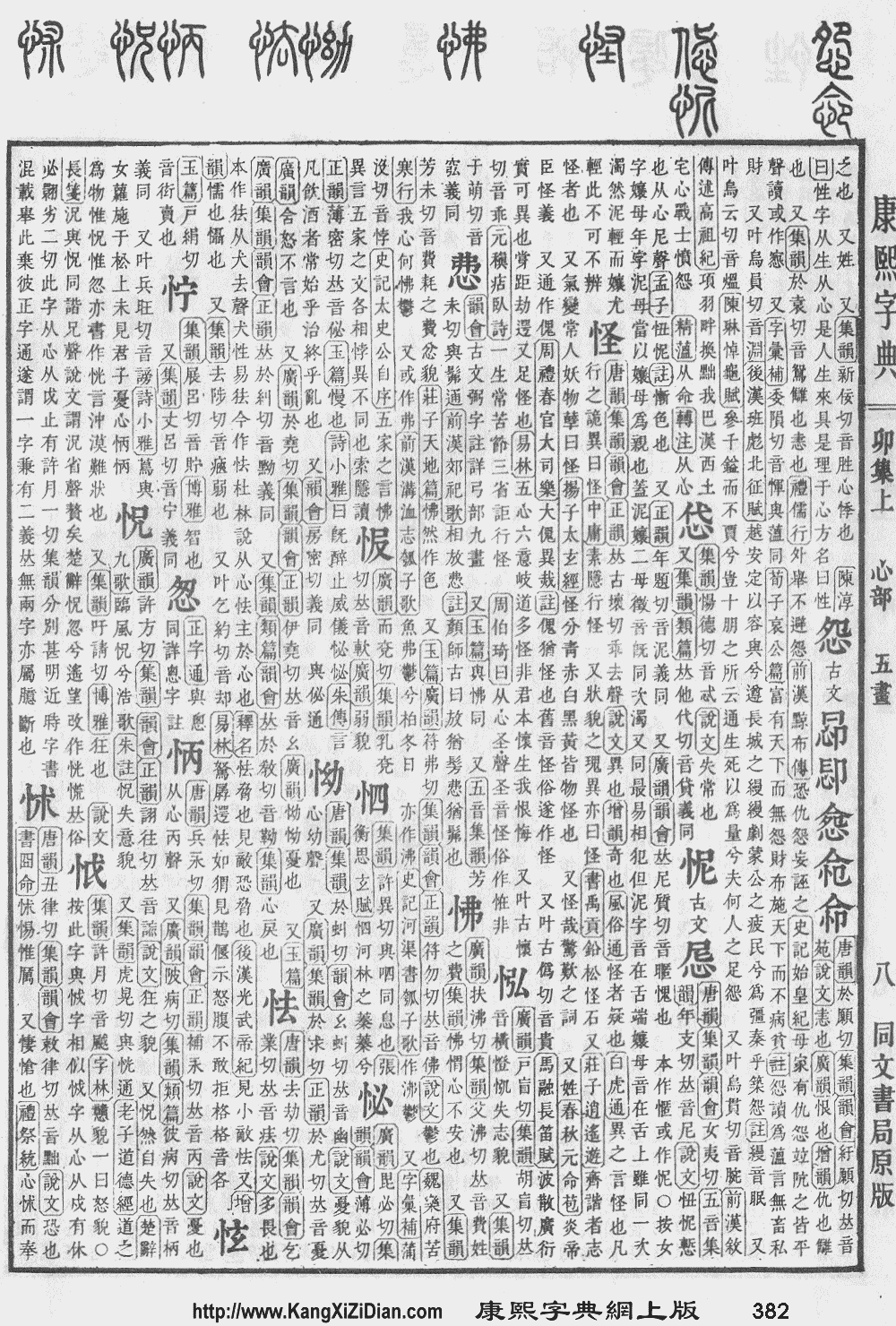
  • Kangxi Dictionary: page 382, character 13
  • Dai Kanwa Jiten: character 10486
  • Dae Jaweon: page 712, character 3
  • Hanyu Da Zidian (first edition): volume 4, page 2288, character 3
  • Unihan data for U+602B

Chinese

simp. and trad.
怫

Glyph origin

Pronunciation


Rime
Character 怫
Reading # 2/2
Initial (聲) 並 (3)
Final (韻) 物 (60)
Tone (調) Checked (Ø)
Openness (開合) Closed
Division (等) III
Fanqie 符弗切
Baxter bjut
Reconstructions
Zhengzhang
Shangfang
/bɨut̚/
Pan
Wuyun
/biut̚/
Shao
Rongfen
/biuət̚/
Edwin
Pulleyblank
/but̚/
Li
Rong
/biuət̚/
Wang
Li
/bĭuət̚/
Bernard
Karlgren
/bʱi̯uət̚/
Expected
Mandarin
Reflex
fú
Expected
Cantonese
Reflex
fat6
Baxter–Sagart system 1.1 (2014)
Character 怫
Reading # 2/2
Modern
Beijing
(Pinyin)
fú
Middle
Chinese
‹ bjut ›
Old
Chinese
/*[b][u]t/
English grieved, annoyed

Notes for Old Chinese notations in the Baxter–Sagart system:

* Parentheses "()" indicate uncertain presence;
* Square brackets "[]" indicate uncertain identity, e.g. *[t] as coda may in fact be *-t or *-p;
* Angle brackets "<>" indicate infix;
* Hyphen "-" indicates morpheme boundary;

* Period "." indicates syllable boundary.
Zhengzhang system (2003)
Character 怫
Reading # 2/2
No. 3325
Phonetic
component
弗
Rime
group
物
Rime
subdivision
1
Corresponding
MC rime
佛
Old
Chinese
/*bɯd/

Definitions

怫

  1. (literary) dejected; unsettled
  2. (literary) angry; pent up; annoyed

Compounds

  • 怫恚
  • 怫然
  • 怫然不悅/怫然不悦
  • 怫然作色
  • 怫然變色/怫然变色
  • 怫鬱/怫郁

Pronunciation


Definitions

怫

  1. Alternative form of 悖 (“to go against; to run counter to”)

Compounds

  • 怫異/怫异

Pronunciation


Rime
Character 怫
Reading # 1/2
Initial (聲) 並 (3)
Final (韻) 微 (21)
Tone (調) Departing (H)
Openness (開合) Closed
Division (等) III
Fanqie 扶沸切
Baxter bj+jH
Reconstructions
Zhengzhang
Shangfang
/bʉiH/
Pan
Wuyun
/bʷɨiH/
Shao
Rongfen
/biuəiH/
Edwin
Pulleyblank
/bujH/
Li
Rong
/biuəiH/
Wang
Li
/bĭwəiH/
Bernard
Karlgren
/bʱwe̯iH/
Expected
Mandarin
Reflex
fèi
Expected
Cantonese
Reflex
fei6
Baxter–Sagart system 1.1 (2014)
Character 怫
Reading # 1/2
Modern
Beijing
(Pinyin)
fú
Middle
Chinese
‹ bjɨjH ›
Old
Chinese
/*[b][u]t-s/
English grieved

Notes for Old Chinese notations in the Baxter–Sagart system:

* Parentheses "()" indicate uncertain presence;
* Square brackets "[]" indicate uncertain identity, e.g. *[t] as coda may in fact be *-t or *-p;
* Angle brackets "<>" indicate infix;
* Hyphen "-" indicates morpheme boundary;

* Period "." indicates syllable boundary.
Zhengzhang system (2003)
Character 怫
Reading # 1/2
No. 3309
Phonetic
component
弗
Rime
group
隊
Rime
subdivision
2
Corresponding
MC rime
𥝋
Old
Chinese
/*bɯds/
Notes 沸由涕校改

Definitions

怫

  1. (literary) angry; glowering

Compounds

  • 怫恚
  • 怫愄
  • 怫然 (fèirán)
  • 怫然不悅/怫然不悦
  • 怫然作色
  • 怫然變色/怫然变色

References

Japanese

Kanji

怫

(uncommon “Hyōgai” kanji)

  1. This term needs a translation to English. Please help out and add a translation, then remove the text {{rfdef}}.

Readings

Vietnamese

Han character

怫: Hán Nôm readings: phật

  1. This term needs a translation to English. Please help out and add a translation, then remove the text {{rfdef}}.
This article is issued from Wiktionary. The text is licensed under Creative Commons - Attribution - Sharealike. Additional terms may apply for the media files.